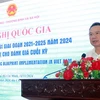
Head of the Party Central Committee (PCC)'s Economic Commission Nguyen Van Binh address the seminar (Photo: VNA)
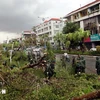
 Hanoi (VNA) - “Recent studies show Vietnam is one of the five nations most severely affected by climate change as it has a long coastline and large river basin. Predictions say by the end of the 21st century, 40 percent of the Mekong Delta area will be under water. The figures are 11 percent and 3 percent in the Red River Delta and other coastal areas, respectively. In addition, 20 percent of Ho Chi Minh City's area is vulnerable to flooding. As the result, climate change will directly affect between 10- 12 percent of the nation's population, causing 10 percent of GDP losses.”
The figures were released by Head of the Party Central Committee (PCC)'s Economic Commission Nguyen Van Binh at a seminar in Hanoi on January 17, themed “Proactively responding to climate change and strengthening energy security for sustainable development.”
The seminar and the New Energy Technology Exhibition are among activities of the 3rd Vietnam Economic Forum, chaired by the PCC’s Economic Commission, in coordination with USAID, IFC and the United States Business Association, ABB and GE groups, as well as ministries, sectors and localities.
Risks come from both sides
"The current climate change situation is happening in a more complicated and quicker manner than forecasts made by scientists," said Binh.
According to the official, climate change impacts will get bigger and more unpredictable in many localities, resulting in resources depletion and environmental degradation.
Climate change impacts also hinder socio-economic development and damage achievements. Apart from direct negative impacts, climate change threatens food security.
In Vietnam, climate change speeds up energy dependence. On the other hand, developing traditional energy sources generates emissions of greenhouse gases, which in turn, becomes the direct cause of climate change.
"It is, therefore, crucial to conduct research and evaluation of this double impact to prevent and mitigate climate change while working out solutions to strengthen national energy security for sustainable development,” Binh affirmed.
 At the seminar themed “Proactively responding to climate change and strengthening energy security for sustainable development.”(Photo: VNA)
Deployment of new energy sources surges
Addressing the event, John Kerry, former US Secretary of State, Honorary President of the Carnegie Endowment for International Peace said, "(The) challenge of climate change is a huge problem worldwide, not just in Vietnam. Moreover, climate change always has a close relationship with the energy sector.”
Vietnam will need to pay more attention to devising effective measures to respond to climate change, given its high rate of energy growth, he warned.
Many countries have shifted from traditional energy sources to new and renewable energy, he added, stressing that this has become a popular solution to ensuring sustainable energy development and minimising the negative effects of climate change.
Meanwhile, Michael Greene, Country Director of USAID Vietnam suggested Vietnam develop a specific energy security strategy, saying the Vietnamese Government needs to undertake a more drastic mechanism to promote renewable energy.
Implementing policies on effective use of energy needs to be serious to address energy security for Vietnam in the long run, Michael Greene said.
Other local and international experts contributed in-depth analysis of climate change in Vietnam, focusing on recent negative impacts and adaption in the Mekong Delta.
 John Kerry, former US Secretary of State, Honorary President of the Carnegie Endowment for International Peace addresses the event (Photo: VNA)
 Bruno Angelet, Head of the Delegation of the European Union to Vietnam, committed to continue providing support for Vietnam in implementing relevant policies.
A representative from the Australia-Vietnam Economic Reform (Aus4Reform) Programme underlined the outcomes of the Vietnam Economic Forum over the past three years, saying it has made significant contributions to sustainable growth.
For his part, Standing Vice Chairman of the PCC’s Economic Commission Cao Duc Phat spoke highly of the discussions at the event, saying the commission will take all these suggestions for consideration.
According to Phat, the PCC’s Economic Commission has hosted a preliminary review of the PCC’s Resolution No. 24-NQ /TW dated June 3, 2013 on actively responding to climate change, enhancing natural resource management and environmental protection; 10-year implementation of the Politburo's Resolution No. 18-NQ /TW dated October 25, 2007 on national energy development strategy orientation up to 2020, with a vision toward 2050./.