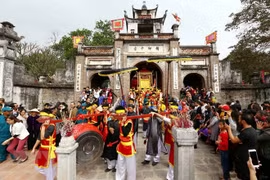
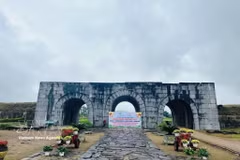
Co Loa Citadel is a unique 2,300-year-old relic of Vietnam. (Photo: thegioidisan.vn)
Hanoi (VNS/VNA) - Architects, historians and scientists discussed measures topreserve Co Loa - Hanoi’s oldest citadel - and promote its cultural andhistorical value at a conference in Hanoi last weekend.
Hosted by Tia Sang Magazine, the “Co Loa: From Core Values to Preservation andDevelopment” conference was held because the relic site faces encroachment anddamage despite the city’s efforts to protect the citadel, which is also one ofthe oldest relics of Vietnam. The conference gathered many renowned Vietnameseexperts as well as members of heritage management boards.
With its unique historical, architectural andarcheological value, the citadel was recognised as a national relic since 1962and as special national relic since 2012.
Before 1995, the Co Loa Citadel was managed bylocal authorities before being handed over to several management boards. It wasnot until 2014 that the management board of the citadel was officially establishedas a unit under the Thang Long- Hanoi Preservation Centre.
A master plan on the preservation andrestoration of the Co Loa Citadel in Hanoi to develop the site into ahistorical and ecological park was approved in 2015 by then-Prime Minister NguyenTan Dung.
According to the Co Loa Citadel Management Board,the relic is now under serious encroachment due to the low awareness of locals.For example, they cultivate crops even on the city wall, raise fish in the dykeand have even been granted land ownership. Some parts of the citadel havebecome roads. Many components of the relic with special archeological valueshave nearly been vanished due to the expansion of nearby residential buildings.
However, the functions of the management boardinclude inspecting, discovering and reporting violations but not penalizingviolators; however, most of their reports to the local authorities have notreceived any responses yet.
According to Le Viet Dung, deputy chief of the CoLoa Citadel Management Board, they are granted permission to manage the core ofthe relic, including the Inner Citadel, An Duong Vuong King Temple or NgocWell, as well as several lands nearby their head office, covering a total areaof four hectares. Meanwhile, the other parts of the relic, which is nearly 900hectares, and three rounds of the earth walls are under control of the localauthorities and citizens who consider them as normal land, not a relic.
Professor Nguyen Van Huy judged that with propervision and investment, the citadel would become one of the most attractivedestinations to tourists of the capital, largely due to the associatedhistorical stories and well-preserved natural surroundings. However, suchtourism potential faces the risk of encroachment amid rapid urbanization andpeople’s demand to improve their lives, he said.
He also mentioned the emerging problems of therelic’s poorly defined borders, as well as its direct managers and theirduties. “The management lacks unification, synchronization and concentration,”he added.
The United Nations Educational, Scientific andCultural Organisation (UNESCO) have issued guidance on tourism managementwithin heritage sites, which have clarified that every sustainable tourismprogramme demands the involvement of the beneficiaries or concernedorganisations. The “awakening” of the heritage therefore requires statepolicies and enterprises’ investment.
According to Tran Thi Thu Thuy from the CulturalDepartment of UNESCO, encouraging the community’s involvement demands buildingtrust. “The local authority must publicise all the information about thepolicies of development, interact with the locals and ensure their commitment,”she said.
PhD Nguyen Thi Hau, Deputy Secretary General ofthe Vietnam History Association, also stressed the importance of communityinput. She suggested that the preservation with community involvement shouldoriginate at the grassroots level to ensure sustainability, because only thecommunity, individuals and social organisations are capable of preserving theheritage and helping the heritage co-exist with the community. This strategyhas proved effective in many heritages worldwide like Angkor Wat temple complexin Cambodia
“We are preserving the heritage with a‘downwards’ point of view. Viewed from above, only economic or politicalbenefits can be seen, not the locals’ needs. If viewing from the locals’position, the authority will understand their problems and simultaneously helpthem realise what they need to do to preserve the relics, to develop tourismand how they will benefit, she stressed.
Reckoning that it’s better late than never,Professor Huy added that in order to promote the values of the Co Loa Citadel, leadersof Hanoi need to renovate their viewpoint and prioritise boosting the relic tobecome the most highlighted attraction of the capital.
The Co Loa Citadel was built near Phong Khe,about 20 km to the north of today’s Hanoi, during the end of the Hong BangDynasty (about 257 BC).
Covering nearly 500ha, the citadel is a place ofworship for King An Duong Vuong and Princess My Chau, who are mentioned in themagic crossbow legend that has been woven into the history of Vietnamesepeople.
According to folklore, An Duong Vuong founded theancient Vietnamese state of Au Lac and chose Co Loa as the capital city.-VNS/VNA
VNA