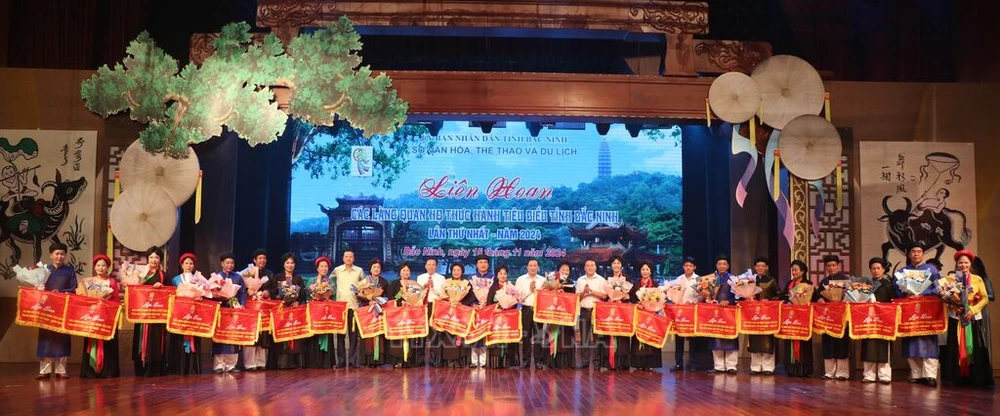
Festival celebrates 15 years of UNESCO-recognised Quan ho singing

More than 700 singers from 24 Quan ho (love duet) singing villages in the northern province of Bac Ninh on November 15 gathered at the first-ever Quan ho village festival, an event held to mark the 15th anniversary of the UNESCO’s recognition of the folk singing as an intangible cultural heritage element of humanity.

At the first-ever Quan ho village festival (Photo: VNA)

Bac Ninh (VNA) – More than 700 singers from 24 Quan ho (love duet) singing villages in the northern province of Bac Ninh on November 15 gathered at the first-ever Quan ho village festival, an event held to mark the 15th anniversary of the UNESCO’s recognition of the folk singing as an intangible cultural heritage element of humanity.

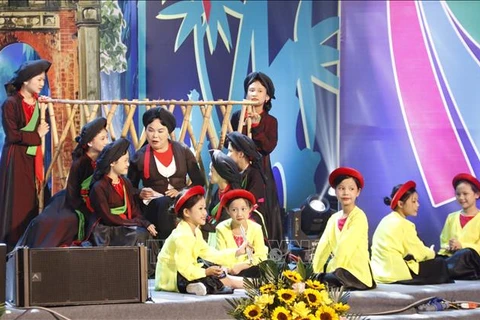
They honoured the heritage through traditional unaccompanied duets, solo performances, and group singing.

The festival aimed at evaluating the villages’ contributions to preserving the folk songs over the recent past while creating an opportunity for local singers to meet and exchange experiences in practicing the heritage in the community.

According to Deputy Director of the provincial Department of Culture, Sports and Tourism Nguyen Xuan Trung, Quan ho has evolved beyond its traditional village boundaries to become a vibrant force in the community's spiritual and economic life.

The art form has transformed from village performances to diverse stages, reaching audiences both domestically and internationally.

Originally, Quan ho singing was only found on the southern bank of the Cau river in Bac Ninh province. However, due to its significant influence, it spread to neighbouring areas on the northern bank of the Cau river in Bac Giang province. The Cau river is also known as the Quan ho river.

There are opinions suggesting that Quan ho dates back to the 11th century, while others believe it originated in the 17th century. All of them emphasise the significant value of the intangible cultural heritage of Quan ho. This art form is considered the core of the culture of the Kinh Bac region, with a history of thousands of years of civilisation.

Compared to other forms of folk art such as "hat xoan", "hat gheo", "hat ca tru", "hat vi dam", "tuong", and "cai luong", Quan ho singing has existed the longest, with a lifespan of thousands of years.

Quan ho is a form of folk singing characterised by a duet format. The male singers, known as "lien anh", wear traditional attire of folded scarves and "the", shirts, while the female singers, known as "lien chi", don elegant dresses and round hats made from palm leaves with long silk straps. They sing together in pairs, delivering simple and soulful verses in a traditional style that does not require musical accompaniment yet remains melodious.

Most Quan ho songs follow the verse form of "luc bat" or its variations, and there are also songs in prose form. Up to now, at least 300 melodies of Quan ho have been notated, consisting of verses and poems, primarily in the "luc bat" form, passed down by Quan ho artists to collectors.

Quan ho was recognised by UNESCO as an intangible cultural heritage element of humanity in 2009.

Every year, as spring arrives, people from Quan ho villages in the Kinh Bac region, including both Bac Ninh and Bac Giang provinces, return to their hometowns to join various local festivals, such as temple and pagoda ones. These festivals are incredibly unique because they have been closely associated with the tradition of Quan ho singing for generations./.
VNA

See more

Vietnam concludes the 16th World Bodybuilding & Physique Sports Championship 2025 with three runner-up titles (Photo: https://nld.com.vn/)

Vietnam wins triple runner-up titles at world bodybuilding championships

With 10 golds, five silvers, and two bronzes, Vietnam equaled its 2024 medal count but failed to retain its ranking amid fierce competition from other leading nations. Vietnam achieved a trio of runner-up finishes, placing second in the men’s team, women’s team, and overall ranking.

A Vovinam performance - Illustrative image (Photo: VNA)

Vovinam strengthens role as "cultural ambassador" in Europe

The two-day programme featured master-level exams, qualifying and final rounds, technical demonstrations and exchanges within the federation. Performances and bouts were praised for their technical quality, sportsmanship and adherence to the philosophy of “Sportsmanship – Solidarity – Honesty – Nobility – Progress.”

The Vietnam – Japan Buddhist cultural exchange festival is held at the Tam Chuc National Tourist Complex in Ninh Binh province from November 15 to 16. (Photo: VNA)

Ninh Binh hosts Vietnam – Japan Buddhist cultural exchange festival

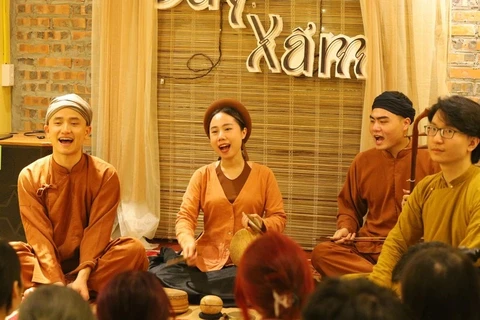
This year’s festival featured a variety of traditional Vietnamese and Japanese rituals and artistic activities, including sutra chanting at the Tam The Hall of Tam Chuc pagoda, Xam folk singing, flower-offering and Buddha recitation ceremonies (Pure Land Buddhism), sutra writing (Japanese Buddhist tradition), a lantern night, morning meditation sessions, and a Buddha offering ceremony at Ba Sao Pagoda.

At the Japanese-language speech and presentation contest held as part of the 4th Kanagawa Festival in Da Nang on November 13. (Photo: baodautu.vn)

Da Nang hosts fourth consecutive Kanagawa festival

The event vividly illustrates the friendly and cooperative relationship between the two localities, reflecting Kanagawa’s goodwill and attention toward Da Nang. It also serves as a foundation for the two sides to continue promoting cooperation in potential fields that align with their development orientations.

At the show (Photo: VNA)

Indian rock band Parikrama starts Dak Lak tour

Formed in 1991, veteran rock band Parikrama ranks among India’s longest-running and most respected rock bands, with more than 3,500 global shows at venues like the Kennedy Centre in the US, Download Festival and Brixton Academy.

Craft heritage of ancient capitals meet at Temple of Literature

Craft heritage of ancient capitals meet at Temple of Literature

As part of the Thang Long – Hanoi Festival 2025, the Temple of Literature has become a major highlight, hosting a series of cultural and educational events celebrating Vietnam’s age-old tradition of learning and showcasing the capital’s most iconic heritage.

By 2025, Lam Dong province’s tea cultivation area shrinks to about 12,000 ha of raw material zones. (Photo: VNA)

Four records set as Vietnam hosts first-ever world tea fest 2025

The World Tea Fest 2025, Vietnam’s first international-scale tea festival, features four remarkable records: a mass tea-brewing performance by 1,111 artisans; the preservation of a 100-year-old tea factory; the participation of beauty queens from 80 countries; and the display of 1,000 ancient tea trees, each several centuries old.

Vietnam to host first Asian Esports Championships (Photo: VNA)

Vietnam to host Asian Esports Championships for the first time

Vietnam will host the Asian Esports Championships (ECA 2025) for the first time from November 19–22 in the Mekong Delta city of Can Tho, marking a milestone in the country’s growing presence on the global esports stage, the Vietnam Recreational and Electronic Sports Association (VIRESA) has announced.

The Hanoi Tourism Ao Dai Festival 2025 concludes on November 9 (Photo: VNA)

Hanoi Tourism Ao Dai Festival 2025 wraps up, celebrating heritage and style

Deputy Director of the Hanoi Department of Tourism Nguyen Tran Quang emphasised that the four-day festival served a dual mission, honouring and preserving the intangible cultural heritage of the Ao Dai while boosting tourism and raising public awareness, particularly among the youth, about the importance of national cultural identity.

Delegates at the Slovak Culture Day in Ho Chi Minh City on November 8 (Photo: VNA)

Slovak Culture Day celebrated in Ho Chi Minh City

Highlights included an exhibition titled "Party in the 21st Century", featuring 58 works blending photography, painting, and ethnography to showcase traditional Slovak “Party” headpieces worn by unmarried women and brides in the 19th–20th centuries.