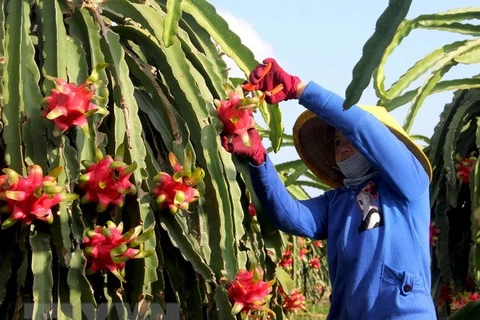
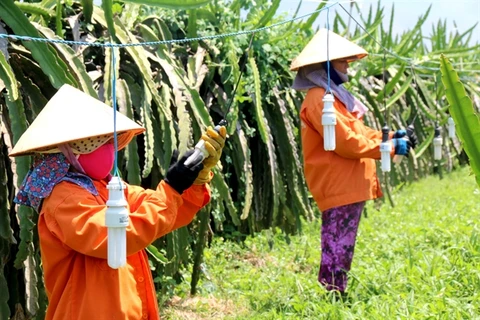
Seminar: Connecting information, finding output for agricultural products in ethnic minority and mountainous areas. (Photo: VNA)
 Hanoi (VNA)- Many festivals selling different kinds of fruits such as mango, longan, and litchi from the Da River were successfully organised in retail systems. Through these events, visitors get to know more about the origin of the fruits they purchased.
The organisation of such festivals is an effective way to boost consumers’ expenditure in the domestic market, as well as introduce local farm produce to international customers, thus promoting exports to the global markets.
The information was delivered by the Ministry of Industry and Trade at a seminar titled “Connecting information and seeking markets for agricultural products of ethnic minority and mountainous areas.”
The event was organised by the Industry and Trade Newspaper in Hanoi on September 7.
Creating greater added value for agricultural products
Over the past time, many Vietnamese agricultural products have been exported to major markets. For example, Son La mangoes are exported to the UK and Australia; Luc Ngan lychee is popular in Japan and France. This has revealed the effective implementation of policies in terms of developing brand, promoting consumption, and especially providing market information to people in rural and mountainous areas.
Mr. Pham Cong Toan, Deputy Director of the Department of Industry and Trade in the northern province of Bac Giang, said in order to keep a foothold for local agricultural products like Luc Ngan lychee, the province has prepared a lot of plans over the past few years. “The ultimate goal is to improve the quality.”
In 2017, the province approved a list of 52 key and potential products to promote large-scale production by forming many cooperatives and groups of production households.
Bac Giang has also helped lychee growers to apply science and technology into cultivation so that they can increase the areas of growing the fruit meeting the VietGAP and GlobalGAP standards. The province has focused on replicating the organic lychee production model, building and strictly managing the growing area codes, creating high-quality and safe products.
In addition, the province also guides and supports businesses and cooperatives to improve packaging, labeling and tracing the origin of the products.
Bac Giang province also reviews, inspects, evaluates, and supervises all existing planting area codes. It issues new planting area codes and digitizes growing area codes to help increase competitiveness of the products and meet the increasing requirements of domestic and international markets.
Similarly, the northern province of Quang Ninh has also worked to create stable markets for agricultural products, said Ms. Nguyen Hoai Thuong, Deputy Director of the provincial Department of Industry and Trade.
“After 10 years of implementing the One Commune, One Product (OCOP) programme, the province has been able to help farmers build brands and seek stable markets.”
The province has also supported businesses to develop deep processing to increase the value of local products, as well as carried out a digital transformation project linked with production and consumption, especially for OCOP products, she added.
Accelerating digital transformation
The coordination between the State, businesses and farmers is crucial to promote sales of farm produce. To create such a close connection, Mr Nguyen Anh Phuong, Chief Operating Officer for the North of MM Mega Market Vietnam, said the involved parties need to be proactive in seeking markets and predict the market development trends.
“This will help them meet strict standards to be able to export to foreign markets.”
Phuong boasted that the company now has a system of more than 1,000 supermarkets in foreign countries such as Thailand and Singapore.
 Preliminary processing of lychee for export to Japan at the factory of Ameii Vietnam Joint Stock Company. (Photo: VNA)
 Meanwhile, Mr Nghiem Tuan Anh, a representative of the e-commerce platform postmart.vn (under the Vietnam Post), said his business has promoted trade and economic development, especially in remote and rural areas.
Currently, Vietnam Post has 13,000 service locations nationwide, which are easy for people and businesses to access.
“As a result, thousands tone of agricultural products can reach consumers.”
There is a huge opportunity for agricultural products in rural and remote areas to reach consumers as long as we can create a connection between buyers and sellers and facilitate the transportation network, he said./.