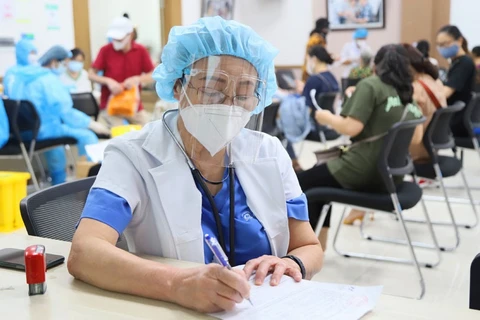
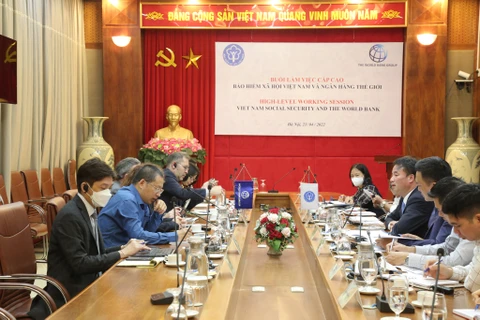
A panel discussion at the conference on strengthening ‘Public-Private Partnership for sustainable healthcare transformation’ in Hanoi on May 18. (Photo: VNA)
 Opening the event, the newspaper's editor-in-chief Le Trong Minh said that Vietnam's health sector faced many challenges, such as increasing infectious and non-communicable diseases, hospital overcrowding, shortage of supplies and equipment, the ageing population as well as the disparity between regions and healthcare levels in terms of quality of medical services and standardisation of modern equipment.
“For the health system to be capable and always ready to respond to future situations, towards a comprehensive and sustainable health care system, it is necessary to have new investment orientations in social resources for the health system, as well as stronger cooperation from the parties involved, including the Public-Private Partnership (PPP) method,” said Minh.
At the event, MPI deputy minister Tran Duy Dong said it was very important to mobilise financial resources for new investments in infrastructure and equipment to improve quality in the health sector and meet people's healthcare needs. In many countries around the world, the application of the PPP model in the health sector has contributed to solving the shortage of capital resources.
“In Vietnam, the 12th Central Committee’s Resolution No. 19-NQ/TW dated October 25, 2017, emphasised the promotion of PPP investment method in public services, especially health services. The PPP Law, which the National Assembly passed in 2020, has created a stable legal environment for PPP projects and raised confidence for the community of investors and businesses, especially international investors," he said.
However, Dong stressed, that the implementation of the PPP law still faced many shortcomings. PPP projects are implemented mainly in several key areas: transportation, energy, clean water supply, wastewater, and waste treatment. Such projects have not yet been implemented or have not been applied successfully in agriculture, health care, education, culture and sports.
“Although this (health care) is a potential field, it has not yet attracted many investors. From 2019 to now, there have been no more investment projects in the form of PPP in the health sector. Therefore, the conference will be an opportunity to review the policy framework for implementing investment projects in the form of PPP in the medical field. From there, we can identify opportunities and challenges in implementing the PPP model in the health sector,” added Dong.
According to statistics from the World Bank, as of 2019, there were 58 projects on the list of PPP projects in the health sector that were proposed. However, in these projects, only 13 projects have reached the stage of the pre-feasibility study report, six projects have reached the stage of the feasibility study report, five projects have reached the stage of bidding and selecting investors, and two projects remain at their signing stage. PPP projects in the health sector are mostly concentrated in a few cities and provinces, such as Hanoi, Ho Chi Minh City and Da Nang City.
AstraZeneca Vietnam chairman and general director Nitin Kapoor said to enhance the health system’s sustainability, and it is needed to uplift the capacity of the grassroots health network and primary healthcare so that non-communicable diseases (NCD) can be managed more proactively and effectively in the community.
“We also need to build a strong domestic pharmaceutical industry to enable Vietnam to have self-reliance in terms of treatments and solutions, to ensure faster access for local communities,” said Kapoor.
Kapoor also committed to supporting Vietnam by supplying vaccines and innovative medicines and investing nearly 600 billion VND in R&D and clinical trials, as well as 2 trillion VND in tech transfer and contract manufacturing of some of key non-communicable disease medicines in the next few years.
Phillip Alexander Wray, director of DKSH Pharma Vietnam, is also committed to being a trusted partner to the Vietnamese Government and contributing toward the sustainable healthcare development of Vietnam.
“Joining the health ministry’s effort to realise the digital transformation plan 2025-2030, DKSH can offer support in digitising the patient engagement experience with a paperless process via our PSPhere solution, which has already been launched in many markets," said Wray.
"PSPhere is the digital solution that connects all stakeholders involved in delivering healthcare to patients while ensuring patients are at the centre of the experience. This means that beyond-the-pill services, such as home nursing, remote monitoring devices, digital therapeutics and telemedicine services can be delivered in an integrated manner, and patients can get the support required outside of a clinical setting.”
According to Fitch Solutions, healthcare spending in Vietnam is expected to reach 23 billion USD by 2022, while BMI Research's report also shows that the pharmaceutical industry can reach 16.1 billion USD in size by 2026./.
VNA