An urban-friendly technology from Japan that is also friendlier to theenvironment is expected to make installation of steel piles for bridgesand flyovers a much quieter, stronger and cheaper process.
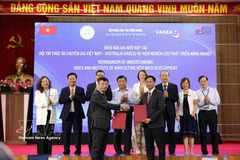
The NSEco-Pile, a screwed steel pile developed by Japanese firm Nippon Steeland Sumikin Engineering, was transferred to a Vietnamese partner March23.
It has helical blade welded of the edge which performs thedigging as it is rotated, driving the pile into the ground like awood-screw.
Takashi Takeuchi, Director of the Japanese firm'sBuilding Construction and Steel Structures Division, said the technologythat matches urban conditions in Vietnam has many advantages.
Firstof all, it can be used in narrow areas and does not require a bigconstruction site and also produces lower noise and vibrations comparedto technologies currently in use, he said.
He cited the production of lower dust and total avoidance of waste soil as other significant advantages.
DoLe Khang, Deputy General Director of the Hanoi-based Thang LongConstruction Joint Stock Corporation, which received the technology,said the NS Eco-Pile was an advanced technology highly suitable forconstructions in Vietnam's urban areas like Hanoi and Ho Chi Minh City.
"Onceconstructed, the area occupied is half that of other existingtechnologies. It also shortens the construction period, which means thetotal construction cost can be lower," Khang said.
He said inother technologies, including the currently popular bored pile, theconstruction of one pile may take 2.5 to three days while with the newtechnology, the construction of five piles will take just 1.5 to twodays.
He also emphasised the new technology's recycling capacity,saying it can be removed and recycled as temporary piles, which meansit is very convenient for building temporary bridges for major urbanconstructions in the country.
Speaking at the handover ceremony,Deputy Transport Minister Nguyen Ngoc Dong said that the ministrywelcomed all new technologies that were eco-friendly and suitedVietnamese conditions.-VNA