Corporate bond issuance rises in eight months

A total of 117 trillion VND (5.03 billion USD) worth of corporate bond notes were raised in the first eight months of 2019, according to SSI Securities Corporation’s research unit.
Corporate bond issuance rises in eight months
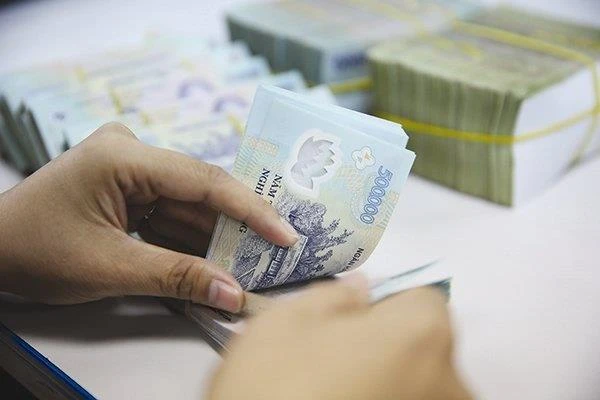
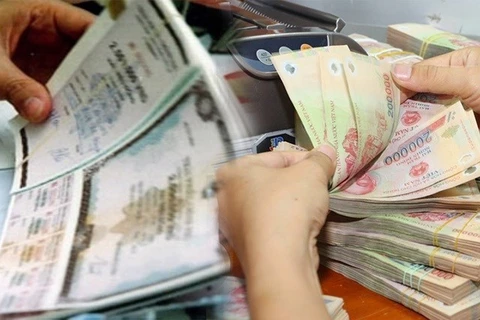
Corporate bond issuance rises in eight months ảnh 1Cash notes being counted in exchange for bond notes.
(Photo: vietnambiz.vn)

Hanoi (VNS/VNA) - A total of 117 trillion VND (5.03 billion USD)worth of corporate bond notes were raised in the first eight months of 2019,according to SSI Securities Corporation’s research unit.

The figure means the successful issuance rate in the first eight months was90.8 percent and the value of the corporate bond market was equal to 10.2 percentof Vietnam’s total gross domestic product (GDP), SSI Retail Research estimated.

The total value of corporate bond offered in the first eight months wasestimated at 129 trillion VND, the SSI unit estimated upon informationdisclosed on the stock exchanges and companies’ websites.

According to the Ministry of Finance, a total of 224 trillion VND worth ofcorporate bond notes was raised in 2018, up 94.5 percent year on year. Thevalue of the market last year was 474.5 trillion VND, equalling 8.6 percent ofthe total GDP and higher than the 6.19 percent in 2017.

Commercial banks were still the biggest issuers, raising total 56 trillion VND– 47.9 percent of the total. Banks were followed by property developers, whichraised nearly 37 trillion VND – 31.5 percent of the total, infrastructureconstructors (9.2 trillion VND, 7.9 percent), and non-banking financial firms (4.42trillion VND, 3.8 percent).

Though realty firms ranked second in the list of top issuers, the successfulissuance rate of the sector was 77.3 percent – the lowest among thosementioned. Forty-four property firms opened 139 placements to offer 47.8trillion VND worth of bond notes.

Banks’ bond yield rates were the lowest, fixed and annually-paid. Averageper-annum bank bond yield rate was 6.75 percent and average maturity was 3.3years.
On the contrary,realty bond yield rates were the highest at a per-annum average of 10 percent,which was followed by infrastructure (9.79 percent) and financials (8.64 percent).

According to SSI Retail Research, Decree 163/2018/NĐ-CP dated December 4, 2018opened the corporate bond market for the business community by reducing theratio of short-term capital spent on medium- and long-term lending.

The increase of the risk ratio in bank loans for real estate projects motivatedcompanies to raise capital via bond issuance from making bank loans.

In addition, the transparency of information disclosure and more activeparticipation of middle stakeholders like banks and brokerages made corporatebonds more attractive.

However, there are still risks with the local corporate bond market despitegood growth in recent years, according to Nguyen Viet Cuong, vice director ofanalysis centre at Vietinbank Securities Co.

“The biggest risk now is information transparency. In other markets, the roleof credit rating firms is quite clear and important because they have variousrankings for various types of corporate bond and investor appetite,” he said.

“Therefore, Vietnam will soon have to make space for business credit ratinginstitutions to make the corporate bond market more transparent” and make it agood source of capital for companies beside bank loans, Cuong said.

Though the Vietnamese corporate bond market has made big improvements, itshould be noted that commercial banks are still the biggest bond buyers,especially in the real estate sector, while the identity of buyers should bepublic, Nguyen Duc Hung Linh, director of individual customer analysis andconsultancy at SSI Securities Corp, said.

If the role of credit rating firms remained vague, bond buyers, especiallyindividuals, would not be able to find the appropriate yield rates, he said,adding investor protection policies must be improved in the future.

According to economic specialist Bui Quang Tin, CEO of Bizlight BusinessSchool, bondholders may face higher risks when they purchase corporate bondsbecause they have no collateral from the companies.

"The higher the yield rates are, the higher the risks," he said,adding "the major risk lies in true information of firms, which cannot befound publicly and is sometimes hidden from individual investors".

Purchasing corporate bonds may sometimes mean all-in for investors, accordingto Tin. If the company declares bankruptcy, investors may lose everything sothere must be a policy to protect bond buyers from such risk. – VNS/VNA
VNA
See more

A delegation from the Nghe An provincial People’s Committee inspects production and business activities at the VSIP Nghe An Industrial, Urban and Service Park. (Photo:nhandan.vn)

Nghe An steps up reforms to attract FDI

In 2025, the provincial People’s Committee licensed 25 new FDI projects and approved capital adjustments for 20 others, bringing the total newly registered and additional investment to more than 1 billion USD. Many large-scale projects in the Southeast Nghe An Economic Zone have already become operational, contributing to export growth, state budget revenues and job creation.

Nearly 35,500 enterprises are newly registered nationwide, with total registered capital reaching nearly 313.7 trillion VND and more than 167,500 registered workers. (Photo: VNA)

Nearly 35,500 new businesses set up in first two months

The enterprises registered combined capital of about 313.7 trillion VND and more than 167,500 employees. Compared with the same period last year, the number of new businesses surged by 70.7%, while registered capital rose by 36.1% and registered labour increased by 19.1%.

The yarn factory of Unitex Textile and Dyeing Company Limited applies new technology to optimise operations using an automated model. (Photo: VNA)

Resolution 68: International lessons for private sector development

A common feature in many successful economies is a fundamental shift in the perception of private enterprises. In countries such as Singapore, Germany, Republic of Korea (RoK) and China, private firms are viewed not mainly as entities requiring strict control but as development partners and key forces generating growth, jobs and innovation.

The production line of Regza Electronics Vietnam Co., Ltd. located in Dong Nai province. (Photo: VNA)

Vietnam’s overseas investment rises 2.3-fold in first two months

During the period, 36 new overseas projects were granted investment certificates with total registered capital from Vietnamese investors reaching 532.4 million USD, up 2.3 times compared to the same period last year. In addition, three projects adjusted their capital with an additional 7.8 million USD, 1.5 times higher than a year earlier.

Workers of PTSC Thanh Hoa check the system for crude oil imports. Vietnam saw strong increase in fuel imports in the first two months of this year. (Photo" VNA)

Vietnam records strong increase in fuel imports in two months

Statistics of Vietnam Customs showed that Vietnam spent more than 1.44 billion USD importing 2.18 million tonnes of petroleum products in the first two months of this year, representing a sharp increase of 31.4% and 43%, respectively, over the same period last year.

Prime Minister Pham Minh Chinh visits a macadamia cultivation model in Huoi Tao B village, Pu Nhi commune, Dien Bien province on March 8. (Photo: VNA)

PM requests boosting agricultural development in Northwestern region

PM Chinh encouraged local residents to explore additional crops and livestock suitable for intercropping in order to maximise land use efficiency. Farmers were also urged to strengthen cooperation with one another and with businesses by joining cooperatives, consolidating land resources and working together to expand production and improve incomes.

Farmers in the Mekong Delta province of An Giang harvest rice grown under the project 'Sustainable Development of One Million Hectares of High-Quality, Low-Emission Rice Associated with Green Growth in the Mekong Delta by 2030.' (Photo: VNA)

Promoting high-quality rice exports amid mounting challenges

According to the Ministry of Agriculture and Environment (MAE), an estimated 600,000 tonnes of rice worth 370 million USD was exported in January, up 12.4% in volume and 16.9% in value year-on-year. The average export price reached 616.6 USD per tonne, up 4%.

Fuel supply in Hanoi remains stable. (Photo: VNA)

Fuel prices rise sharply from 3 pm on March 7

Since the beginning of this year, domestic fuel prices have undergone 11 adjustments. During this period, both RON95 and E5 RON92 experienced four decreases and seven increases, while diesel oil two falls and nine hikes.

Customers buy and sell fuel at a Petrolimex petrol station. (Photo: VNA)

Capital’s fuel market remains stable after March 5 price adjustment

Operations at several petrol stations across Hanoi have run normally. Along major routes, petrol stations remained open and continued to serve customers as usual. The number of vehicles refueling showed no major changes compared to the days before the price adjustment. Sales activities continued without interruption, and there were no long queues or supply disruptions.

Thang Long II Industrial Park in Hung Yen province. (Photo: VNA)

Green industrial parks draw FDI to northern Vietnam

From 2026, the industrial real estate market in the northern region is forecast to enter a new growth phase as strategic infrastructure projects near completion, supply expands, and green industrial parks become a decisive factor for foreign direct investment (FDI).

Border guards from Thanh Hai Border Guard Station patrol fishing vessels entering Phu Hai port in Phu Thuy ward, Lam Dong province. (Photo: VNA)

Lam Dong orders swift action to address IUU fishing gaps

Vice Chairman of the provincial People’s Committee Le Trong Yen has directed heads of relevant departments, sectors and localities to strictly implement directives and newly issued regulations on IUU prevention, while strengthening public awareness efforts so fishermen and businesses better understand and comply with the rules.