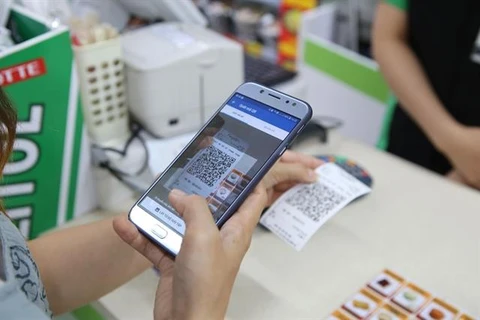
A customer pays for a drink by QR code at a tea shop (Photo: VNA)
 Hanoi (VNS/VNA) - E-wallet firm MoMo launched a cashback programme on November 3 with value of up to 100,000 VND (4.30 USD) per transaction and for four transactions daily at most.
The company said the move follows the success of its first cashback programme in August, which had to wrap up earlier than planned due to overwhelming demand.
This is one of various promotion programmes banks and payment solution companies are offering to attract Vietnamese users to quick response (QR) code payment.
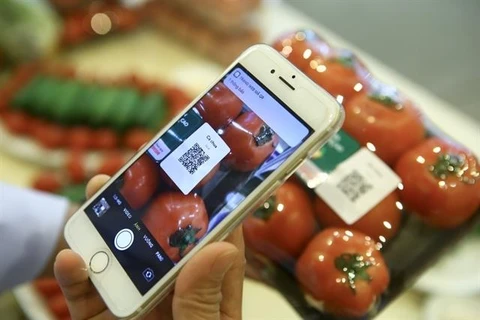
A QR code is similar to a bar code and made up of black and white squares that can be read by various devices, including smartphones and point of sale (POS) terminals.
For years, companies have been using QR codes for multiple purposes, from advertising and promotions to merchandise tracking and coupons. QR codes have also started to be used for payments, with customers scanning a QR code and having the money transferred from their account to the merchant, without the need for a POS terminal.
Vietnamese customers are increasingly familiar with QR code payments, with large firms such as Vietnam Airlines, Vietjet Air, Co-opmart, Lotte Mart, petrol retailer PV Oil and a lot of convenience stores, food-beverage and clothes shops.
In Vietnam, 24 banks, including State-owned banks such as Vietinbank, Vietcombank and BIDV, have offered QR code payment services, not to mention other industry players such as fintech and e-wallet firms.
The number of merchants accepting QR code payments increased to 50,000 by mid-2019 from 30,000 at the end of last year.
Costly investment
In recent months, many banks and e-wallet firms have launched promotions to attract customers to make payment via QR code. Accordingly, if customers pay for products by scanning QR codes instead of cash or cards, they will enjoy a 10-20 percent discount or be awarded cashback.
Trinh Thi My Kim, a teacher in Hanoi, said that she recently installed MoMo after her friend introduced her to the promotion programmes offered via the e-wallet.
“Previously, I only used QR payments on mobile banking for food or clothes because of price discounts. Now I added MoMo for its cashback in many stores,” Kim said.
Kim and others are using several e-wallet apps and they switch to different apps depending on the products and promotion programmes.
Besides banks, some e-wallet firms are dominating the cashless payment industry such as MoMo, Moca, ZaloPay, Viettel Pay and Payoo.
MoMo has teamed up with 20 banks and 10,000 partners in various sectors like power, telecommunications, insurance, entertainment, e-commerce and food and beverages, and has some 12 million users.
Moca, through a partnership with Grab, has also witnessed an impressive increase in the number of users, with the total number of non-cash payment transactions via Moca on Grab rising 150 percent in the first half of this year.
In September, Vingroup also launched VinID e-wallet. With a broad range of products and services from shopping, medicine to education and resorts, VinID is expected to become a big player in the industry.
According to Pham Cong Quynh Lan, deputy general director of Vietinbank, e-wallets have poured a lot of money into promotions to entice users but most only switch to this method due to the promotions.
“The number of frequent users has increased slowly. When the promotions end, they go back to cash,” Lan was quoted as saying by baodautu.vn.
However, according to industry experts, QR code payment is still at an early stage and service providers need to spend a lot to establish a habit for users. Promotion funds are often shared by both service providers and merchants.
“The advantages of QR payment are low cost investment and rapid deployment time, which makes it suitable for small-scale service providers, mobility services, or taxi businesses,” Dang Tuyet Dung, Visa Country Manager for Vietnam and Laos, told Vietnam News.
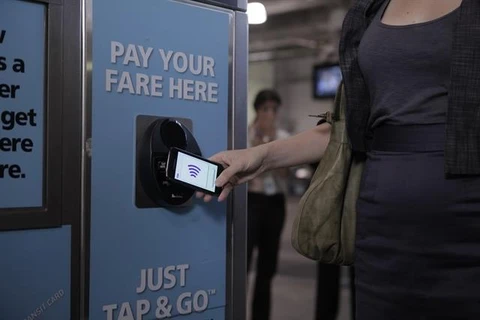
However, Dung said paying with QR code is reliant on internet infrastructure in terms of transmitting transaction information to the accepting unit, not to mention that this method’s processing speed is not as fast as contactless payment.
According to Visa’s report about Southeast Asia payment attitudes in 2018, only 19 percent of the Vietnamese respondents have used a QR code to pay.
“Generally, it will take time for the consumers to get acquainted with this new method,” Dung said.
Another problem faced by dozens of service providers is that users rarely use more than three payment apps on their phone. This means the battle to attract users will be fiercer in the future, with 70-80 percent of e-wallets expected to be eliminated.
In China, a leader in terms of cashless payment, two payment applications supporting QR code payment – Tencent's WeChat Pay and Alibaba's Alipay – have a respective 900 million users and 500 million users. In addition, AliPay and WeChat Pay have integrated many different services into their mobile wallets.
Thus, local existing e-wallets are forecast to spend more and more money on promotions to seek the loyalty of customers, as well as to expand their network to increase convenience for users./.
VNA