State budget collection in the southeast and Mekong Delta regions regions hit 495 trillion VND (Photo: VNA)
 Hanoi (VNA) – Complicated developments of the latest resurgence of COVID-19 have severely impacted production and business activities of cities and provinces in the southeast and Mekong Delta regions, slowing down economic development pace of these two major economic areas of the country.
Minus growth forecast for some localities
At an online meeting on the building of socio-economic development and public investment plans in 2022 for the southeast and Mekong Delta regions on September 15, Deputy Minister of Planning and Investment Tran Quy Dong said that the average growth of the two regions in the first six months of this year was lower than the country’s level.
He noted that the Mekong Delta region only recorded a 4.5 percent growth in the period, and that of the southeastern region was 4.58 percent, while the country’s average was 5.64 percent.
However, despite amid the extremely difficult situation, several localities had maintained higher economic growth than the country’s average level, including Binh Phuoc (6.16 percent), Tay Ninh (7.04 percent), Binh Duong (7.23 percent), Long An (6.06 percent), Ben Tre (6.47 percent), and Bac Lieu (7.17 percent).
Regarding economic targets in the first eight months of this year, Dong said that State budget collection in the two regions hit 495 trillion VND (21.74 billion USD), accounting for 46.5 percent of the country’s total. Meanwhile, their export revenue was 87.65 billion USD, making up about 41.1 percent of the country’s total. The two regions drew 10.54 billion USD in foreign direct investment (FDI), accounting for 55.14 percent of the country’s total. At the same time, the number of newly-established enterprises in the regions was 37,252, said Dong.
The official held that the economic growth of the two regions may be even lower in the whole year, and some cities and province may suffer minus growth due to the prolonged pandemic situation.
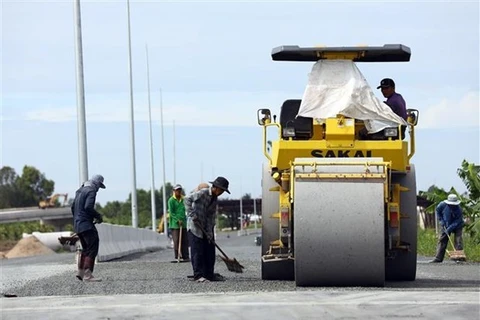
 The economic growth for the whole year in the southeast and Mekong Delta regions may be even lower, and some cities and province may suffer minus growth due to the prolonged pandemic situation. (Illustrative image. Source: VNA)
 The southeast region comprises Ho Chi Minh City, Tay Ninh, Binh Duong, Binh Phuoc, Dong Nai and Ba Ria - Vung Tau provinces. Meanwhile, the Mekong Delta region consists of Can Tho city and the provinces of Long An, Tien Giang, Dong Thap, Vinh Long, Tra Vinh, Hau Giang, Soc Trang, Ben Tre, An Giang, Kien Giang, Bac Lieu, and Ca Mau.
At the event, representatives from Binh Duong said that COVID-19 may affect the province’s State budget collection and spending for 2021 and estimate for 2022, citing difficulties in production of local firms.
Similarly, Can Tho representatives said that in 2021, the city may fail to complete eight out of 17 major target it set for the year.
Meanwhile, Dong Nai representatives said that in 2021, the province is likely to complete 17 targets, surpass three others but fail to achieve two targets in gross regional domestic product (GRDP) growth and per capita GRDP.
Optimal conditions to be created for businesses
Regarding major tasks and solutions for each region in the rest of the year, Bui Thi Thu Thuy, Vice Director of the Local and Territorial Economy Department under the Ministry of Planning and Investment said that along with pandemic prevention and control efforts, the regions should focus on implementing the “dual targets” in economic development, social welfare, defence, security, and social order and safety.
Specifically, the biggest task for the southeast region now is to speed up vaccination progress and effectively implement pandemic containing measures to prevent new resurgence, early reopen the economy and recover business and production activities, she said.
She asked regional localities to create optimal conditions for businesses to maintain production and remove obstacles facing them, minimising the shortage of materials and workforce and preventing the disruption of production chain that may lead to stagnant production and higher unemployment rate.
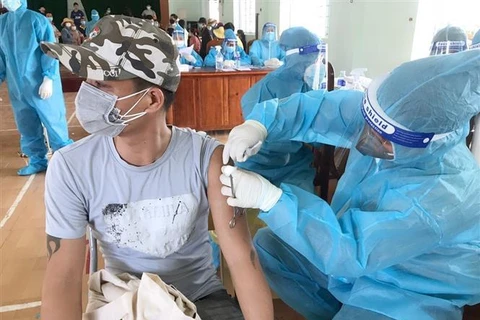
 Southern localities are speeding up vaccination activities (Illustrative image. Source: VNA)
 The current target is to resume the new normal situation as soon as possible, support businesses and recover production, as well as create optimal conditions for economic growth such as attracting more investment, speeding up administrative reform and creating favourable investment environment, Thuy said.
The Mekong Delta region could also miss many socio-economic targets, including many important goals, under the pandemic impacts,.
Therefore, besides continuing with pandemic prevention and control, she advised the localities in the region to early recover industrial production, while promptly implementing support policies to pandemic-hit businesses.
They should also make careful preparations for resuming production as soon as possible, and seek ways to sell local farm produce, she said./.