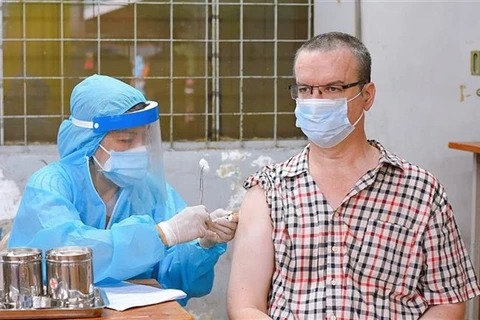
Matt Ryan uses his free time during lockdown to cook and deliver free food to frontline workers. (Photo courtesy of Matt Ryan)
 Adapting to the new situations with strict social distancing regulations is not easy for anyone, let alone foreigners who do not have a family around for support and do not speak Vietnamese.
With stringent restrictions in place in many localities, a simple thing like doing groceries can turn out to be a challenging task.
Adrian John Leeds, a Brit living in Hoan Kiem district, Hanoi, said he was struggling to buy food during the early days when the city applied strict social distancing under Directive 16 in late July.
“In the beginning of the lockdown, it was really tough," he told Vietnam News.
"The only place I could safely buy food was my local small grocery store. But, they ran out of food very quickly and all that was left was 'student food' like noodles and sausages.”
This resulted in him losing three kilogrammes over a month.
Luckily, the problem resolved over time as the shop eventually restocked and he was able to buy more food to meet his needs.
Adrian has been living in Vietnam for three years working as a photographer and founder of a design consultancy.
He said before COVID, he would regularly travel to other Southeast Asian countries for work and pleasure.
Now, he mostly stays at home and only goes out once or twice a week to get groceries and even could not meet his Vietnamese fiancée in person for six weeks although they don’t live too far apart.
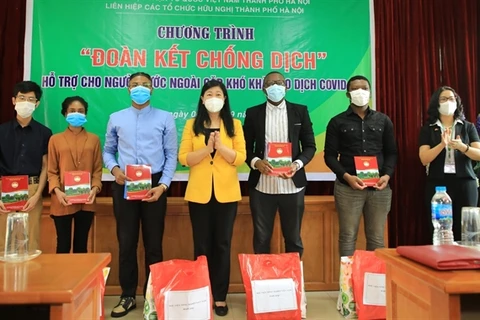
Amid the gloomy days, a nice surprise has come to him that warmed his heart. On September 3, local officials came to his house to give him a COVID-19 supportive package – a bag full of essential food, health supplies and 500,000 VND (22 USD).
“I am very happy with the support I have received, even if it's a small gesture," he added.
“I was not expecting anything. I felt like I was not forgotten. It seems like the Government wants to look after its expat community.”
Unlike Adrian, Chris Saint, an Australian retiree living in Hoi An did not have trouble buying food.
But for him, the main issue was access to accurate information.
Chris cited the fact that most decisions and decrees by the authority are announced in Vietnamese without an English translation while many expats cannot speak the language.
“Expats are often in the dark to the details of any government action," he said. This makes it harder for them to comply and difficult for them to access services.”
As a locality which saw a rapid rise in COVID infections, Hoi An started social distancing orders under Decree 16 on July 31.
“There were issues in the first week of the lockdown due to lack of clarity,” Chris said.
“Many foreigners have to rely on information from social media as a primary source of information.”
As an administrator of a Facebook group for expats living in Da Nang, Hoi An and Hue with nearly 10,000 members, Chris has been sharing as much information as possible, especially from official media outlets published in English “to promote factual information.”
He added that another problem many expats were facing was financial difficulties.
Personally, Chris is not bearing this burden as his family has their own savings to keep them going through this tough time.
But from his observation, he said it was a real issue for many expats who had lost their income and did not have the reserves to sustain themselves for a long period of time.
Matt Ryan, a British owner of a restaurant in Thu Duc City, Ho Chi Minh City, also lost his regular income as his restaurant had to close for months amid the severe COVID outbreak in the southern economic hub.
His business was only allowed to reopen on September 8 when the city eased some restrictions but he and his staff are still struggling to keep it running amid shortage of input materials.
However, for Matt, this is a small price to pay in order for the country to contain the pandemic and bring society back to its feet. “It's tough, it's really tough,” he said.
“But our city is facing an unprecedented emergency and the authorities are doing what they think is best to get it under control and protect the hospitals from being completely overrun.”
Although his business was disrupted, Matt didn’t let any time be wasted. He and his staff in the restaurant decided to cook free meals to frontline workers in the city.
Thinking positively is the way he chooses to navigate this challenging time.
“We have to be strong, look after one another and stay positive as best we can. This too shall pass,” he said.
Matt also appreciates the Government’s efforts in supporting the expat community.
He and his wife both had their first vaccination shot arranged by the local authority.
“There was no difference in the procedure to get the vaccine between local people and foreigners,” he said.
Chris Saint also feels blessed that he is now in Vietnam. “I feel safe where I am due to the efforts of the Government and the frontline people. Safer than I would in my own home country,” he said.
Like Matt, Chris spent time doing charity work to provide free food to poor people in his neighbourhood.
“Could life be better? Absolutely. There has never been a time better than now to appreciate what you do have,” he said.
“People need to value health and family above everything else. Prosperity will have to wait.”/.
VNA