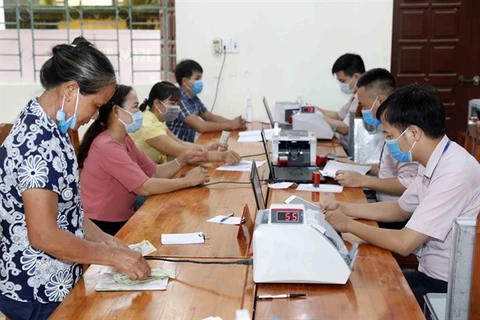
Speakers at a workshop on promoting non-cash payment in the digital economy on December 4. (Photo: VNA)
Hanoi (VNA) – The novel coronavirus outbreak has changed the payment habit in Vietnam, with non-cash transactions particularly surging in the public service, Director of the State Bank of Vietnam’s Payment Department Pham Tien Dung said on December 4.
At a workshop on promoting non-cash payment in the digital economy, Dung said digital payment ecosystem has been applied at over 30 hospitals, while 50 commercial banks completed e-tax payment with customs and taxation authorities in the 63 cities and provinces nationwide.
Twenty-seven commercial banks and 10 intermediary organisations joined hands to carry out online payment of electricity bills, he said, adding nearly 90 percent of the Electricity of Vietnam’s revenue from power bills was collected through commercial banks.
As of August 31, 92.9 percent of the 90,858 state-owned agencies had transferred salary payment through bank accounts, as compared with 81 percent recorded in the end of 2016.
During January-August, over 239 million transactions worth some 547 trillion VND (23.7 billion USD) were carried out via bank cards, up 28.9 percent and 15.8 percent year-on-year, respectively.
However, Dung pointed out several challenges of non-cash payment, including undeveloped infrastructure in rural and mountainous areas, the public’s lack of confidence in access to new payment technologies, and complicated developments of hi-tech crimes.
Colonel Truong Son Lam, deputy head of the Department of Cyber Security and Hi-tech Crime Prevention under the Ministry of Public Security, said it is necessary to raise banking staff’s awareness of tricks and to organise regular examinations so as to identify suspicious transactions.
Meanwhile, Chief Economist at BIDV Can Van Luc gave out several effective models in China, India, and Thailand to promote cashless payment such as refund for e-payments, free transaction for small e-payment, and interbank mobile payments system PromtPay, among others.
He recommended competent authorities to complete legal corridors, issue regulations on management of fintech firms, digital wallet, mobile money, as well as update the national scheme on cashless payment./.
VNA