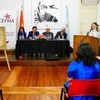
Professor Nguyen Huy My, a member of the Nguyen Huy family, talks to pupils of Truong Loc Primary School in Ha Tinh about the book "Hoang Hoa su trinh do". (Photo: VNA)
 Hanoi (VNA) - In 2018, Vietnam not only had more heritages honored by the UNESCO but also made discoveries that "shocked" international archaeologists and found evidence of the country’s continuous sovereignty over the Hoang Sa (Paracel) islands.
Ancient book on Vietnamese envoy’s journey to China becomes world heritage
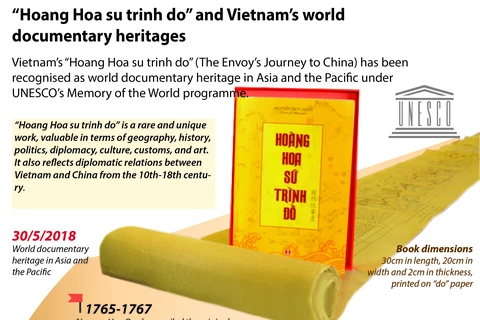
On May 30, at its eighth plenary meeting in the Republic of Korea (RoK), the UNESCO Memory of the World programme recognised Vietnam's “Hoang Hoa su trinh do” (The Envoy’s Journey to China) as a documentary heritage in Asia-Pacific.
The book was printed on “do” paper. With writings, drawings and maps, the book recorded the diplomatic relationship between Vietnam and China in the 18th century through the journeys of Vietnamese envoys. There are also some pictures of mountains and rivers, and natural landscapes. It also described reception forms and the length of the road.
It was compiled and edited by Nguyen Huy Oanh (1713-1789) based on documents of previous envoys and historical records as well as notes from his own journey in 1766-1767, during which he worked as the main envoy of the Vietnamese delegation.
 “Hoang hoa su trinh do” recorded the diplomatic relationship between Vietnam and China in the 18th century, reflecting exchanges among countries in Asia-Pacific. (Photo: VNA)
 A representative of UNESCO in Vietnam said it is a rare and unique work on historical envoy journeys that has been well preserved by a family.
Vietnam has second UNESCO-recognised global geopark
On April 9, at its 204th session, the UNESCO Executive Board approved Non Nuoc Cao Bang as one of its global geoparks. Non Nuoc Cao Bang was the second site in Vietnam to receive the status after the Dong Van Karst Plateau.
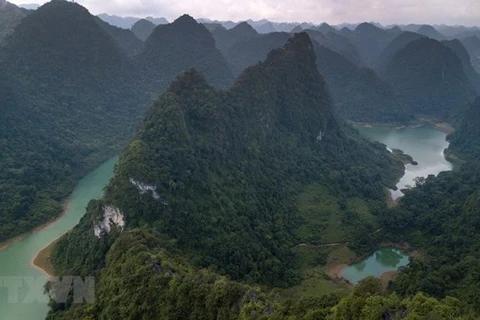
 Non Nuoc Cao Bang is the second UNESCO-recognised global geopark in Vietnam (Photo: VNA)
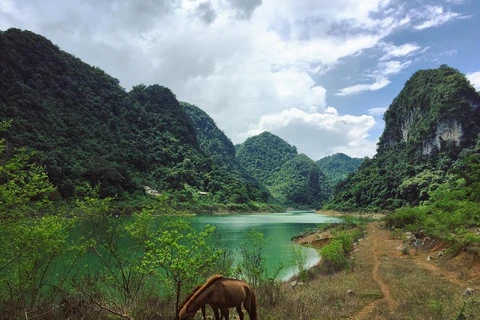
 Covering more than 3,000 square kilometres, the geopark is home to the ethnic communities of Kinh, Tay, Nung, Dao, and Hmong, among others. The fossils, sediments and limestone landscapes found there are evidence of the Earth's movement and changes over more than 500 million years. The park’s diverse flora and fauna across nine reserves and special forests are also noteworthy.
The sites also houses some 200 historical, cultural, and archeological sites, including the national special relics Pac Bo and Tran Hung Dao forest along famous tourism destinations like Ban Gioc waterfall. It is home to a diverse flora and fauna system in nine reserve and specialized forest zones with 30 types of rare fauna and flora genes.
Discovering more Nguyen-era documents on Vietnam’s sovereignty over Hoang Sa islands
Recently, researcher of Hue culture Phan Thuan An discovered two more administrative documents under the Nguyen dynasty that confirm Vietnam's continuous sovereignty over the Hoang Sa islands. These documents were discovered at a temple dedicated to Princess Ngoc Son, the daughter of King Dong Khanh.
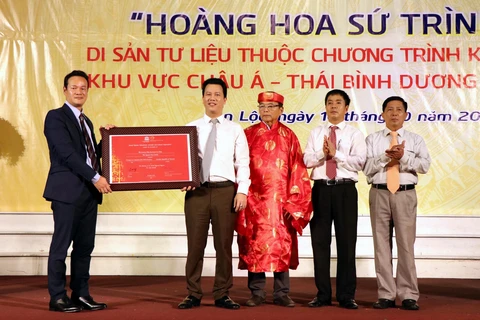
 The Thua Thien-Hue Department of Culture and Sports hands over to the Ministry of Foreign Affairs the Nguyen-era royal documents related to Vietnam’s sovereignty the Hoang Sa islands. (Photo: Quoc Viet/VietnamPlus)
 The first document, dating back to the 13th year under King Bao Dai’s reign, involved the proposal for and the King’s approval of conferring the Order of the Dragon of Annam, 5th class, to a border guard unit on February 10, 1939. The unit was honoured for their contributions in eradicating “barbarians” in the mountains and “establishing defence stations on Hoang Sa.”
The second document dated February 3, 1939, recorded the event during which the French Protectorate of Annam asked King Bao Dai to approve a medal for Louis Fontan, who headed a guard team stationed in Hoang Sa archipelago protecting the island under the Nguyen dynasty. During his tenure, he got malaria and died in a hospital in Hue. The proposal was accepted.
The time and characters mentioned by the two documents help affirm Vietnam’s sovereignty over the Hoang Sa islands.
Prehistoric remains found in Krong No volcanic caves
From archaeological excavations in the Krong No volcanic cave area of Dak Nong province, Vietnamese scientists for the first time discovered prehistoric humans’ houses, burial sites and remains.
Humans first appeared here in the early New Stone Age (about 7,000-10,000 years ago), followed by the inhabitants in the middle period of the New Stone Age (about 6,000-7,000 years ago). Prehistoric humans left the cave at the end of the New Stone Age and in early Metal Age (about 3,000 years ago).
"While working in the excavations, experts from the US, Japan, China said they had never found ancient human remains in volcanic caves. In addition, the Basalt environment is not capable of preserving the remains. However, the ancient people living in this volcanic cave had found a food source of mollusks (clams, snails, and mussels, among others). The mollusks’ shells that were rich in calcium helped change the environment and preserve the remains inside the cave,” said Associate Professor Nguyen Lan Cuong from the Vietnamese Archaeology Association.
Therefore, the discovery was described as “shocking” and was an important turning point of Vietnamese paleoanthropology. It provided evidence for the study of ancient people living in the Central Highlands thousands of years ago.
The archaeological findings are convincing scientific evidence to add to the dossier submitted to the UNESCO for consideration and recognition of the Krong No volcanic cave geological park as one of its global geoparks.
Discovery that changed perception of human appearance in Vietnamese territory
After archaeological excavations at the early Old Stone Age relic site in An Khe (Gia Lai) in 2015-2018, scientists discovered many tools of prehistoric people (such as cutting tools, three-sided sharp points, and stone hand axes) among the tools.
 Items obtained from the archaeological excavations. (Photo: Institute of Archeology)
 Associate Professor Nguyen Giang Hai, also former Director of the Institute of Archaeology, said that no Southeast Asian country has ever discovered relics of such era until the discovery in An Khe. Therefore, it was a shock to international archaeological communities and changed the view of many scientists.
“It affirmed that in about 80,000 years ago, human beings were present in the territory of Vietnam today. It can be seen as the oldest trace of early humans and cultural relics in the Vietnamese territory. The results of this archaeological excavation have also added new materials to the map of human emergence, distribution and evolution in the world,” said Hai.-VNA