Da Nang calls for RoK’s investment in ICT

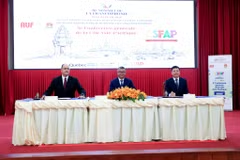
A forum to promote investment in information and communications technology (ICT) in the central city of Da Nang from the Republic of Korea (RoK) was held virtually on November 30, bringing together representatives from over 200 enterprises and investors from the two countries.
Da Nang calls for RoK’s investment in ICT ảnh 1Participants at the forum (Photo: VNA)
Da Nang (VNA) – A forumto promote investment in information and communications technology (ICT) in the central city of Da Nang from the Republic of Korea (RoK) was held virtually on November 30, bringing together representatives from over 200 enterprises and investors fromthe two countries.

The event aims to introduce potential, advantages, preferential and investmentsupport policies of Da Nang to RoK businesses and investors, especially inICT, and high technology.

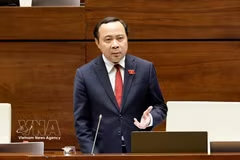
Addressing the event, DeputyMinister of Information and Communications Phan Tam said the RoK is the largestforeign investor in Vietnam with over 9,000 valid projects worth over 71.5billion USD, including nearly 500 investment projects in the ICT field with thepresence of the world's leading technology corporations such as Samsung and LG.

To welcome more investments fromthe RoK, the Vietnamese Government has been perfecting models, mechanisms andpolicies to create breakthrough development for concentrated IT parks in keyeconomic centres, he said.  

Da Nang is likened to a "siliconvalley of Southeast Asia". The municipal authority is working withthe central agencies to build a digital ecosystem, giving priority toattracting foreign-invested projects in IT and high technology, towardsdeveloping the central city into a destination for global digital technologycorporations, Tam said.

Participants discussed the developmentof Vietnam's ICT industry, investment of Korean firms in general andKorean ICT enterprises in particular in Vietnam.

Korean investors also shared their investment experience in Da Nang.

Consul General of the RoK in Da Nang Ahn Min-sik said this is the right time tostrengthen cooperation in IT in order to connect other sectors, expressing his hope that RoK corporations and Da Nang city will promote stronger ICTcooperation as well as in other fields for sustainable development.

According to Vice Chairman of the municipalPeople’s Committee Tran Phuoc Son, the city considers the RoK one of its key partners,and wishes to promote connectivity and investment from Korean companies in its ICTsector.

Da Nang pledges to create favourable conditions for RoK investorsto set up and operate effectively projects in Da Nang, he affirmed.

The RoK is one of the strategicmarkets that Da Nang is calling for investment. The RoK isone of the five countries and territories having the highest number of projectsand investment capital in Da Nang, with 233 projects worth 378.14 million USD as of this November.

Information technology is one of thekey areas that Da Nang city is focusing on calling for Korean investors. Thecity has set a target of earning 2.34 billion USD from the ICT sector by 2025./.
VNA

See more

Delegates pose for a group photo at the Bengaluru Tech Summit 2026 in Karnataka, India (Photo: VNA)

Vietnam attends annual int’l tech summit in India

Vietnam's growing focus on science and technology, digital transformation and innovation as new drivers of development made India a natural partner in achieving its development and digital transformation goals. Cooperation potential between the two countries remains substantial, spanning both hardware and software.

Vietnamese Deputy Minister of Science and Technology Tran Trung Tinh speaks at the event. (Photo: Published by VNA)

Vietnam, RoK seek to expand cooperation in AI and semiconductor sectors

Vietnamese Deputy Minister of Science and Technology Tran Trung Tinh stressed that the Politburo's Resolution No. 57-NQ/TW identifies science and technology, innovation and digital transformation as leading breakthroughs and key drivers of rapid and sustainable development. Semiconductors and artificial intelligence (AI) are among the strategic technologies prioritised for development.

Representatives of Cambodia’s Ministry of Education, Youth and Sport (MoEYS), the Agence Universitaire de la Francophonie (AUF) and Viettel Cambodia (Metfone) sign a tripartite agreement to strengthen cooperation and accelerate digital transformation in Cambodia’s higher education sector. (Photo: khmertimeskh.com)

Vietnamese company joins Cambodia’s digital transformation efforts

The agreement establishes a cooperation framework to modernise higher education through digital governance, digital learning, artificial intelligence (AI) applications, and capacity building through training and knowledge sharing. It also aims to expand internship, employment and scholarship opportunities for students.

USTH students access modern equipment (Photo: VNA)

Vietnam’s AI ambition runs into talent wall

AI is becoming a foundational technology, cutting across industrial production, healthcare, education, finance, governance and public service delivery. But turning technological potential into practical value requires a workforce able to study, master and apply AI to Vietnam’s real-world problems.

Trainees practise programming and operating robots at the Ho Chi Minh City High-Tech Park Training Centre. (Photo: VNA)

Vietnam, Malaysia hold potential for cooperation in robotics industry

Businesses from both countries should lead joint research and field-testing projects in areas such as electronic component inspection, warehouse transport, agricultural monitoring and medical logistics, said Samirul Ariff Othman, a policy, economic and business analyst at Global Asia Consulting and visiting lecturer at Universiti Teknologi PETRONAS.

Illustrative image (Photo: SGGP)

Ericsson establishes R&D capability in Vietnam

This initiative builds on Ericsson’s growing software engineering and testing capabilities in the country, and will further strengthen Vietnam’s contribution to Ericsson’s global technology development.

An AI-powered robot at the 2026 Seoul AI Conference. (Photo: VNA)

RoK’s AI robotics drive opens cooperation opportunities with Vietnam

Dao Tuan Hung, President of the Business Association of Vietnamese in Korea (BAVIK), said Vietnam should adopt a practical approach by prioritising specialised robots, including autonomous mobile robots (AMR/AGV), collaborative robots and machine vision systems, in sectors such as agro-fishery processing, textiles and garments, electronics and logistics.

Russian survey vessel Akademik M.A. Lavrentyev (Photo: VNA)

Russian survey vessel docks in Hai Phong

This is the third joint marine scientific survey in Vietnamese waters, running from November 4 - December 12, and one of the opening field activities under the Vietnam–Russia roadmap for marine scientific research cooperation for 2026-2035.

Smart products, chips and semiconductor materials are displayed at the launch ceremony of the national semiconductor chip prototyping support centre in Hanoi on June 26, 2026. (Photo: VNA)

Vietnam-Japan semiconductor cooperation paves the way for high-tech investment

The two countries are implementing five semiconductor research projects involving leading universities, with funding agreements signed in July. The projects cover three-dimensional integrated circuits, advanced semiconductor materials, secure artificial intelligence (AI) chips and power electronic components.

An exhibition space at the “Da Nang Semiconductors and High-Tech 2026” conference, organised by the Da Nang People’s Committee. (Illustrative photo: VNA)

Mobilising international resources to drive Vietnam’s technology development

Vietnam previously focused mainly on attracting overseas experts and intellectuals to work in the country over the long term, but this approach encountered certain difficulties. Cooperation methods are now shifting towards greater flexibility, allowing experts to take part in conferences and scientific seminars, contribute to addressing major national challenges, or participate in short-term training and research programmes.

Assoc. Prof. Dr. Dinh Ngoc Thach, lecturer and researcher in automatic control theory and robotics at the French National Conservatory of Arts and Crafts (Cnam) (Photo: VNA)

Core technologies key to sustainable robotics development in Vietnam: expert

Vietnam should select suitable robotic platforms and gradually build capacity in core technologies, including sensing, environmental perception, positioning, state estimation, AI, control and system integration. This will help develop technologies applicable across multiple sectors while avoiding fragmented investment and dependence on a single product category.