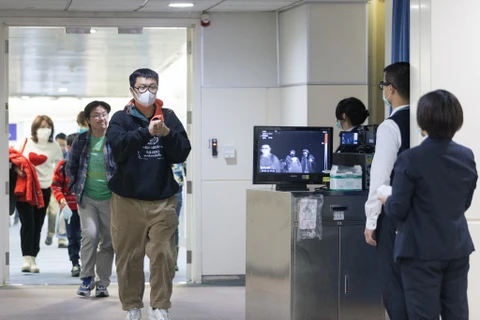
Staff of the international health quarantine centre of Quang Ninh province examine the body temperature of people from China via a thermal scanner at Mong Cai Border Gate (Photo: VNA)
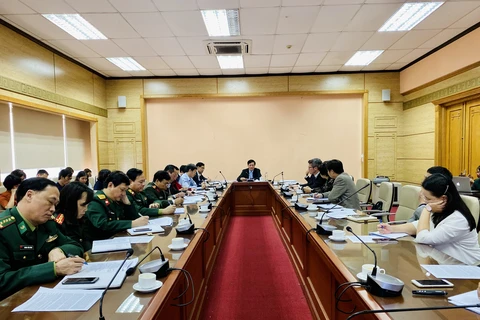
 Hanoi (VNA) – Deputy Prime Minister Vu Duc Dam chaired an urgent meeting in Hanoi on January 24 in response to the acute respiratory disease caused by a novel coronavirus (nCoV) strain.
The Deputy PM noted the nCoV epidemic first appeared in Wuhan city of China in December 2019. Vietnam is one of the countries with a high risk of being affected by this disease as it has a long borderline, frequent exchanges and large trading with China, especially during the Lunar New Year holiday when the travel demand surges.
The two cases tested positive for nCoV in the southern region are just initial results since the World Health Organisation (WHO) said this is a new disease for which there hasn’t been a standard testing method. Some other suspected cases are being kept under close monitoring, their samples are being tested and results will be announced as soon as they are available, he said.
Dam cited international experts as warning that nCoV has limited human-to-human transmission, but as Vietnam shares a long borderline with China, a higher level warning should be issued for the country.
He ordered the immediate implementation of health declaration at all points of entry, especially for people from Wuhan.
Dam requested relevant agencies to strictly manage persons with fever and advise people against going to nCoV-affected areas, including Wuhan and Huanggang cities of China, and countries and territories reporting infection cases.
The Deputy PM said the Health Ministry’s emergency operations centre has been activated to prevent nCoV from spreading. He also urged strong actions to protect health workers from being infected with the virus from patients and provide sufficient and precise information for the public.
Kidong Park, a WHO representative in Vietnam, said people should not worry too much about the disease. However, those with coughing and fever symptoms should proactively come to medical establishments to have examinations.
The WHO will coordinate closely with the Government and the Health Ministry of Vietnam to prevent and control the nCoV-caused disease, he added.
Earlier, PM Nguyen Xuan Phuc sent a note to ministries, sectors and localities, requesting them to redouble efforts in the face of the disease.
The two cases tested positive for nCoV in Vietnam are Chinese citizens who have been quarantined at Ho Chi Minh City-based Cho Ray Hospital.
Li Ding, 66, went to Hanoi from Wuhan on January 13, before going to Nha Trang city in central Khanh Hoa province, said Dr Nguyen Ngoc Sang of the Cho Ray Hospital’s Department of Tropical Diseases.
His son Li Zichao, 28, who has lived in the Mekong Delta province of Long An near HCM City for the past four months, went to visit him in Nha Trang. Both of them then traveled to HCM City and Long An, said Sang.
The father got fever on January 17, while the son had similar symptoms January 20. Both were admitted to the Cho Ray Hospital on January 22 night.
The Deputy PM said the Health Ministry’s emergency operations centre has been activated to prevent nCoV from spreading. He also urged strong actions to protect health workers from being infected with the virus from patients and provide sufficient and precise information for the public.
Kidong Park, a WHO representative in Vietnam, said people should not worry too much about the disease. However, those with coughing and fever symptoms should proactively come to medical establishments to have examinations.
The WHO will coordinate closely with the Government and the Health Ministry of Vietnam to prevent and control the nCoV-caused disease, he added.
Earlier, PM Nguyen Xuan Phuc sent a note to ministries, sectors and localities, requesting them to redouble efforts in the face of the disease.
The two cases tested positive for nCoV in Vietnam are Chinese citizens who have been quarantined at Ho Chi Minh City-based Cho Ray Hospital.
Li Ding, 66, went to Hanoi from Wuhan on January 13, before going to Nha Trang city in central Khanh Hoa province, said Dr Nguyen Ngoc Sang of the Cho Ray Hospital’s Department of Tropical Diseases.
His son Li Zichao, 28, who has lived in the Mekong Delta province of Long An near HCM City for the past four months, went to visit him in Nha Trang. Both of them then traveled to HCM City and Long An, said Sang.
The father got fever on January 17, while the son had similar symptoms January 20. Both were admitted to the Cho Ray Hospital on January 22 night.
A pneumonia outbreak, caused by a new strain of the coronavirus family that caused SARS and MERS, first surfaced in Wuhan city, China last December.
The disease has spread to many other countries and territories. China's National Health Commission has confirmed 541 infection cases and 17 deaths as of January 23.
The World Health Organisation (WHO) has confirmed that the new coronavirus could be contagious between humans.
The Vietnamese Ministry of Health has warned people to keep their distance from people with acute respiratory infections and wear a mask when talking to them. Equipment to monitor arriving passengers’ body temperature have been installed at airports in Hanoi, HCM City, Da Nang and Cam Ranh in central Vietnam./.
VNA