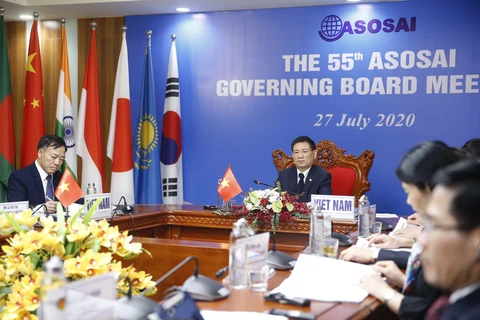
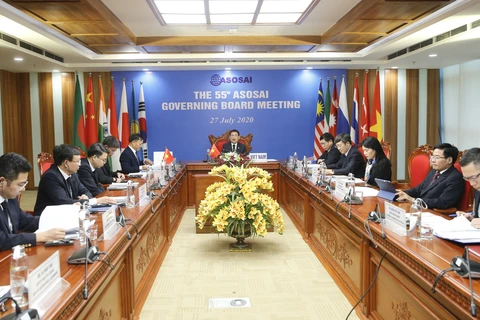
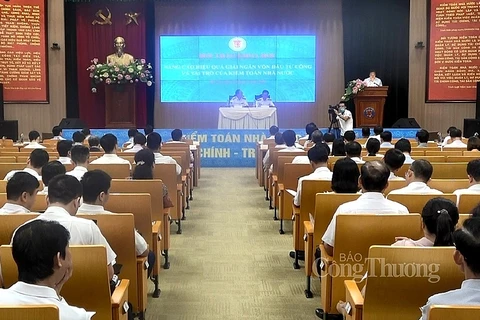
Illustrative image (Photo: Internet)
 Hanoi (VNA) – The National Assembly’s Standing Committee has issued a resolution on the development strategy for the State Audit Office of Vietnam (SAV) in the period from 2021 to 2030.
The resolution highlights the viewpoint that the SAV, as an agency set up by the National Assembly, will operate independently and in accordance with the law, upholding the core value of Independence – Integrity – Professionalism – Prestige – Quality, contributing to the development of a stable, sustainable and transparent national finance.
The development of the SAV should suit the real situation in the country while meeting requirements of the international integration process and matching international principles and practices in the field.
The resolution sets the overall targets of developing the SAV into an effective and important tool of the Party and State in inspecting and supervising the management and use of public finance and assets; enhancing accountability and transparency of agencies funded by the State budget, effectively serving the operation of the National Assembly and Government in performing their functions, and supporting People’s Councils and People’s Committees of localities in performing management, supervision and decision making work.
The SAV must enhance its capacity and efficiency in performing auditing activities through applying information technology, intensifying international cooperation, and ensuring transparency and professionalism, thus contributing to raising the State’s capacity in management and governance of finance and public assets in service of socio-economic development in the period from 2021 to 2030.
Regarding specific targets, the resolution calls for the building and perfection of the legal system to concretise the Constitution and laws on State auditing; along with the building of a professional, effective and efficient apparatus of the SAV. The number of SAV staff members will be decided by the NA Standing Committee but not more than 2,700 by 2030.
A goal set for the 2026-2030 is to conduct regular annual audits of the budget balance at ministries, centrally-run agencies, provinces and centrally-run cities. Audits of operations, specialized audits, information technology audits, and audits of the environment will be promoted, towards accounting for 30 – 40 percent of the total audits each year. Attention will be paid to detecting loopholes in mechanisms, policies and laws with a view to eradicating them.
The resolution highlights the viewpoint that the SAV, as an agency set up by the National Assembly, will operate independently and in accordance with the law, upholding the core value of Independence – Integrity – Professionalism – Prestige – Quality, contributing to the development of a stable, sustainable and transparent national finance.
The development of the SAV should suit the real situation in the country while meeting requirements of the international integration process and matching international principles and practices in the field.
The resolution sets the overall targets of developing the SAV into an effective and important tool of the Party and State in inspecting and supervising the management and use of public finance and assets; enhancing accountability and transparency of agencies funded by the State budget, effectively serving the operation of the National Assembly and Government in performing their functions, and supporting People’s Councils and People’s Committees of localities in performing management, supervision and decision making work.
The SAV must enhance its capacity and efficiency in performing auditing activities through applying information technology, intensifying international cooperation, and ensuring transparency and professionalism, thus contributing to raising the State’s capacity in management and governance of finance and public assets in service of socio-economic development in the period from 2021 to 2030.
Regarding specific targets, the resolution calls for the building and perfection of the legal system to concretise the Constitution and laws on State auditing; along with the building of a professional, effective and efficient apparatus of the SAV. The number of SAV staff members will be decided by the NA Standing Committee but not more than 2,700 by 2030.
A goal set for the 2026-2030 is to conduct regular annual audits of the budget balance at ministries, centrally-run agencies, provinces and centrally-run cities. Audits of operations, specialized audits, information technology audits, and audits of the environment will be promoted, towards accounting for 30 – 40 percent of the total audits each year. Attention will be paid to detecting loopholes in mechanisms, policies and laws with a view to eradicating them.
The SAV will work to shift from conventional auditing procedures to digital auditing based on big data with the support of Artificial Intelligence in a proactive manner, and improve auditing capacity to meet the requirements of the Government’s management administration work, and supervision work of the National Assembly and People’s Councils.
Regarding international cooperation, professional integration will be the key pillar, towards the goal of quickly narrowing the gap in professional capacity between the SAV and counterparts in the region and the world. Multi-lateral cooperation will be geared raising the SAV’s position in the international community through joining in the implementation and drafting of common auditing standards and rules. Meanwhile, bilateral cooperation will focus on the sharing of experience, technology to enhance the SAV’s capacity. The SAV will organize a number of coordinated audits, send or receive auditors for training, and conduct cross-assessment with regional and global supreme audit agencies.
The SAV will work to complete its electronic working environment in the direction of integrating and sharing data, streamlining internal processes, building a database based on big-data technology and connected with the national financial and asset supervision system, so as to turn the SAV into a crucial tool in macro-economic planning and building development policies for the digital economy in Vietnam.
The resolution assigns the Government to direct relevant ministries and sectors to coordinate with the SAV and agencies of the National Assembly to implement the SAV’s development strategy. National Assembly agencies are tasked with researching, instructing and coordinating with relevant agencies to perfect legal documents to ensure their consistency and uniformity, creating favourable conditions for the SAV to perform its functions and tasks in accordance with the Constitution.
Based on the strategy, the SAV must build a plan for implementation and regularly report to the National Assembly Standing Committee on the outcomes of implementation and propose adjustments or supplements to the strategy, if necessary./.
Regarding international cooperation, professional integration will be the key pillar, towards the goal of quickly narrowing the gap in professional capacity between the SAV and counterparts in the region and the world. Multi-lateral cooperation will be geared raising the SAV’s position in the international community through joining in the implementation and drafting of common auditing standards and rules. Meanwhile, bilateral cooperation will focus on the sharing of experience, technology to enhance the SAV’s capacity. The SAV will organize a number of coordinated audits, send or receive auditors for training, and conduct cross-assessment with regional and global supreme audit agencies.
The SAV will work to complete its electronic working environment in the direction of integrating and sharing data, streamlining internal processes, building a database based on big-data technology and connected with the national financial and asset supervision system, so as to turn the SAV into a crucial tool in macro-economic planning and building development policies for the digital economy in Vietnam.
The resolution assigns the Government to direct relevant ministries and sectors to coordinate with the SAV and agencies of the National Assembly to implement the SAV’s development strategy. National Assembly agencies are tasked with researching, instructing and coordinating with relevant agencies to perfect legal documents to ensure their consistency and uniformity, creating favourable conditions for the SAV to perform its functions and tasks in accordance with the Constitution.
Based on the strategy, the SAV must build a plan for implementation and regularly report to the National Assembly Standing Committee on the outcomes of implementation and propose adjustments or supplements to the strategy, if necessary./.
VNA