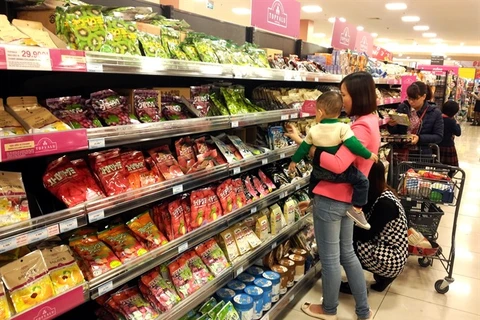
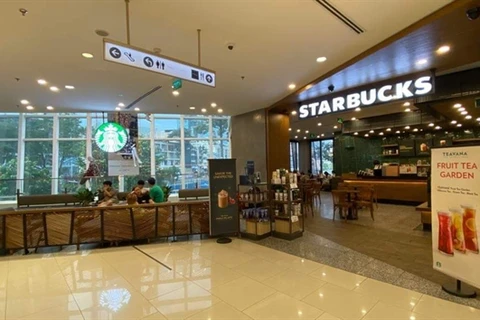
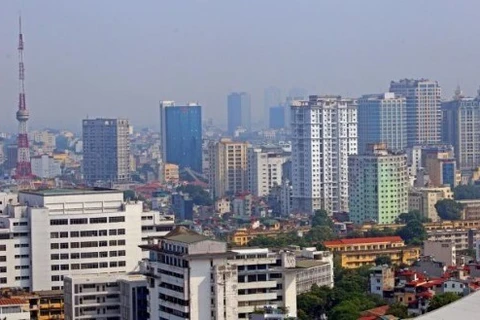
A trading centre in HCM City (Photo: VNA)
 Hanoi (VNS/VNA) - The shift toward e-commerce due to the COVID-19 pandemic has brought challenges to Vietnam’s retail property market, according to Savills Vietnam.
“COVID-19 has posed serious challenges within the real estate market, in particular for retailers. The market has witnessed many businesses having to foreclose or reduce operations to remain afloat," Tu Thi Hong An, director, Commercial Leasing HCM City, Savills Vietnam, said.
According to The Korean Times, the Korean E-Mart supermarket brand was acquired in May by Truong Hai Thaco Auto Corporation. Facing unprecedented challenges during its six years of operation in Vietnam, the brand struggled to expand and limited itself to just one location. It was believed that E-Mart struggled to find an ideal location that would match its requirements, Savills Vietnam said.
This is not the first time a foreign brand has struggled and eventually lost in Viet Nam’s harsh retail market. Before this, several foreign retailers like Metro and Casino Group had to back away, as well as the French supermarket chain Auchan was forced to be acquired by Coop, a local retailer.
Through the deal to secure a 5.5 percent stake with a price tag of 400 million USD in Vietnam’s Masan Group and VinCommerce (ownership of VinMart and VinMart ) by joint consumer-retail platform Crown X by Alibaba and Baring Private Equity Asia (BPEA), just a day before the E-Mart acquisition announcement, the untapped potential of Vietnam’s retail sector is shown vividly through its attraction to foreign companies.
Once this deal is completed, VinCommerce (a subsidiary acquired by Masan) will be one of the largest suppliers of the Lazada e-commerce platform (owned by Alibaba).
Through these transactions it is clear the retail landscape in Vietnam is changing, as the line between online and offline shopping continues to fade.
A report from the Vietnam E-Commerce and Digital Economy Agency (iDEA) said that 53 percent of purchases were done online in 2020 and the retail sector was given a bright forecast.
According to Fitch Solutions, Vietnam currently holds the fourth place in Southeast Asia's fast growing e-commerce sector, and the average household spending is predicted to rise up to 9.5 percent per year, an increase of 0.5 percent from an earlier forecast. Consumer spending categories are also expected to regain momentum in 2021.
According to the National Development Plan for E-Commerce 2021-2025, up to 55 percent of the Vietnamese population will make purchases online.
An also said: "This simply reflects how business is a competition for survival of the fittest in our evaluation. As the retail sector in HCM City is still seeing the arrival of many foreign brands within the food and beverage (F&B), fashion and accessory industry, it shows that many foreign businesses still see huge upside potential of the Vietnamese market."
“Despite the ongoing challenges of COVID 19, retail performance indicators are contrary to the current state of the market. Total revenue of the retail sector continues to rise as e-commerce becomes more popular and foreign brands enter the market,” she added.
Total revenue from mobile e-commerce transactions is estimated to reach 7 billion USD in 2021 and up to 10.2 billion USD in 2023, according to Savills.
Meanwhile, Hoang Nguyet Minh, director of commercial leasing, Savills Hanoi, said: “International retail brands see Hanoi as an expansion market. A premium shopping mall or a high-end hotel retail area has more appeal to these tenants than regular shop-houses or standalone projects.”
Foreign investors are helping accelerate growth of modern retail. The Ministry of Industry and Trade reported their already significant positions with 17 percent of shopping centres and supermarkets; 70 percent of convenience stores; 15 percent of minimarts; and 50 percent of online shopping and TV shopping channels.
The rapidly growing middle class is approaching an inflection point for domestic consumer spending growth, with GDP per capita approaching 3,000 USD. That shows significant retail potential, according to Savills Vietnam.
According to JLL, Socar Mall – the first mall in Thu Thiem is set to open in the third quarter of 2021 and expected to bring 38,000 sq.m to the retail property market. Meanwhile, the retail podium of some completed mixed-use developments is still looking for tenants and have yet to define opening dates.
In HCM City, vacancies continue to be constraint given limited new supply, meanwhile rents are flat as the impacts of pandemic are still lingering.
In Hanoi, Vincom Mega Mall Smart City with a total area of about 40,800 sq.m plans to enter this market in the second quarter of 2021. This will be the largest shopping centre in Nam Tu Liem district and is expected to become a new destination for residents in the area.
Given new supply and expected high occupancy rates due to developers' good track record, while other malls recorded tight vacancy, coupled with the expected control of COVID-19, Hanoi’s retail property market expects to push down the vacancy rate to a single-digit level./.
VNA