Patients with Wilson disease and their families attend a meeting of the club opened by the Vietnam National Children’s Hospital’s Department for Liver and Gallbladder. (Photo: suckhoedoisong.vn)
 Hanoi (VNA) - Trinh Quoc C., 6, was playing with his friends at a kindergarten in Hai Phong city seven years ago when he cried out in pain. He had been struck with a sudden, severe stomachache.
His mother rushed him to a local hospital where he was diagnosed with appendicitis and an operation carried out soon after. That should have been the end of his stomachache. Unfortunately, two months later, the little boy was still suffering from stomachache, and he had a distended belly.
C. was then taken to the Vietnam National Children’s Hospital (VNCH) in Hanoi. He was first hospitalised for more than a month in the infectious diseases department so that all possibilities of diseases could be eliminated before being transferred to the liver and gallbladder department where doctors found that he was suffering the Wilson’s disease.
“At that time, we thought we would lose our son. Even doctors said his chance was only nine percent optimistically,” said his mother Vu Thi H.
C. was lucky to survive after the doctors treated the genetic disorder in which a person’s liver fails to eliminate redundant copper from the body.
“He has been living a normal life until now by taking medicines daily and getting his health checked every three months,” said the mother.
According to doctors, C. can have a normal family in the future. He just has to avoid having a partner with the same disease.
Nguyen Ba Bac found out he had Wilson’s disease 10 years ago when he was a high school student. But thanks to early detection and treatment, he has been living normally. The copper rate in his body has decreased and he stopped taking medicines three years ago. He graduated from the Hanoi University of Architecture last month.
But not all children and young people with the disease are diagnosed early.
Nguyen Minh Tan, 31, had a normal childhood and a normal life as a youth until he was diagnosed with the disease very late as a second-year college student. As a result, he suffered muscle contractions and had to be confined to a wheelchair.
“This is a rare disease in Vietnam. Right now the hospital is treating 136 children with it,” said Dr Le Thanh Hai, VNCH’s Director.
“If the disease is discovered early, it can be cured in time, helping the patient to integrate into the community, but if not, it can have bad consequences, even death,” Hai said.
Dr. Nguyen Pham Anh Hoa, head of the hospital’s liver and gallbladder department, said that the rate of Wilson’s disease was at 1 per 100,000 in men and 4 per 100,000 in women.
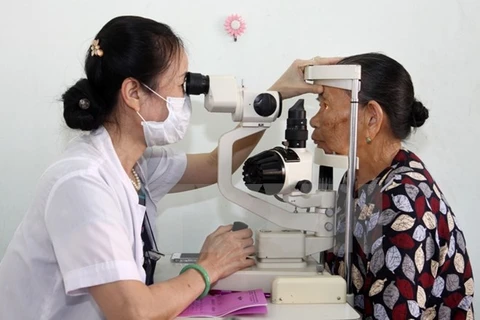
“The disease is caused by excess copper accumulation in the body’s organs with a variety of clinical manifestations, most commonly brain, liver, eye, kidney, joint, and bone damage,” Hoa said, adding that the disease was difficult to detect because it is easily confused with other liver or neurological diseases.
"Wilson’s disease is still quite uncommon, not just for lay people, but also for doctors and nurses in the country. Many patients with this problem are taken to hospitals without diagnosis or diagnoses of hepatitis or epilepsy,” she said.
Hoa said it is estimated that more than 2,000 people in Vietnam have the disease. But the number of patients diagnosed was much less because a large number of people with Wilson’s disease have not been diagnosed and treated or are being treated for secondary diseases in other organs like hepatitis, arthritis, nephrotic syndrome or neuropathy, she said.
In the early stages, the symptoms of the disease are often very discreet, such as elevated liver enzymes without clear reasons that are often confused with hepatitis, emotional or movement abnormalities. Such symptoms are often overlooked, but if detected early, will be the most effective treatment for the disease, Hoa said.
In later stages, patients may have symptoms like speech difficulties, languid speech, drooling, while children are distracted, hot-tempered and suffer cognitive decline. At a heavier stage, patients suffer jaundice, dry eyes, fatigue, hard joints, movement like robots and even nosebleeds and vomiting blood. Worse yet, it leads to liver failure where the mortality rate can be as high as 95 percent without a liver transplant, Hoa added.
Hoa said that the biggest concern of many Wilson disease patients was that health insurance only covers medicines for patients under 17, when many patients have to take drugs for the rest of their lives.
"Every day, a patient with Wilson’s disease spends more than 100,000 VND (4.5 USD). Many patients are in a difficult situation, so they want the insurance to cover medicine fees for older people as well,” Hoa said.
The department organised a club for patients with Wilson’s disease more than a year ago. The club has attracted more than 100 members and their families who share experiences and updated knowledge about the disease.
"Our volunteers in this club are all patients with the disease. Many of them have been treated and become stable,” Hoa said.
"There are many children out there, many patients with this disease have been ignored. I hope that more people know about this disease to help early detection and treatment, especially for children,” she said.-VNA
VNA