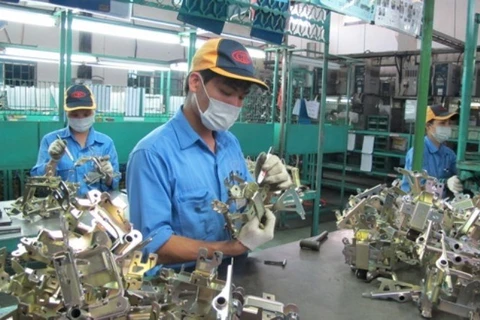
Electronics components are manufactured at 4P Company in Hung Yen province. Slow global growth in 2019 could drag on demand for Vietnam’s electronics exports. (Source: VNA)
Hanoi (VNS/VNA) - Slowing global demand will have adverse impacts on Vietnam’s manufacturing growth in the remaining months of the year, experts forecast.
Reports from the General Statistics Office (GSO) showed the growth rate of the processing and manufacturing sector slowed to 11.18 percent in the first half of the year, from the 12.7 percent in H1 2018.
Analysts from Fitch Solutions forecast the slowdown would continue in the second half of the year due to easing external demand.
“We maintain our view that slowing external demand on the back of slowing global growth will weigh on Viet Nam’s industrial activity, particularly for the manufacturing sector, over the remainder of 2019, although we still expect manufacturing to be the largest contributor to growth,” the analysts told Vietnam News.
According to Fitch, global growth is expected to slow to 2.9 percent in 2019, from 3.2 percent in 2018, which would drag on demand for Vietnam’s electronics exports. The products currently account for 40 percent of the country’s total exports.
In fact, a cutback in gross fixed capital formation (GFCF) in economies downstream in the global electronics supply chain has been seen. For example, facility investment in the Republic of Korea fell by 16.1 percent year-on-year in the first quarter of 2019, which suggests a pessimistic business outlook among RoK businesses. Additionally, fixed capital formation in India slowed to 3.6 percent year-on-year in the quarter ending March 2019, from 11.7 percent year-on-year in the December 2018 quarter.
“Given Vietnam’s position upstream in the global electronics supply chain, we believe that this trend bodes poorly for Vietnam’s export growth outlook over the near term,” Fitch analysts said, adding slowing eurozone growth, forecast to come in at 1.6 percent in 2019 from 2.1 percent in 2018, would also weigh on demand for Vietnam’s exports to the EU, which constitute 17 percent of the country’s total exports.
GSO Director General Nguyen Bich Lam told a conference last week that export turnover of some key export staples has been under downtrend and could not maintain the growth momentum in the second half of this year.
Lam was concerned that in the second half of 2019, it would be difficult for the processing and manufacturing industry to retain the growth rate as in the same period last year.
Experts said easing external demand, together with unfavourable base effects over the remainder of 2019, would weigh on Vietnam’s growth, particularly in the final quarter. Fitch forecast Vietnam’s real GDP growth to come in at 6.5 percent this year, down from 7.1 percent in 2018.
Positive signs
Despite some drag from manufacturing, experts also pointed out construction and services growth should remain resilient and provide some support to Vietnam’s overall growth.
“Strong foreign direct investment (FDI) in real estate businesses over 2018 as well as over the first five months of 2019 inform our view for construction activity to remain robust over the coming quarters,” Fitch analysts said.
Fitch also expects the country’s services sector to receive support from an improvement in the labour market and strong foreign investment.
The GSO’s labour market data showed a decline in youth (15-24 years old) urban unemployment to 9.8 percent in the second quarter of 2019 from 10.6 percent in the previous quarter, despite overall urban unemployment remaining stable at 3.1 percent. Over the same period, urban underemployment rose to 0.95 percent from 0.60 percent.
These figures suggest insufficient job creation in areas which urban youths are skilled in, and this is prompting these individuals to seek out employment which does not adequately leverage their skillsets.
However, experts forecast this trend would likely be temporary as an improvement in the overall economic outlook on the back of the shift of business operations from China to Vietnam and a better export outlook supported by the EU-Vietnam Free Trade Agreement and Vietnam’s ratification of the Comprehensive and Progressive Agreement for Trans-Pacific Partnership, amongst others, should provide strong tailwinds for job creation which cater better to the capabilities of the workforce. A stronger labour market outlook should bolster incomes and consequently retail services.
Additionally, overall FDI in Vietnam continues to be robust and this should also support services activities, especially in warehousing, transport, finance and real estate, over the coming months.
As the positive impacts are expected to mainly show in Vietnam’s 2020 growth prints, Fitch revised up its 2020 growth forecast for Vietnam to 6.8 percent from 6.5 percent previously. – VNS/VNA