English to be second university language in Vietnam

English to besecond university language in Vietnam

The Ministry of Education and Planning has set itself an ambitious goal of making English the second language at universities across Vietnam.
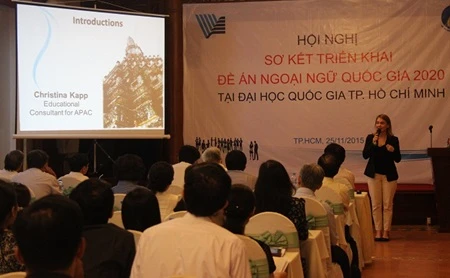
English to besecond university language in Vietnam ảnh 1Illustrative image (Photo:VNA)

HCM City (VNA) – The Ministry of Education and Planning has set itself an ambitious goal of making English the second language at universities across Vietnam.

Minister of Education and Training Phung Xuan Nha had said earlier this month that the ministry has created a roadmap to achieve the goal starting this academic year, and urged universities to improve their English teaching methods.

He asked universities to apply the latest technologies in teaching English, teach students about the importance of globalisation and expand international links to promote the use of the language.

He said students would be required to make all presentations and hold all discussions in English, while the staff would speak English at their meetings.

The ministry has given specific instructions to the 61 universities and academies it runs to take the initiative to draw up teaching standards that match ASEAN standards.

They would then be published to solicit public opinion before the ministry tweaks its education and training plans, he said.

Other universities needed to review and report the challenges they face in making English the second language and suggest solutions, he said.

The ministry said it would assist pedagogy universities in training capable English teachers through new programmes that focus on training in remote areas like the north-western, Central Highlands and south-western regions.

Nha said it would also improve the curriculum, materials, textbooks and testing.

Foreign language plan

At the beginning of this year the ministry announced that English would be a compulsory subject from grade three onwards starting in 2018 as part of its foreign language teaching plan.

English is currently only mandatory from grade 10 onwards.

Under the plan, from 2018 students in grade three and above will have four English lessons a week.

English is now only an optional subject in primary schools, with one or two lessons a week.

The ministry reported that around one 10th of primary school students do not learn English since the country has a shortage of some 7,700 teachers.

Besides, only a third of English teachers at primary and high schools meet teaching standards, according to the ministry.

In the recent national high school graduation exams, students fared worst in English out of the eight compulsory subjects, with an overwhelming number scoring 2-3.5 out of 10.

The public was shocked when the results were announced, but both the students and teachers admitted they reflect the candidates’ true ability.

Prof Tran Xuan Nhi, a former deputy education minister, said children should study English in kindergarten, adding that they are capable of learning new languages at a very early age.

Experts said that since Vietnam aims to compete in the global marketplace through the recently launched ASEAN Economic Community, improving its level of English is crucial.

Vietnam ranks 29th on the Education First’s English Proficiency Index, and fifth among Southeast Asian countries.

According to the ministry, a second language refers to one that is used in daily life and learnt by students without the need for lessons, while a foreign language is learnt in school but rarely used in daily life.

In Vietnam, English is becoming more and more common, especially in big cities like HCM City and Hanoi and tourists destinations.-VNA

VNA

See more

Representatives of police forces from seven southern provinces and cities sign a coordination agreement at the conference. (Photo: VNA)

Police boost inter-provincial coordination to curb IUU fishing

Police forces from Lam Dong, Ca Mau, An Giang, Can Tho, Vinh Long, Dong Thap, and Ho Chi Minh City held a joint review on January 12 in Xuan Huong - Da Lat ward, Lam Dong province, strengthening efforts to combat organisations and individuals arranging or brokering illegal border crossings for illegal fishing overseas.

Police of Lam Dong province have worked around the clock to complete the Quang Trung Campaign. (Photo published by VNA)

Lam Dong police complete Quang Trung Campaign six days ahead of schedule

Under the campaign, the force was tasked with building 27 of the 41 houses requiring reconstruction across the province, accounting for nearly 66% of the total. All 27 houses were completed, and by January 9, they had been fully handed over for use, earlier than the January 15 deadline.

More trains added to serve Lunar New Year demand. (Illustrative photo: VNA)

More trains added to serve Lunar New Year demand

The railway sector will add more Thong Nhat (reunification) trains and regional services to meet the sharply rising travel demand of people and tourists during the 2026 Lunar New Year (Tet), Vietnam’s largest traditional festival.

The “Not Alone” campaign is rolled out widely across social media platforms nationwide. (Photo: VNA)

"Not Alone" Campaign: Over 8 million students, teachers, parents equipped with online safety skills

Implemented from October 6 to November 30, 2025, the campaign’s achievements were also reflected in its impressive outreach. On social media platforms, “Not Alone” generated more than 1.5 billion views and reached over 40 million people, with the participation of more than 1,000 key opinion leaders. Millions of creative contents using hashtags such as #khongmotminh and #NiemTinSo attracted strong community engagement.

The Vietnam Exposition Centre (VEC) in Dong Anh district, Hanoi (Photo: VNA)

Spring flower fair to open in February

The fair will feature flowers, ornamental plants, bonsai, orchids, peach and apricot blossoms, kumquat trees, along with Tet decorations such as lanterns, folk paintings, ceramics, handicrafts and feng shui items.

Elderly people take part in activities at a daytime care centre for senior citizens. (Photo: VNA)

Making breakthroughs via policies for older persons

The Politburo’s Resolution No. 72-NQ/TW on groundbreaking solutions to strengthen the protection, care and improvement of public health sets the target of raising average life expectancy to 75.5 years by 2030, with at least 68 years lived in good health.

One of the first-prize winning entries in the “Social housing prototype design ideas – Towards sustainable solutions” contest. (Photo courtesy of the organising board)

Highly applicable social housing design ideas honoured

According to the organising board, the award-winning entries will provide an important foundation for the Ministry of Construction to continue research and develop prototype and typical designs for broad use in localities.