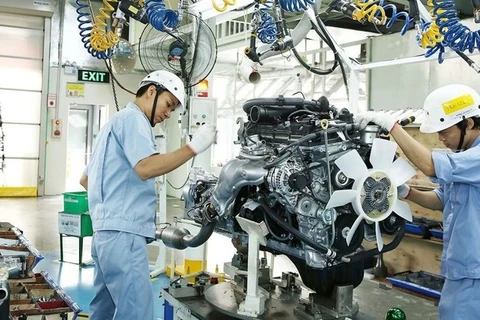
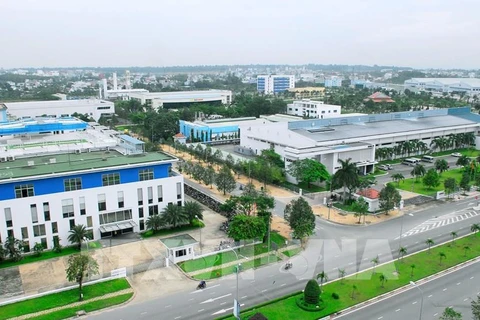
Workers manufacture mechanical gear at Japanese-invested RK Engineering Co in Dinh Vu Industrial Zone in the northern port city of Hai Phong (Photo: VNA)
 This is one of the contents of a survey conducted by the General Statistics Office, which has just been announced in the Publication of the 2021 Economic Census.
Accordingly, by type of enterprise, the non-State enterprise sector concentrated the most enterprises and employees as of December 31, 2020, with 660,100 enterprises, accounting for 96.4% of the total number of enterprises nationwide.
The sector attracted 8.6 million employees, accounting for 58.6% of the total number of employees.
The FDI enterprise sector has the fastest growth rate in the number of enterprises among the three industries. It accounts for an increasingly large share of the total number of jobs created in the enterprise sector.
The number of FDI enterprises is 22,200 enterprises, accounting for 3.3% of the total number of enterprises. It attracted 5.1 million employees, accounting for 34.6%.
Due to the State's policy of equitisation and rearrangement, the State-owned enterprise sector continuously decreased during this period, the total number of State-owned enterprises was only 1,963 enterprises as of December 31, 2020, accounting for 0.3% of the total number of enterprises, a decrease of 26.3% compared to 2016.
The enterprises attracted 1 million employees, accounting for 6.8% of the labour of the entire enterprise sector.
The General Statistics Office pointed out that non-State enterprises have the same average labour size as small enterprises in terms of employees. In contrast, State enterprises and FDI enterprises have the same average labour size as large businesses.
In terms of the economic region, the number of businesses and workers is increasing in the Red River Delta and the Southeast region, where the two largest economic centres in the country are located, HCM City and Hanoi.
The Southeast region and the Red River Delta region clearly show their role as the two largest economic centres in the country, always leading in the number of enterprises and employees.
Accordingly, the Southeast region is the economic locomotive. This region has the most significant number of enterprises in the country, with 281,100 enterprises as of December 31, 2020, accounting for 41.1% of the total number of enterprises in the country.
The region attracts 5.4 million employees, accounting for 36.6% of the total number of employees working in the enterprise.
The Red River Delta region is the second largest economic centre in the country with 216,800 enterprises, accounting for 31.7% of the total number of enterprises in the country, attracting 4.9 million employees, accounting for 33.2%.
Along with that, domestic and foreign investment capital into enterprises maintained a fast growth rate over the years, and the scale of enterprises was expanded mainly based on the development of capital factors instead of labour factors.
The source of capital attracted to enterprises has grown rapidly over the years, with the total capital used for production and business of the entire enterprise as of December 31, 2020, reaching VNĐ48.7 quadrillion (US$2 trillion), a year-on-year growth of 12.3%.
In the 2016-20 period, the attracted capital reached an average of 38.4 quadrillion VND per year on average, with the average growth rate reaching 14.8% per year, an increase of 104.1% compared to the 2011-2015 period.
The growth rate of capital is always higher than the growth rate of the number of employees, showing that the average labour size of enterprises tends to shrink, but the average size of the capital of enterprises tends to expand.
"This reflects businesses that expand their scale mainly based on capital growth instead of labour growth; at the same time, it shows that Vietnam is a potential market to attract investment capital, which is a premise to promote resources for in-depth economic growth", said General Director of General Statistics Office Nguyen Thi Huong.
In addition, the capital structure among different types of enterprises changes in the direction of gradually increasing the proportion of capital sources of non-State enterprises and FDI enterprises and progressively reducing the proportion of capital sources of State enterprises. Non-State enterprises attract the most capital sources.
The leader of the General Statistics Office said that the Prime Minister carried out the economic census according to Decision No 307/QĐ-TTg dated February 27, 2020.
This is one of three censuses conducted by the statistics authorities to help the Party and State get an overall economic picture of the country; serving the strategic consulting work of ministries, branches and localities; and grasping the current situation of the economy, and of each industry and locality in particular./.
VNA