Ethnic schools seek alternatives as new programme offers limited language course options

While the new general education programme has ethnic languages as elective courses, the limited options on offer mean that schools are struggling to decide on alternatives for students whose mother tongue is not included.
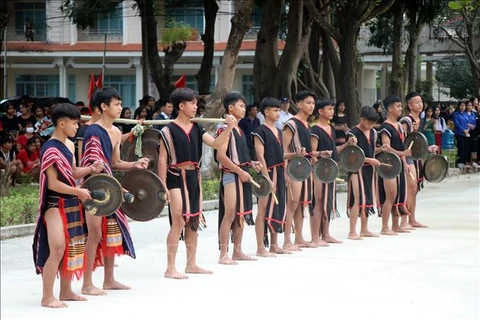
Ethnic schools seek alternatives as new programme offers limited language course options ảnh 1A Mong ethnic student in Nghe An province learns how to write in his mother tongue. (Photo: giaoducthoidai.vn)
Nghe An (VNS/VNA) - While the new general education programme hasethnic languages as elective courses, the limited options on offer mean thatschools are struggling to decide on alternatives for students whose mother tongueis not included.

The Nhon Mai Semi-boarding School for Ethnic Minorities is located in one ofthe most remote communes in Tuong Duong district, central Nghe An province.

Most of the school students are of Mong ethnicity, followed by Kho Mu and Thai.

In accordance with the optional subjects in the new general educationprogramme, Mong and Thai students can sign up to learn their ethnic languages.

However, the case is not the same for Kho Mu students, even though theyoutnumbered the group of Thai students at the school.

As the optional subject of Ethnic Language only offers Bahnar, Cham, Ede,Khmer, Jrai, Mnong, Mong and Thai languages, Kho Mu students have no textbookor teacher to learn theirs.

Tran Duc Quy, the school’s deputy dean said: “They are still very young, sothey are not fully aware of the importance of language and writing in theirethnic cultural identity.

“Therefore, the enrolment for ethnic language courses depends on theattentiveness and encouragement from the teachers.

“However, from the viewpoint of parents and people, if we only have Thai and Monglanguage classes and none for Kho Mu, there will be comparisons and concerns.”

Vo Tuyet Chinh, deputy head of Tuong Duong district’s education and trainingdivision, said that the locality is the largest mountainous area in Nghe An province,and is home to multiple ethnicities.

“Teaching ethnic languages is a way to preserve and promote the ethnic identityfor students. This is also a mission of education in the mountainousareas," said Chinh as quoted by the Giao duc & Thoi dai (Education& Times) e-newspaper.

“However, the implementation process faces multiple challenges, includingteaching materials and personnel.

“We hope a detailed guideline will soon be issued before we get to work.”

Meanwhile, the Thong Thu 1 Primary School in Que Phong district is stillweighing the optimal solution regarding language teaching.

Tang Xuan Son, the school’s dean said that the majority of the students hereare of Thai ethnicity, and they all use their mother tongue in their community.

However, the primary school does not yet teach them how to read and write Thai,as the local dialect has certain differences compared to the teaching materialsavailable.

Therefore, the school is considering using the two weekly elective periods forEnglish or supplemental Vietnamese classes.

This would help them with communication and a better understanding of thetextbooks in the new education programme.

In Ky Son district, the Dooc May Primary School has been holding Mong languageclasses for several years.

All of its pupils are of Mong ethnicity, and therefore are excited to learn toread and write in their mother tongue, said the school’s dean Tran Huu Truong.

With his years of experience in the local education sector, Truong agreed thatteaching ethnic languages is very difficult in schools whose students are ofvarious ethnicities, instead of just one like Dooc Mạy commune.

He also shares the perspective that in these schools, students can utilise thetwo elective periods for English, if there are enough teachers, or foradditional Vietnamese lessons.

Truong explained that ethnic primary schoolchildren tend to have difficulty inunderstanding the national language, and therefore take more time to learncompared to those who have the official language as their mother tongue.

These could also be beneficial for younger students when they go to the thirdgrade and foreign language is a compulsory subject.

Thai Binh Duong, who is in charge of ethnic minority affairs at the Nghe AnProvincial Department of Education and Training, said that based on theregistrations submitted by local schools, the department will help organiseethnic language classes when there is sufficient teaching materials andteachers in charge.

They are also working on an alternative option for students whose ethniclanguage is not among those included in elective courses in the new generaleducation programme to ensure the children’s benefits./.
VNA
See more

A young volunteer donates blood during the 2026 Red Sunday programme. (Photo: VNA)

Nearly 5,000 people join blood donation campaign in Ho Chi Minh City

According to health authorities, Vietnam collected nearly 1.75 million units of blood in 2025, with 98% from volunteer donors, equivalent to around 1.75% of the population participating in blood donation. Large-scale campaigns such as Red Sunday have played a key role in achieving these results.

More than 30 kilogrammes of various drugs trafficked from Cambodia to HCM City were seized in a police operation in March 2025. (Photo: VNA)

Ho Chi Minh City aims to become drug free by 2030

Every commune, ward or residential area in Ho Chi Minh City is expected to meet official drug-free standards by the end of 2029, while schools, hospitals, government offices, businesses and social organisations across the city are to remain free of drug activity.

Military forces take a resident from a flooded area. Photo: VNA

Da Nang, Oxfam join hands to support flood victims

In the coming time, the Da Nang Red Cross Society will continue to coordinate with Oxfam to implement support activities in Nong Son commune, helping residents overcome difficulties and stabilise their livelihoods.

Training on response to reservoir incidents (Photo: VNA)

Central Civil Defence Fund established to bolster disaster response

The Central Civil Defence Fund is authorised to receive, manage and use voluntary contributions from domestic and foreign entities and individuals, plus transfers from provincial civil defence funds in line with the PM’s decisions and allocations from relevant state financial sources outside the state budget, all earmarked for incident and disaster response and recovery efforts.

Vietnamese women shine in the traditional Ao dai (Photo: VNA)

March shines with elegance of “Ao dai”

In early March, scenes of women in flowing Ao dai taking spring photos by lakes, parks, offices, temples and historical sites have become a familiar sight on the streets of Hanoi. Social media is also filled with images and stories surrounding the elegant attire, which has become a symbolic signal of the season dedicated to honouring women.

Hanoi voters learn about candidates’ biographies and action programmes. (Photo: VNA)

Hanoi thoroughly prepares for NA, People’s Council election

According to the municipal Election Committee, the capital city has established election committees in 126 communes and wards. In addition, 11 electoral boards for National Assembly deputies, 31 electoral boards for the city-level People’s Council, 831 commune-level electoral boards and more than 4,000 polling teams have been set up to serve the election process.

Artisan Vu Van Vinh from Chuyen My commune introduces to visitors a set of mother of pearl inlaid lacquer furniture including a platform bed, tea cabinet, and lacquered horizontal boards and parallel sentences made by his family, worth more than 3 billion VND. (Photo: VNA)

Four Hanoi craft villages join global creative crafts network

The recognition is not only a source of pride for the capital but also creates opportunities to promote these craft villages globally, strengthen international connections, and support their sustainable development in the process of global integration.

Vietnamese women affirm growing role in national economy

Vietnamese women affirm growing role in national economy

Vietnamese women have long been an indispensable force in the country’s socio-economic development. Today, they are present across a wide spectrum of economic activities, from production, trade and small-scale services to innovative start-ups, collective economic development, the digital economy, green growth, the circular economy and financial inclusion.

Voters study information of candidates to the 16th National Assembly and People’s Councils at all levels in the 2026-2031 tenure. (Photo published by VNA)

K’Ho ethnic minority group in Lam Dong province looks forward to Election Day

Lac Duong commune is a remote locality largely inhabited by the K’Ho ethnic minority in Lam Dong. The commune has 15 villages with more than 14,000 residents in 3,119 households and 8,799 registered voters. Given that residents live scattered along National Highway 27C and that the area’s mountainous terrain makes travel difficult, local authorities have prepared plans to organise the election smoothly.

Officers of the Vietnam Coast Guard Region 2 Command step up communications efforts to encourage fishermen to comply with anti-IUU fishing regulations. (Photo: VNA)

Vietnam Coast Guard Region 2 intensifies efforts to help remove IUU fishing “yellow card”

According to Colonel Truong Ba Long, Deputy Commander and Chief of Staff of the Vietnam Coast Guard Region 2 Command, the close integration of efforts to combat IUU fishing with routine patrol and control activities to safeguard maritime sovereignty, prevent smuggling and trade fraud, fight drug-related crimes, and conduct search and rescue operations constitutes a regular task of the unit.