European firms in Vietnam more positive about Q3 performance

Leaders of European businesses in Vietnam were more positive about their firms’ performance in the third quarter of 2020, according to the Q3 Business Climate Index (BCI) released by the European Chamber of Commerce (EuroCham).
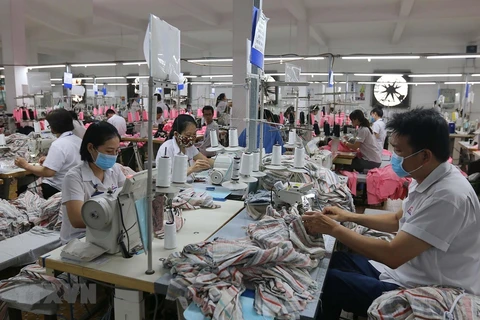
European firms in Vietnam more positive about Q3 performance ảnh 1Workers make garment at a factory in Vietnam (Illustrative photo: VNA)

HCM City (VNA) –Leaders of European businesses in Vietnam were more positive about their firms’performance in the third quarter of 2020, according to the Q3 Business ClimateIndex (BCI) released by the European Chamber of Commerce (EuroCham).

The index, conducted by YouGov Vietnam,rebounded in Q3, jumping 24 points to reach 57.5 – the highest score since theoutbreak of the global COVID-19 pandemic.

In Q1, when COVID-19 first hit internationaltrade and investment, the BCI fell to 26 points. It saw a slight increase in Q2as Vietnam became one of the global success stories of the pandemic. 

Now, with businesses able to operate with farfewer restrictions and the EU-Vietnam Free Trade Agreement (EVFTA) enteringinto force on August 1, the confidence of European business leaders has seen astrong resurgence, according to EuroCham.

Business leaders were more positive about theirown enterprise in Q3, with 40 percent describing their performance as either“Excellent” or “Good” – more than double the 18 percent recorded in theprevious three-month period. 

EuroCham said Q4 looks to be even morepromising, with 44 percent predicting a strong end to 2020. Meanwhile, most companiesare anticipating stabilisation in their headcount (65 percent) and investmentplans (57 percent), with just under half (44 percent) expecting to see anincrease in their revenue and orders.

With the EVFTA entering into force in Q3, theBCI also asked EuroCham members about its impact on their business andinvestment plans. One-third said that the agreement was an important part oftheir decision to invest in Vietnam, with the top two factors predicted todrive growth being tariff reductions and greater market access for investors.
   
Chairman of EuroCham Nicolas Audier said: “Despitea difficult 2020 for international trade, our data shows that Vietnam’s swiftand effective response to the global pandemic has paid dividends. Europeanbusiness leaders feel more positive both about their own enterprises andVietnam’s trade and investment environment, and report a sense of cautiousoptimism going into Quarter Four.”

“The implementation of the EU-Vietnam Free TradeAgreement in August has, no doubt, helped to boost this growing confidence. Ourdata shows that falling tariffs and growing market access are important to ourmembers, and will help to spur new foreign-direct investment from the EU in thefuture,” he added.

The BCI is a regular barometer of EuroChammembers and their perceptions of the trade and investment environment. Eachquarter, it tracks the performance of EuroCham’s member companies and theirperceptions of the economic outlook in Vietnam./.
VNA

See more

Tran Ngoc Quan, Trade Counsellor and head of the Vietnam Trade Office in Belgium and the EU (Photo: VNA)

Belgian firms suggested to expand presence in Vietnamese market

Entering 2026 – the first year of implementing the Vietnam – EU Comprehensive Strategic Partnership, the Vietnam Trade Office in Belgium and the EU views this as a pivotal time to inject new momentum into trade ties, said Trade Counsellor Tran Ngoc Quan.

Saigon Marina IFC, an emerging landmark, reflects Ho Chi Minh City’s pioneering spirit.

Saigon Marina IFC – The light of Ho Chi Minh City’s new icon

Saigon Marina IFC, an emerging landmark, reflects Ho Chi Minh City’s pioneering spirit. Designed to become an International Financial Centre, this new architectural icon along the Saigon River is envisioned not only as a premium commercial complex, but as a central platform supporting financial institutions, international investors and cross-border capital flows in the years ahead.

Shoppers at a supermarket in Hung Yen (Photo: VNA)

Retailers see tax compliance, AI as key to survival in 2026 survey

The annual survey, conducted at the end of 2025 among retail and food and beverage (F&B) sellers nationwide, found that businesses are shifting their focus from rapid growth to operational efficiency, cost control and legal compliance amid increasingly stringent regulatory standards.

Visitors shop at Glorious Spring Fair 2026 (Photo: VNA)

Spring Fair 2026 opens broader prospects for Vietnam–UAE trade cooperation

For Vietnam, the UAE serves not only as a consumer market but also as a gateway to the Middle East and North Africa. Vietnamese agricultural products such as cashew nuts, pepper, cinnamon and rice have steadily gained market share, while aquatic products, including tra fish and tuna, are increasingly present in the UAE’s hospitality sector.

Bao Viet Bank's employee counts Vietnamese banknotes at a transaction counter in Hanoi. (Photo: VNA)

Credit quota reform, tighter capital rules may widen gap among banks

Yuanta Vietnam Securities estimates that to achieve GDP growth above 10%, credit growth would need to exceed 16%. This suggests bank credit is no longer expected to be the main growth driver, with greater reliance on fiscal policy, public investment and capital markets.

Commercial Counsellor Do Viet Phuong, Head of the Vietnam Trade Office in Cambodia. (Photo: VNA)

Spring Fair 2026 offers ample room to deepen Vietnam–Cambodia trade ties

Cambodia holds substantial potential for cooperation in agro-processing and exports, especially in key products such as rice, cashew nuts and rubber. In recent years, the country’s cultivation area and agricultural output have grown steadily, providing a stable raw material base for processing industries.

Vietnam is projected to have approximately 2.4 million SMEs, accounting for over 98% of the country’s total enterprises. (Photo: cafef.vn)

Banks offer diverse solutions to support SMEs

With an increasingly significant role in the economy, the small and medium-sized enterprise (SME) sector is becoming a key segment in the credit growth strategies of many banks and the banks have been taking diverse solutions to support the enterprises.