Experts call for more support to mechanical engineering industry

The fourth Industrial Revolution’s technologies help improve manufacturing efficiency and competitiveness, but not many firms, with their limited resources, can afford them, experts have said.
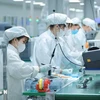
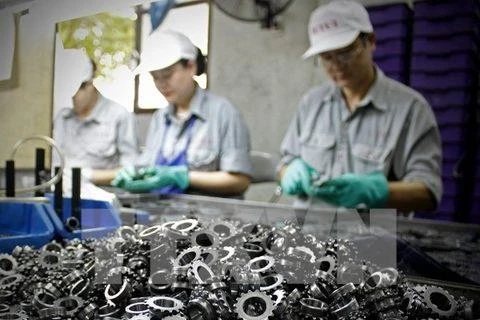
Experts call for more support to mechanical engineering industry ảnh 1At a mechanical production factory (Illustrative image. Source: thegioihoinhap.vn)

HCM City (VNS/VNA) -
The fourth Industrial Revolution’s technologies helpimprove manufacturing efficiency and competitiveness, but not many firms, withtheir limited resources, can afford them, experts have said.

Do PhuocTong, Chairman of the HCM City Association of Mechanical – ElectricalEnterprises (HAMEE), said: “New machinery and technologies today arealways integrated solutions that enable managers to know the current status ofthe manufacturing process, how the machine is operating and in what mode, andso on. This helps boost efficiency and reduce errors in the productionprocess.”

Hetold Vietnam News: “Investing in the fourth Industrial Revolution’stechnology requires a large amount of money. Many Vietnamese firms in the mechanicalengineering sector want to invest in new technologies but their limitedresources prevent them.”

Manybusinesses also have difficulty in finding human resources who understand andcould use new technologies, according to Tong.

Manyforeign companies have shifted their production to Vietnam, and a number oflocal and foreign companies have expanded production, increasing demand forhuman resources.

“But thehuman resources in society cannot be suddenly increased. So training andretaining human resources is currently a very tough problem for businesses inthe mechanical engineering industry.”

Pham XuanDa, head of the Ministry of Science and Technology’s southern affairs, saidmanufacturing was the backbone of the economy.

“Thoughthe [Government’s] preferential and support policies have not met theexpectations of the mechanical engineering industry, it has achieved remarkableresults such as expanding rapidly in terms of numbers from around 10,000 in2010 to more than 21,000 enterprises in 2016, and increasing exports to over 16billion USD.”

“Localenterprises can make some products that we previously had to import. Productionlines in factories are synchronised, and enterprises have developed a number oftechnologies.”

Localfirms also successfully developed many kinds of machinery, equipment andproduction lines for the agricultural sector, including for animal feedproduction and cassava starch processing, he said.

But theindustry faced many shortcomings, including low competitiveness, shortage ofraw material supply and qualified human resources and lack of linkages betweencompanies, he said.

Accordingto experts, in the context of integration and the fourth industrial revolution,new requirements have emerged for the mechanical industry, requiring them tomake more efforts to improve their competitiveness and they need supportivepolicies from the Government.

Tong said:“There is no policy to support enterprises investing in reforming theirmanagement system.

“For along time the Government has had policies to support enterprises investing inupgrading machinery and equipment to improve production capacity.”

"Butif an enterprise has good equipment but not good management, it would be hardto fully exploit the equipment," he explained.

“Therefore,we want the Government to offer enterprises stronger support in the area ofmanagement.”

He saidrelevant agencies should do research to come up with solutions to help firmsinstall a management system at reasonable cost or subsidise it.

Havingadvanced management systems comparable with international standards would helpimprove the competitiveness of Vietnamese firms, he said.

Tong, whois also chairman of Duy Khanh Engineering Co.,Ltd, said his company was lookingfor solutions to enable an administrator to control production capacity andprocesses to optimise the manufacturing process, improve production efficiencyand better meet customer requirements.

It hadworked with a software company to develop a system for controlling thecompany’s activities from operating machines to taking orders, he said.

“This ...is essential for businesses in the mechanical engineering industry. With bettermanagement capacity, enterprises will better meet customers’ demands andcustomers will have more trust in [such] businesses.”/.
VNA
See more

Students practice microcontroller programming at the Viet - Han College of Technology in Bac Ninh province (Photo: VNA)

Vietnam steps up semiconductor talent training to meet market demand

Vietnam needs to step up semiconductor workforce training to meet growing market demand and enhance its capacity to participate in the global technology value chain, experts said, highlighting the importance of closely linking training with businesses, production and technological research.

Vietnam seeks to boost education and technology cooperation with France

Vietnam seeks to boost education and technology cooperation with France

Education and training, science and technology, and high-quality human resources are key areas of cooperation in Vietnam-France relations, said Politburo Member, Secretary of the Communist Party of Vietnam Central Committee, and Chairman of its Commission for Organisation Nguyen Duy Ngoc while visiting the Institut Polytechnique de Paris on September 11.

General Secretary of the Communist Party of Vietnam Central Committee and President To Lam witnesses the exchange of cooperation agreements between the two countries. (Photo: VNA)

Vietnam, France deepen cooperation in science, technology, workforce training

The University of Science and Technology of Hanoi (USTH), under the Vietnam Academy of Science and Technology (VAST), and the French Alternative Energies and Atomic Energy Commission (CEA) exchanged two cooperation agreements in Paris on September 11, in the presence of General Secretary of the Communist Party of Vietnam Central Committee and President To Lam.

A display area for unmanned aerial vehicles (UAVs) at a workshop in Da Nang city on June 12, 2026. (Photo: VNA)

Vietnam eyes UAV industry as key driver of low-altitude economy

For Vietnam, the opportunity presented by unmanned aerial vehicles (UAVs) lies not only in expanding their applications but, more importantly, in gradually building industrial capacity, mastering technologies and engaging more deeply in global value chains.

A semiconductor chip by TSMC (Photo: VCG)

Vietnam seeks deeper integration into global semiconductor value chains

Nguyen Anh Tuan, Director of the National Centre for Pilot Semiconductor Chip Manufacturing Support under the Ministry of Science and Technology, said that amid increasingly intense global technological competition, the semiconductor industry is not only a high-value-added economic sector but also a foundation for technological self-reliance, national security and economic competitiveness.

Demonstration of an autonomous electric street sweeper. (Photo: VNA)

Hanoi approves controlled pilot of two technology projects

The two projects involve an intelligent autonomous transportation system developed by Phenikaa-X JSC and a technology for producing mixed rare-earth oxides with a purity of over 95% on a semi-industrial scale developed by the Mining Technology and Construction Consultancy JSC.

Prof. Dr. Tran Hong Thai, President of the Vietnam Academy of Science and Technology (VAST), has a working session with leaders of Russia’s State Atomic Energy Corporation Rosatom. (Photo: VNA)

Vietnam, Russia develop quantum technology cooperation roadmap

Quantum technology is an emerging field undergoing rapid breakthroughs and requiring enormous investment resources. Learning from the experience of pioneering countries such as Russia will enable Vietnam to significantly shorten the time needed to build its workforce and develop endogenous capabilities.

Senior Vice-President of Latin America and Asia at Thales Group Guy Bonassi (L) at a meeting with Vietnamese Ambassador to France Trinh Duc Hai (Photo published by VNA)

Vietnam, France should expand cooperation in strategic fields: business leader

General Secretary of the Communist Party of Vietnam Central Committee and President To Lam’s visit to France, Guy Bonassi, Senior Vice-President of Latin America and Asia at Thales Group, said the upgrade of bilateral ties to a Comprehensive Strategic Partnership reflects their shared desire to deepen and broaden cooperation, with technological autonomy, resilience and human resources development assuming increasingly important roles.

The Vietnamese delegation led by Deputy Prime Minister Ho Quoc Dung visits the Korea Institute of Science and Technology (KIST). (Photo: VNA)

Vietnam, RoK promote strategic technological cooperation

Deputy Prime Minister Ho Quoc Dung proposed expanding joint research programmes, particularly in strategic areas where Vietnam has development needs, and KIST has strengths, including semiconductor integrated circuits, AI, batteries and energy storage, and biotechnology.

Digital transformation brings economic benefits closer to businesses

Digital transformation brings economic benefits closer to businesses

In addition to streamlining processes and reducing the time required to complete administrative procedures, digital models are creating more opportunities for businesses, household enterprises and small traders to access information, adopt new payment methods, connect with partners and expand their markets.