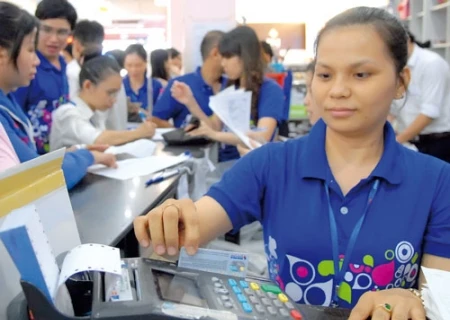
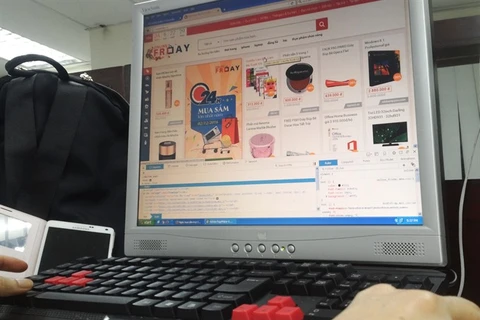
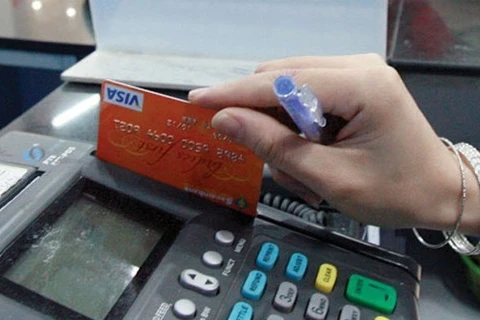
The number of bank cards has increased to around 111 million now, according to a Central Bank report (Photo: baogialai.com)
 Hanoi (VNA) - The Prime Minister recently ratified a project to stimulate non-cash transactions in 2016-20 with a view to reducing the cash transactions rate to under 10 percent.
The project aims to accelerate e-commerce and implement the Master Scheme on E-commerce Development.
All supermarkets and modern distribution centres will take part in e-commerce while 70 percent of water, electricity, telecom payments will be in non-cash mode. Half of all individuals and households will switch to non-cash transactions.
New, modern means of payments will be developed in rural and remote areas, financial inclusion will be targeted and at least 70 percent of people aged over 15 will have bank accounts by 2020.
These targets were outlined based on encouraging achievements in the last six years, which have gradually made non-cash payments a trend in Vietnam.
Cash payments as a ratio of total payments have declined from 14.02 percent in 2010 to 12 percent now.
According to a State Bank of Vietnam report released recently, there are currently around 67.4 million bank accounts compared to 16.8 million in 2010.
Modern infrastructure and technology to facilitate non-cash payments, especially online payments, have developed significantly. The number of bank cards has increased to around 111 million now.
There are around 254,000 points of sales (POS) and 17,380 automatic teller machines (ATMs), up 13.77 percent and 5.39 percent since the end of 2015.
The central bank has also rolled out policies related to modern infrastructure and technology to boost non-cash payments, protect customers’interest and ensure service quality.
It has instructed banks to quickly convert all magnetic cards into chip cards to prevent fraud. It wants all ATM cards to become EMV-standard chip cards by 2020 to reduce the risks involved in e-commerce for both buyers and sellers.
But analysts, while not denying the recent accomplishments, still have doubts about the cash-use target.
They said cash was used in nearly 90 percent of all transactions, and there were only three years left to reduce that to below 10 percent.
The biggest hindrance to achieving the target is the people’s cash habit, with not only individuals but even businesses yet to get used to non-cash transactions.
For instance, the facility to pay taxes online has been in place since 2014 and 95 percent of all enterprises have registered for it, but many do not use it.
Besides, this remains an alien concept to the millions of business households and private individuals.
Although e-commerce has developed rapidly in Vietnam, a majority of buyers still opt for cash on delivery (COD).
According to the Department of E-commerce and Information Technology, many still prefer COD partly due to their habit and partly because they do not fully trust e-commerce websites.
Only around 4.5 million people have applied for e-payment of electricity bills, a mere 18.47 percent of the total number of users in the country, according to the Electricity of Vietnam (EVN) group.
Banking insiders said most supermarkets, commercial centres and other modern retail sites accepted cards.
Meanwhile, by October last year, 90 percent of urban people possessed cards, with the total number of cards reaching 110.8 million.
But the number of users was very modest at just 15 percent .
One of the reasons is that though a huge number of cards have been issued, the location of ATMs is skewed in favour of major cities while 70 percent of the country’s population lives in rural areas.
Another reason is the lack of security, which makes people apprehensive about non-cash payment methods.
A spokesperson for the Commerce Development Research Institute pointed out that the habit of cash payment remains widespread, especially in rural areas.
Besides, the interest rate and fees on credit on credit cards are astronomical, which also makes people reluctant to use them.
To ensure that the PM’s non-cash payment plan can be achieved on schedule, all these problems must be resolved immediately, analysts said.-VNA
VNA