Experts make policy recommendations to foster Agriculture 4.0

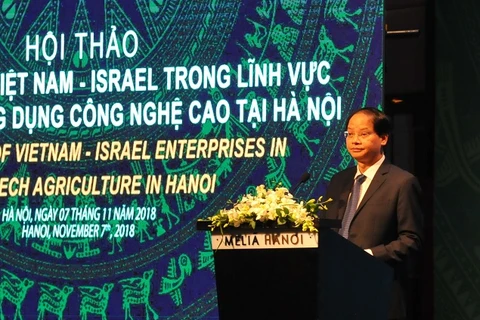
Experts outlined challenges and made policy recommendations to enhance the use of advanced technology in agriculture during a seminar on approaching Agriculture 4.0 held by the Central Institute for Economic Management (CIEM) in Hanoi on November 9.
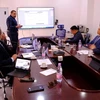
Experts make policy recommendations to foster Agriculture 4.0 ảnh 1Scene at the seminar (Photo: VNA)

Hanoi (VNA) – Expertsoutlined challenges and made policy recommendations to enhance the use ofadvanced technology in agriculture during a seminar on approaching Agriculture4.0 held by the Central Institute for Economic Management (CIEM) in Hanoi onNovember 9.

Addressing the event, CIEMDeputy Director Phan Duc Hieu said that the Fourth Industrial Revolution (Industry4.0) has increased efficiency in agriculture for many countries. In Vietnam,several agribusinesses have applied digital technologies in their productionstages, from seedling and cultivation to harvest and distribution, he said.

Though Industry 4.0 helpsreduce labour intensity and improve productivity for the sector, few companieshave made proper use of the technology, he noted, emphasising the need to formulatepolicies to foster better high-tech approaches amongst agribusinesses.

Nguyen Thi Luyen, head of theCIEM’s Department of Economic Institution, mentioned the significance ofagriculture in the country’s economic growth, saying the sector has enjoyed an increasingtrade surplus, which has exceeded 8 billion USD so far this year, not tomention providing 40 percent of the nation’s total employment.

Vietnam will see strongerwaves of technological innovation in agriculture as it works towards further internationalintegration and trade liberalisation, yet competition will also become stiffer,Luyen noted.

To satisfy the growing demandof consumers, companies should be striving to apply the latest Industry 4.0 advancements,like smart agriculture sensors, Internet of Things, drones, farming robots, orsmart financial management in farms, she suggested.

She moved on to cite Israel’sexperience in taking advantage of the Fourth Industrial Revolution. ThoughIsrael is a small country, lacking labourers in its farming sector, and has sufferedchronic water shortages for years (with two-thirds of its total area as arid orsemi-arid land), it is one of the world’s leaders in agriculture. Israeliagriculture has been built on technological innovation and advancement, ratherthan competitive edges in natural conditions. There are firms providingcomprehensive technological solutions for precision agriculture, so all farmsand net houses in Israel are installed with a digital control system, usingsensors and automated technologies.

In Vietnam, some firms,cooperatives and farmers have started using smart technologies in farming inrecent years. For example, VIFARM JSC based in Ba Ria-Vung Tau has developed acomputer-operated hydroponic system for growing vegetables, while Cau Dat Farmhas invested in an automated agricultural production from farm to fork, shenoted.

However, the number of suchcompanies is relatively small and more advanced technologies have been appliedonly in a few stages of production, she added.

There is plenty of room foragriculture to expand in Vietnam, but if the sector cannot seize opportunitiesfrom Industry 4.0 wave to increase productivity and product quality, it will beleft behind, Assoc. Prof., PhD. Dinh Dung Sy from the Government Office said.

Sy further noted thatagricultural investment towards sustainability should be a focus of thecountry’s socio-economic development in the next decade. It is vital to connectagribusinesses, investors, and farmers and, at the same time, extend land usepermits and facilitate the more flexible conversion of farming land that allowsshifts from growing rice to other crops, aquaculture, or animal husbandry thathave higher added value, he recommended.

The Government should alsoencourage the establishment of agribusinesses, he added.

CIEM’s Hieu highlighted theimportance of selecting appropriate technology in agriculture and developingsignature farming products for each province and region that fit market needs.Furthermore, the Government must adopt business-centred policies that supportthe transfer of agricultural technology and the formation of a sustainablefarming supply chain, he said. –VNA 
VNA
See more

The Quang Tri coastal road project, spanning nearly 55km, is among key projects with regional connectivity that play an important role in promoting socio-economic development in the central province of Quang Tri. The project is expected to be completed by the end of 2026.(Photo: VNA)

Public investment disbursement slow despite record capital scale

As of February 28, total disbursed capital reached 55.74 trillion VND, equivalent to 5.6% of the plan assigned by the Prime Minister. Of the figure, disbursement of the central budget was estimated at 10.18 trillion VND, or 2.9% of the plan, while that of local budgets totalled 45.56 trillion VND, reaching 7% of the target.

Delegates taste UK food (Photo: VNA)

Taste of UK week promotes British foods in Vietnam

The “Taste of the UK” food week, held for the first time in Ho Chi Minh City from February 26 to March 11, is an opportunity to promote British food products and strengthen their presence in Vietnam, while giving local consumers a chance to experience the diversity of UK cuisine.

A customer purchases E5RON92 bioethanol fuel at a PVOIL gas station on Thai Thinh street, Hanoi (Photo: VNA)

Retail fuel prices rise sharply in March 5 adjustment

According to the Ministry of Industry and Trade, the global fuel market during the latest price adjustment period from February 26 to March 4, 2026 was influenced by several major factors, including the escalating military conflict between the US – Israel coalition and Iran.

Workers at a textile factory in Hanoi (Photo: VNA)

Supporting industries seek fresh growth momentum

Against a backdrop of global uncertainty and supply chain restructuring, the Government has introduced a range of measures aimed at injecting new momentum into domestic manufacturing. New provisions covering workforce training, testing and certification, trade promotion and technology upgrades have been implemented.

Workers package fruits at the factory of Vina T&T Group (Photo: nhandan.vn)

Vietnamese exporters adapt to escalating Middle East conflict

The Ministry of Industry and Trade’s Export-Import Department forecasts upward pressure on global prices for consumer goods, fuel, and crude oil in the coming time. Such hikes could exert indirect but broad negative effects on Vietnam’s overall production and trade, with particular exposure in exports destined for the Middle East.

The MoIT will closely monitor global oil prices, output, inventories and trade flows to adjust imports and domestic supply accordingly. - Illustrative image (Photo: VNA)

Vietnam triggers fuel contingency plan over Middle East crisis

The Ministry of Industry and Trade will closely monitor global oil prices, output, inventories and trade flows to adjust imports and domestic supply accordingly. It will also intensify oversight of key traders’ compliance with their 2026 minimum reserve obligations.

Workers process tra fish for export. (Photo: VNA)

Agro-forestry-fishery exports up over 17% in first two months

Of the total export value in the January–February period, agricultural products accounted for 6.09 billion USD, up 17.1% year-on-year. Seafood exports reached 1.76 billion USD, marking a sharp increase of 23.3%, while forestry products brought in 2.82 billion USD, up 7.4%.

Many private businesses are investing in the service and real estate sectors in Da Nang. (Photo: VNA)

Da Nang augments efforts to attract high-quality investments

Da Nang has consistently implemented business support policies and a selective investment attraction strategy, prioritising high technology, smart city building and sustainable development, thereby strengthening investor confidence and enhancing the city’s competitiveness in the new development phase.

Export activities at the Cai Mep - Thi Vai port cluster (Photo: VNA)

Southern region opens wide to new wave of US investment

Since 2025, US enterprises have increasingly explored investment opportunities across provinces in the Southern Key Economic Region. Ho Chi Minh City has emerged as a leading destination, highlighted by multiple cooperation agreements concluded in late 2025.

Visitors explore Vietnamese furniture products at HawaExpo 2026. (Photo: VNA)

Ho Chi Minh City’s HawaExpo 2026 triples in scale

Held under the theme “Gateway to Vietnam Furniture Prowess” and featuring more than 2,500 booths, the four-day event is expected to serve as a gateway to exploring the genuine capabilities of Vietnam’s wood and furniture industry, as well as a strategic trading hub for international markets.