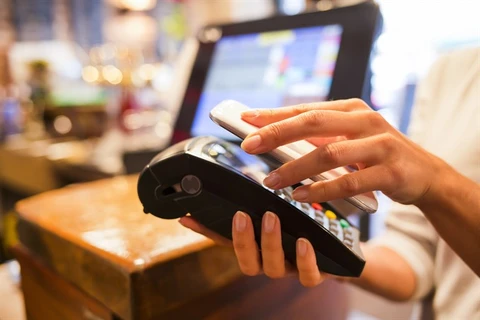
Customers use e-payment services at TPBank’s Livebank (Source: VNA)
 Hanoi (VNS/VNA) - The Government should create an ecosystem and suitable environment for new products and services as well as pioneer their use to promote the development of contactless payment methods. This could be a foundation for building e-government in Vietnam.
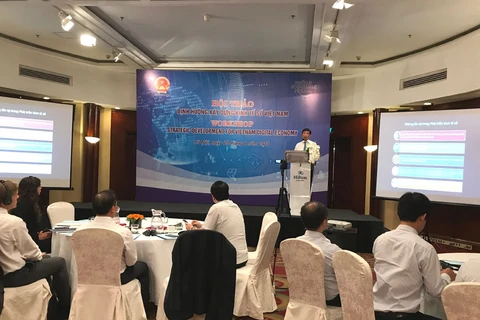
Vu Viet Ngoan, Chief of the Advisory Committee to the Prime Minister, made the statement at a conference on how contactless payments support the establishment of a modern and effective e-government by leveraging the development of a digital economy held in Hanoi last week.
Ngoan said the technological gap had been reduced from 20 to 10 years. This was the reason that firms without new business ideas would lag behind.
“In the conditions of a sharing economy, businesses should make links that combine fintech with banks and credit institutions for development,” he added.
According to the master plan to develop non-cash payment in Vietnam by 2020, all supermarkets, commercial centres and modern distribution units should accept card payments. In this case the rate of cash payments would be just 10 percent. The market would have over 300,000 devices accepting POS.
Additionally, the plan would also focus on non-cash payment in rural and remote areas to bring the rate of people over 15 years old with bank accounts to at least 70 percent by 2020.
Over the past two years, the application of non-cash and contactless payment methods in the country has risen. Statistics from the State Bank of Vietnam showed that financial transactions through mobile phones in 2017 rose by 81 percent while those made online also increased by 67 percent from the previous year.
The country now has 78 organisations providing online payment services and another 41 offering such services through mobile phones.
By the end of September 2017, the number of transactions through mobile phones in Vietnam reached more than 90 million, with a total value of 423 trillion VND (18.63 billion USD).
Non-cash payment technologies and methods have become more diversified. Banks and fintech firms have co-operated to introduce new and modern technologies based on mobile devices.
Sharing the ideas, Truong Van Phuoc, Acting Chairman of the National Financial Supervision Commission, said the rapid development of technologies in the global financial sector has brought benefits and opportunities for consumers, businesses and management agencies.
As Vietnam has become more deeply integrated into the world economy, a modern fintech foundation could help the country’s banking and finance sector effectively participate in the global value chain, thus allowing breakthroughs for Vietnam, he added.
Dao Minh Tuan, Chairman of the Vietnam Bank Card Association and Deputy General Director of Vietcombank, said Vietnam has 77 million bank cards in circulation. However, a high number of such cards have recorded just small payments or even no transaction.
Notably, the amount of non-cash payment transactions in Vietnam has been low in comparison with other countries in the region, he said, adding that the habits and thoughts of Vietnamese people are to blame for the low rate, Tuan said.
He said that people in the country are still hesitant to share personal information online. In addition, most buyers want to check the product before purchase.
To promote non-cash payments in Vietnam, he suggested that banks should apply new payment technologies and methods to increase convenience to card holders.
The solutions include tokenization (using token codes to replace card numbers) in online payments and at POS locations. In addition, the application of QR code payments should be expanded.
Experts said QR payment services have risen in popularity in many countries. WeChat Pay and Tencent in China have surpassed 900 million users, while Alibaba and Alipay have over 500 million users. The total active number is equal to the entire Chinese population. In Japan, QR codes have also seen strong development.
Catching up the trend, some businesses and banks have quickly applied QR codes and attracted a large number of users, including TPBank and VNPAY.
TPBank successfully developed QuickPay as an app on both Android and iOS platforms. The rate of people using the app has increased 165 percent per month since launch. Merchants accepting QR code payments have seen revenues increase by 7 to 10 percent.
Meanwhile, VNPAY has also integrated QR Pay in the mobile banking applications of many banks, including TPBank, Vietcombank, VietinBank and Agribank. The payment method allows customers using the mobile application of banks to scan QR codes to make quick payments for goods and services.
However, banks said the biggest barrier for the payment method in Vietnam was a lack of a common standard, causing difficulties for co-operation between banks and payment firms.
A representative from National Payment Corporation of Vietnam (NAPAS) said the central bank has completed a basic standard on QR Code technology for payments in Vietnam, which could be rolled out in the third quarter of the year.-VNS/VNA
VNA