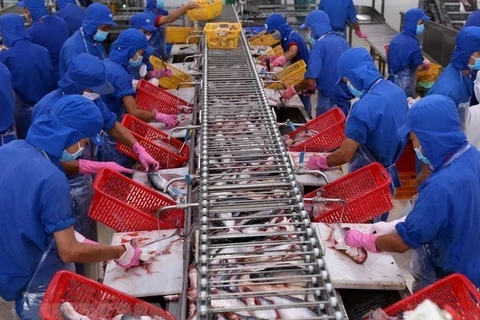
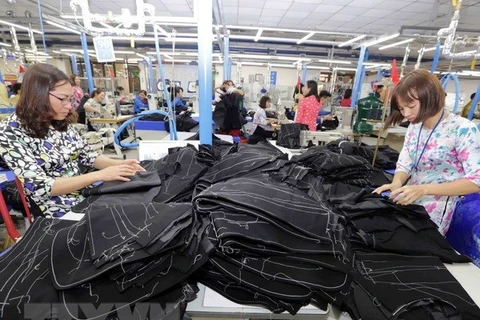
Workers process shrimp for export (Photo:VNA)
 Hanoi (VNS/VNA) - Vietnam’s exports of agricultural products are expected to face more challenges by the end of the year, so enterprises must follow market developments at home and abroad and improve the quality of their products, according to experts.
Vu Tien Loc, Chairman of the Vietnam Chamber of Commerce and Industry (VCCI), said Vietnam’s exports of goods, especially agro, forestry and seafood products are facing a number of obstacles in major markets, including impacts from the US-China trade war and the European Union (EU)’s “yellow card” warning against fisheries exports.
With the “yellow card”, all exported seafood products from Vietnam to the EU have had to be checked by the authorities of the importing country. That is a big barrier for Vietnamese products in one of the country’s major markets.
Minister of Trade and Industry Tran Tuan Anh said there would be no small difficulties for Vietnam’s exports if the US-China trade war is prolonged. By the year end, Vietnam’s exports of goods are expected to face many challenges.
Importing countries would further strengthen protection measures, food safety standards and environmental protection standards. Those would make it difficult for Vietnam’s exported products to enter those markets.
Besides that, there is the US catfish inspection programme, Forest Law Enforcement, Governance and Trade (FLEGT) for wooden products and regulations on traceability in many import countries.
Therefore, according to the Ministry of Industry and Trade, enterprises need to update market information and improve the quality of export goods, meeting strict regulations and standards in export markets.
The ministry said the fisheries industry must work hard by January 1, 2019 to remove the yellow card.
According to the Ministry of Agriculture and Rural Development, the national export value of agriculture, forestry and seafood products in the first six months of this year marked a year-on-year increase of 12 percent to reach 19.4 billion USD.
Of this, the export value rose by 9.7 percent for agricultural products to reach 10.3 billion USD, by 10.5 percent for seafood products to 3.94 billion USD and by 12.7 percent for main forestry products to 4.33 billion USD compared to the same period last year.
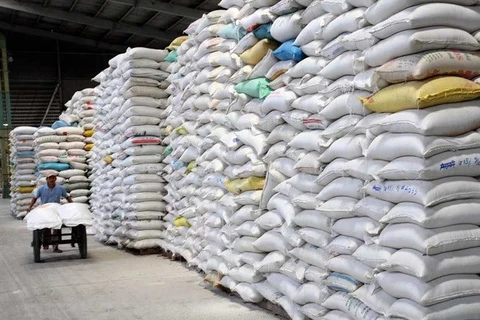
Other products that recorded high export growth in the first six months of the year included rice (up by 42 percent to 1.81 billion USD), vegetables and fruits (up by 20 percent to 2 billion USD), cashew nuts (up by 16.4 percent to 1.71 billion USD) and wood and wooden products (up by 12.1 percent to 4.1 billion USD).
The US and China are the two largest export markets for Vietnam’s farm produce, especially vegetables and fruit, so the trade war between the two countries would have a big impact on such products in Vietnam.
Experts in the agricultural sector said that under pressure from the US’ increase of import tariffs on Chinese exports, China’s agricultural products will have to find alternative markets.
With great supply and cheap price, Chinese vegetables and fruits will continue to compete with Vietnamese versions. Meanwhile, to avoid China’s high import tariff at 25 percent for US agricultural products, the US is likely to promote export agricultural products to Vietnam, including fruit as well as meat of cattle and poultry.
The General Department of Vietnam Customs said in May, US meat imports accounted for 37 percent of the total import meat volume to Vietnam, becoming the largest exporter of meat to Vietnam. The US exported 11,000 tonnes to Vietnam in May, worth more than 13 million USD, a month-on-month increase of 50 percent in value.-VNS/VNA
VNA