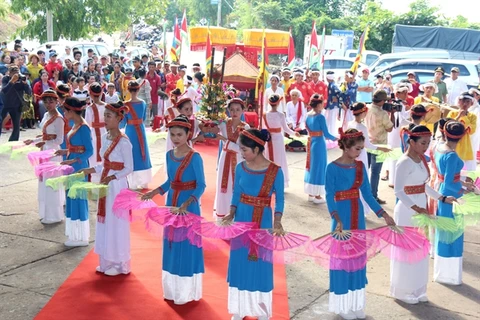
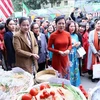
A ritual in Kate Festival of Cham ethnic minority community in Binh Thuan (Photo: VNA)
 Binh Thuan (VNA) – The south-central province of Binh Thuan is home to four national-level intangible cultural heritages, namely the Kate Festival, pottery craft of Cham people, Thay Thim Palace festival, and Cau Ngu festival in Van Thuy Tu temple. Each of these has contributed to promoting the local tourism industry.
Kate Festival
Falling on the first day of the seventh month of the Cham calendar, Kate is the biggest festival in the year of the Cham Brahman people. It reminds the ethnic community of their ancient gods and delivers wishes for bumper harvests and the growth of all beings.
The Cham people call their kings and mandarins the Pokal, village genie the Po Play, and ancestors the Mu Kay.
The first day of the festival begins with a thanksgiving ceremony to the Po Play in villages.
On the second day, the Cham give offerings to the Pokal at ancient temples to pray for a peaceful and happy life. From the third day, they celebrate at home to honour their ancestors.
During the festival, people wear traditional clothes to join in rituals and cultural activities, folk dances, musical performances with traditional instruments, and folk games.
The Kate is the Cham’s most important festival. It is known as one of the 15 largest festivals in the country, attracting thousands of locals as well as domestic and foreign visitors every year.
The Kate Festival was recognised as an intangible cultural heritage by the Ministry of Culture, Sports and Tourism in 2017 and a heritage at the national level in April 2022.
Cham pottery craft
Research shows that in the past, Cham people in Binh Thuan did many crafts for a living such as pottery, weaving and boat building. However, only the craft of pottery making is maintained today in Binh Duc village, Phan Hiep commune of Bac Binh district. The craft has continued from generation to generation from mothers to daughters for hundreds of years.
 The pottery craft of Cham people in Binh Thuan is one of the four national intangible cultural heritages (Photo: VNA)
 The traditional Cham pots are shaped by hand and not made on a turning wheel.
A product is placed on a chair or table and the potter places it on a stool or table, and walks around it, shaping it with anvils, moulds, and wet cloth.
Cham people often gather their pottery to bake them together every 3-4 days.
Pottery, after being fired, is scaled onto a juice from fruit skins or cashew nut shell, creating black blotches.
This decoration makes Cham pottery different from other pottery products. Pottery products of the Cham people do not have many decorative patterns but employ simple, rustic shapes. They are still attractive to tourists and consumers because of their unique features.
The craft was listed by the Ministry of Culture, Sports and Tourism among national intangible heritage in 2012.
Thay Thim Palace Festival
The Thay Thim Palace Festival, which takes place in Tan Tien commune of La Gi town, has been maintained and associated with the local culture and traditional custom of the community for more than 130 years.
The so-called Thay Thim (Uncle and Aunt) is a way for the locals to show respect for the couple, who were talented and compassionate. They contribute to helping the poor in the locality.
The Thay Thim Palace is about 12 kilometers northwest from the centre of La Gi town. The relic was recognised by the Ministry of Culture and Information (now the Ministry of Culture, Sports and Tourism) as a national historical and cultural relic on September 27, 1997.
 The Thay Thim Palace Festival in Tan Yen commune, La Gi town of Binh Thuan (Photo: VNA)
 The Thay Thim Palace festival has long been considered a unique traditional one not only for the local community but also serves as a common cultural heritage of many neighboring provinces and cities in the southern region. It is a lively environment that preserves and promotes traditional culture, shows national cultural identity, and contributes to enriching the treasures of the diverse Vietnamese cultural heritage.
The Dinh Thay Thim, which literally translates as “Thay Thim Palace”, is a temple built over 130 years ago in La Gi to worship a talented kind-hearted hermit called Thay (The Wizard) and his wife, Thim (The Aunt). Thay is said to have used magic to help indigent people.
The festival was recognised as a national cultural intangible heritage on January 12, 2022.
Cau Ngu festival in Van Thuy Tu
Van Thuy Tu is one of the oldest fishing villages in south-central Vietnam. Van means "village" and Thuy Tu means "beautiful water".
Van Thuy Tu temple is considered the largest museum for whale skeletons in Vietnam and Southeast Asia.
The main hall of Van Thuy Tu Temple includes an altar dedicated to the whale gods and fishermen’s ancestors.
 Van Thuy Tu Temple (Photo: VNA)
 Fishermen in Phan Thiet are passionate about their belief in worshiping whales. They believe that “Ca Ong” is the God of Nam Hai - the one who helps the coastal people lead a peaceful and prosperous life. Therefore, they have very thoughtful and solemn forms of burial.
When the giant “Ca Ong” dies, it is buried at sea to avoid causing pollution inland. But no matter where they are buried, fishermen burn incense, make offerings to their whale, and then cover them with red cloth to show respect.
The festival is observed under the belief that whales rescue people in danger at sea. They also represent a symbol of good fortune that can bring local people a prosperous fishing season.
During the festival, locals hold solemn ritual sacrifices, sing folk songs and play folk games, including the holding a sailing regatta in honor of the event.
With its typical values, the “Cau Ngu” festival at the Van Thuy Tu temple was recognised as national intangible cultural heritage by the Ministry of Culture and Sports and Tourism in 2019./.