Exploring terraced rice fields in Yen Bai province

Having been well-known for its most breathtaking terraced rice fields, Mu Cang Chai in the northern mountainous province of Yen Bai has been repeated among travel lovers and photographers, especially in late September and early October - the best time for capturing the most beautiful landscapes of terraced fields in the mountainous district.
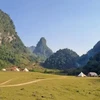
Exploring terraced rice fields in Yen Bai province ảnh 1Mu Cang Chai terraced fields have been popular among tourists (Photo: VNA)

Yen Bai (VNA) - Having been well-known for its most breathtaking terraced rice fields, Mu Cang Chai in the northern mountainous province of Yen Bai has been repeated among travel lovers and photographers, especially in late September and early October - the best time for capturing the most beautiful landscapes of terraced fields in the mountainous district.

Located more than 300km to the northwest of Hanoi and 1,000 metres above sea level, Mu Cang Chai is now a familiar destination for tourists.

Mu Cang Chai features enchanting scenery and gracious people whose way of life is so startlingly different than most in the world; it is endearing and lovely to visit such a beautiful, majestic landscape with kind people.

Passing the Khe pass and then the Bo Hon slope, visitors arrive in Tu Le - a popular stopover on the way to Mu Cang Chai.

The local Mong ethnic group has used that word to describe Khau Pha as a horn rising to the blue sky, and also to indicate the degree of danger. The whole pass is more than 20km long, with mostly cloudy all year round.


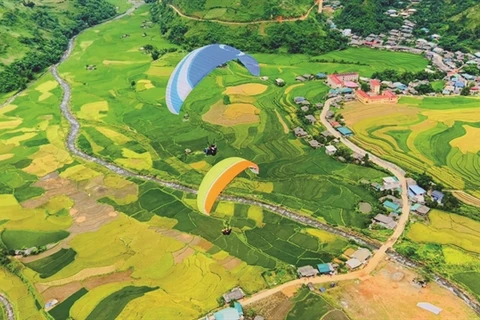
Along the road to Mu Cang Chai town are terraced fields stretching from the top of the mountain down to streams.

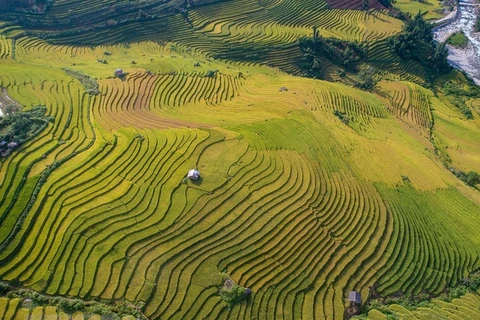
Mu Cang Chai terraced fields have long been well-known and considered a must-visit place for tourists to the northwestern region of Vietnam. These are the terraced fields on mountain slopes, which cover an area of about 2,200 hectares in the three communes of La Pan Tan, Che Cu Nha and De Xu Phinh in Mu Cang Chai district cultivated by the Mong people for centuries.

Mu Cang Chai district is home to 500 hectares of rice terraces in La Pan Tan, Che Cu Nha and De Xu Phinh communes, cultivated by the H’mong people for centuries.
Terraced fields in Mù Cang Chải are beautiful year-round. Visitors in March can see glittering ponds before locals transplant rice seedlings from April to May.

After May, the hills are covered in green until the fields start to turn yellow with ripe rice in early September.

During the harvest in October, the golden rice fields stand out amidst green forests. 
Yen Bai province said it will continue to conduct conservation activities and promote the value of relics and heritage in the area.

Besides, the province will also promote tourism development. From now until 2025, Mu Cang Chai District will become a tourist district and Nghia Lo town will become a cultural – tourist town.

Mu Cang Chai terrace fields in the northern mountainous province of Yen Bai was included into the list of the 50 most beautiful places in the world in 2020 by Big 7 Travel.

“When you imagine magnificent Asian rice fields swirling on the slopes of velvet green hills, you’re picturing Mu Cang Chai, Vietnam,” wrote the website.

Centuries of careful cultivation have shaped what is easily some of the most beautiful rice terraces in the world, it continued.

Ranking 21st in the list, Mu Cang Chai is also full of hiking trails and vibrant local culture. It is a draw to both domestic and foreign tourists and among places where travellers want to come back.

The ranking was drawn up by Big 7 Travel after it asked its 1.5-million-strong social audience for their opinion, mined data from Pinterest and analysed the most-liked images on its Instagram profile this year.

Big 7 Travel provides current and curated recommendations, aiming to helping millions of people discover the world./. 
VNA

See more

Several Vietnamese tourism products are introduced to visitors at the fair. (Photo: VNA)

Vietnam captivates visitors at Algeria tourism fair

Vietnam displays large photographs of renowned destinations such as Hoan Kiem Lake, Trang An Landscape Complex, Phong Nha-Ke Bang National Park, Hoi An Ancient Town, Ban Gioc Waterfall and the terraced rice fields of Mu Cang Chai at the International Tourism and Travel Fair (SITEV 2026) in Algeria.

Sun PhuQuoc Airways opens the gateway for the world to experience the paradise Phu Quoc. (Photo: Sun Group)

US media outlines what makes Phu Quoc Southeast Asia’s most sought-after destination

According to TTW, Phu Quoc is emerging as "one of the most desired destinations in Southeast Asia" due to a rare convergence of pristine natural beauty and a heavily invested, modern tourism ecosystem. From sweeping white sands and turquoise waters to global-class resort and entertainment complexes, the island is drawing an increasing number of international travelers seeking an experience that seamlessly balances luxury with a rich local identity.

Local culture makes Vietnamese destinations appealing. (Photo: VNA)

Vietnam targets tourism breakthrough by filling gaps

Industry officials said advances in sci-tech, innovation and digital transformation are already wrenching tourism away from a bulk-volume model toward one built on data, customised experiences and smart governance. Deeper global integration is further widening market access, tightening value chain links and sharpening Vietnam’s destination brand.

The 7 Wonders Day will be held on July 7 to celebrate Ha Long Bay as one of the best known world natural heritage site. (Photo: courtesy of Ha Long Bay - Yen Tu World Heritage Management Department)

7 Wonders Day to spotlight UNESCO heritage jewel Ha Long Bay

A special event entitled 7 Wonders Day with a series of attractions and experiences for both residents and visitors will be held in Ha Long city, Quang Ninh province, on July 7 to honour the elected New 7 Wonders of the World and Nature.

Con Co “steel island”: a green gem in the open sea. (Photo: VNA)

Con Co “steel island”: a green gem in the open sea

Unlike well-established destinations, this small island quietly preserves its layered heritage: tens-of-thousands-year-old basalt formations, pristine tropical forests and enduring wartime memories. Together, they create a distinctive “green gem” in the open sea, subtle yet captivating enough to hold any visitor.

The Hue–Da Nang “Central Heritage Connection” train takes passengers along one of Vietnam’s most spectacular coastal railway routes. (Photo: nhandan.vn)

Heritage rail journey brings new identity to central Vietnam tourism

The heritage train offers passengers not only a means of transport, but also a sense of connection linking destinations across central Vietnam, tourism with transport, and nostalgic memories with contemporary experiences. While older travellers are reminded of journeys from decades ago, younger passengers and international visitors are discovering a greener, culture-rich way to explore the region.

Many Vietnamese travellers love to plan the trip by themselves even when it requires a lot of time. (Photo courtesy of Booking.com)

Vietnamese travellers enjoy planning for trips

The Booking.com’s Travel Trends 2026 data revealed that a growing number of Vietnamese travellers, about 74% of respondents, are channelling “Main Character Planning Energy”, where planning and booking is just as enjoyable as the trip itself.

Hai Tac Island in An Giang province is increasingly attractive to visitors. (Photo: VNA)

Slow travel increases connections, reshapes tourism trends

Rather than rushing to “check in” at as many attractions as possible, slow travel allows visitors to immerse themselves in local life. Travellers may spend time wandering through a highland market, learning to cook a traditional dish, cycling around a coastal fishing village, or simply enjoying the tranquil rhythm of life in the countryside.

Sunlight streams into the Dinosaur Eye while visitors join the Son Doong adventure tour (Photo: VNA published)

Quang Tri province boosts tourism promotion through international television, films

A special documentary on Son Doong Cave, the world’s largest cave, was aired on March 29 in the renowned “60 Minutes” programme of CBS News. The report retraced the discovery of Son Doong Cave and years of expeditions conducted by the British Cave Research Association, offering global audiences a comprehensive look at the cave through scientific, historical and human perspectives.