Community tourism transforms livelihoods in remote areas

Across Vietnam, a transformative movement is quietly reshaping the landscape of local livelihoods, particularly in remote and mountainous areas as community-based tourism turns the rich traditional cultures and daily lives of ethnic groups into interesting attractions for foreign travelers.

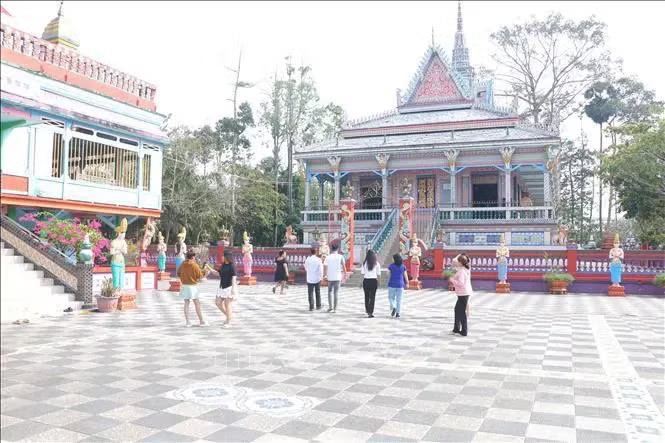
At Sa Lon pagoda in Soc Trang province (Photo: VNA)

HCM City (VNA) – Across Vietnam, a transformative movement is quietly reshaping the landscape of local livelihoods, particularly in remote and mountainous areas as community-based tourism turns the rich traditional cultures and daily lives of ethnic groups into interesting attractions for foreign travelers.

As tourists seek authentic cultural experiences, they are flocking to these areas, breathing new life into local economies and helping preserve their unique cultural heritage.

This influx of visitors is not merely a boon for local businesses, but also a vital lifeline that sustains and spreads the distinctive cultural values that define these communities, said Director of the Institute for Tourism Development Research under the Vietnam National Authority of Tourism Nguyen Anh Tuan.

By promoting immersive experiences, such as making and savoring traditional Cham cakes, engaging in folk music exchanges, and enjoying performances of traditional musical instruments, communities can offer visitors a hands-on approach to their cultural heritage, Ho Luu Phuc from Van Hien University said.
pagoda (1).jpg
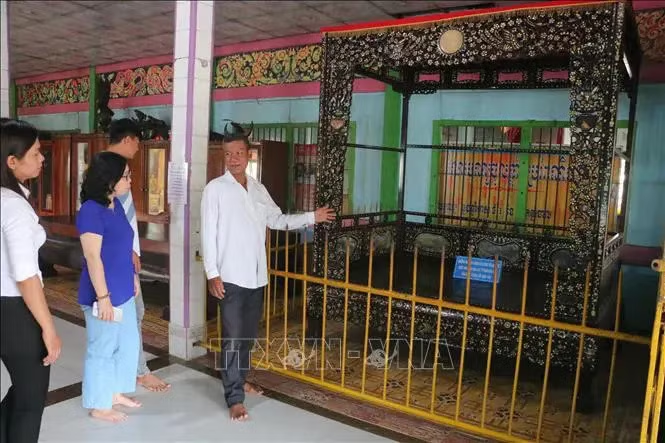
Chen Kieu, a famous Khmer pagoda in Soc Trang (Photo: VNA)

In the southern province of Soc Trang, Dai Tam commune in My Xuyen district has become a model rural commune. Showcasing the cultural heritage of the Kinh, Khmer and Hoa ethnic groups, the commune seamlessly blends cultural preservation with tourism to create a thriving economic model, evident in its average income per capita exceeding 76 million VND (3,000 USD) per year.

Phong Phu Thinh from Dai An hamlet, Dai Tam commune said over 200,000 visitors annually come to the famous Chen Kieu Pagoda carrying Khmer style. They also explore various cultural ceremonies, enjoy traditional Khmer music and dance performances, purchase local specialties, agricultural products, and handicrafts.

Similarly, in Phuoc Dan town, Ninh Phuoc district, the south central province of Tay Ninh, community-based tourism activities are being promoted, offering visitors the opportunity to explore the Bau Tuc pottery village of the Cham people. Here, tourists can discover the unique art of pottery-making, which does not use a potter's wheel, learn about the culture and beliefs reflected in each ceramic product, and purchase local crafts. This not only creates employment opportunities for the local population but also plays a practical role in preserving the traditional craft.

Phuc also proposed innovative solutions to improve community-based tourism products. He underlined the importance of collaboration among local authorities, tourism companies, hospitality providers and relevant sectors. A concerted effort is needed to invest in infrastructure that supports these enriching activities, he said, adding ensuring hygiene and food safety must be prioritised in food tourism to guarantee visitor satisfaction and foster repeated visits./.
VNA

See more

Sun Group’s resort in Da Nang tops the Asian resort category at Condé Nast Traveler’s 2026 Readers’ Choice Awards. (Photo: Sun Group)

Condé Nast Traveler names InterContinental Danang Best Resort in Asia for 2026

On October 6, Condé Nast Traveler announced its “Top 15 Resorts in Asia” list as part of the 2026 Readers’ Choice Awards. InterContinental Danang Sun Peninsula Resort ranked first with a score of 98.76, ahead of Wildflower Hall, Shimla - an Oberoi resort in India - which placed second with 98.56. The Oberoi Vindhyavilas Wildlife Resort, Bandhavgarh, took third place with 98.36.

Tourists experience the buckwheat flower season on the Dong Van Karst Plateau. (Photo: VNA)

Buckwheat blossoms help extend tourism season in stone plateau

Phan Duc Nam, Chairman of the Dong Van commune People's Committee, said the locality is focusing not only on flower cultivation but also on improving landscapes, environmental sanitation and tourism services. The goal is to give visitors more reasons to stay longer and return at other times of the year.

For leisure travellers, a dining venue worth experiencing can be a decisive factor in choosing a destination. (Photo: New World Phu Quoc)

From APEC to Michelin: New opportunities for Phu Quoc to extend stays, boost spending

Gwendal Poullennec, International Director of the Michelin Guide, has observed that Phu Quoc’s culinary identity is shaped by the interplay between fishing-village food culture and restaurants with an international character. This provides a foundation for the island to develop itineraries offering a variety of experiences and price points.

Pu Luong community-based ecotourism site in Thanh Hoa province attracts visitors during National Day holiday. (Photo published by VNA)

Travel firms drive tourist flows, boost tourism value

Travel companies should play a key role in directing tourist flows and linking the tourism value chain, thus enhancing the competitiveness of the tourism sector. They should go beyond selling tours to understand market demand, design products, connect services, organise tourist flows, manage risks and contribute to shaping destination images.

The picturesque scenery outside Phong Nha Cave (Phong Nha-Ke Bang National Park) (Photo published by VNA)

Vietnam steps up tourism promotion on global markets

Experts say that to turn advantages into high-value tourist arrivals, tourism promotion needs to move beyond fragmented activities towards large-scale, long-term campaigns tailored to target markets and closely linked to actual visitor experiences.

Visitors tour Hoi An Ancient Town in Da Nang city. (Photo: VNA)

Vietnam’s tourism targets 12% of GDP by 2030

Resolution 26-NQ/TW targets a direct GDP contribution of 10–12% by 2030, 45–50 million foreign arrivals, 160 million domestic visitors, and total revenue of 80–90 billion USD.

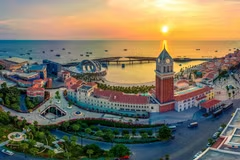
Located on Apollo Square in the heart of Sunset Town, Phu Quoc, Apollo Cafe is a distinctive venue designed by renowned architect Bill Bensley.

Coffee beneath an “upside-down” town: A surreal stop in Phu Quoc

With an entire town recreated on its ceiling, sweeping sunset views and a vantage point for watching fireworks after dark, Apollo Cafe in Phu Quoc offers more than a photogenic backdrop. Designed by Bill Bensley, the venue shows how a café can become an experience travellers deliberately build into their itinerary.

Vietnam is named Asia's Leading Destination for the eighth time and Asia's Leading Heritage Destination for the fourth time at the 2026 World Travel Awards. (Photo: VNA)

Vietnam strengthens tourism profile with WTA 2026 honours

The awards demonstrate that Vietnam's tourism appeal is being recognised across a broad range of areas, from national, urban and heritage destinations to nature-based attractions and tourism products and services, further strengthening the country's presence on the regional and international tourism map

Terraced fields shimmering with water create a picturesque scene in Lang Sang Village, Ta Xua Commune. (Photo: VNA)

Ta Xua named Asia’s leading emerging tourism destination 2026

In recent years, Ta Xua, dubbed "the paradise of clouds", has emerged as one of the mountainous destinations attracting strong interest from young travellers, particularly for its spectacular sea of clouds stretching across the mountains in the northwestern region.