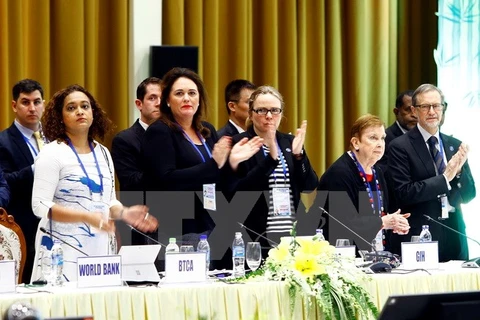
Members of ASEAN Banking Association pose for a photo at the 47th ASEAN Banking Council Meeting in Da Nang (Photo: VNA)
 Da Nang (VNA) - Financial technology (fintech) should be used to strengthen regional integration and promote inclusive and sustainable development, speakers said at the 47th ASEAN Banking Council Meeting in Da Nang on November 24.
Nguyen Thi Hong, Deputy Governor of the State Bank of Vietnam (SBV), said ASEAN members should seek new opportunities and linkages in finance and banking.
She also called for strong connections between the private sector and governments, as also commercial banks with businesses in ASEAN.
Banking systems in the region should strongly boost financial integration and build effective links with businesses for solidarity and prolonged cooperation to realise the 2025 ASEAN Economic Community vision, she said.
ASEAN central bank governors had contributed a lot to financial integration in the region through the ASEAN Banking Integration Framework (ABIF) initiative, she added.
Hong said the initiative helped boost the introduction of commercial banks into the ASEAN financial market and facilitated negotiations of Qualified ASEAN Banks (QABs).
She hoped ASEAN banks would take full advantage of technology to generate maximum benefit and make the banking system secure.
“ASEAN Banking now plays a very important role in boosting economic growth, while ensuring well-managed operations and sustainable development of the banking system in coping with risks,” Hong said.
“We need to restructure our banking system to provide better services with modern and updated technology applications in the context of the Internet boom and the Fourth Revolution.
“The growth of financial technology (fintech) has helped create new services and supported trans-border payments among partners,” she said.
But fintech had also created pressure and tough competition among bankers, she added.
She said the SBV and other central banks in the region had shared experiences in fintech management.
Faid Raham, Chairman of ASEAN Bankers Association (ABA), said many follow-up events and activities had been carried out by national bank associations since the last meeting in Bangkok.
These enabled and strengthened the role of ASEAN banks in the ASEAN Economic Community, he said.
He highly appreciated efforts made by Vietnam to successfully host the 47th ASEAN Banking Association meeting.
ASEAN Secretary-General Le Luong Minh said: “Integration in the financial sector is envisaged under the first characteristic of ASEAN Economic Community (AEC) Blueprint 2025 – a highly integrated and cohesive economy which aims to facilitate the seamless movement of goods, services, investment, capital and skilled labour within ASEAN to enhance trade and production networks as well as to establish a more unified market for firms and consumers in the region.
“Under the AEC Blueprint 2025, ASEAN has developed the ASEAN Strategic Action Plan 2016 – 2025 for Financial Integration, highlighting three key pillars: financial integration, financial inclusion, and financial stability.”
He said "the establishment of Qualified ASEAN Banks (QABs) is a critical milestone for ASEAN toward achieving greater financial and economic integration".
ASEAN now ranks as the world’s 6th largest economy, with a current combined GDP of approximately 2.6 trillion USD, and the third largest market with a combined population of 640 million people.
Minh also noted: “The implementation of the ASEAN Banking Integration Framework and ASEAN Financial Inclusion Framework has taken into account the diversity of economic structures and levels of development across the ASEAN Member States.
“We are committed to an ASEAN payment system that is safe, innovative, competitive, efficient and more interconnected as specified in the 2016-2025 Strategic Action Plan 2016-2025 for Financial Integration. ASEAN is also aiming to achieve international standards by adopting ISO 20022 as a preparation for the domestic payment systems for bilateral/ multilateral linkages within ASEAN by 2025.”
Vietnam’s contribution
Chairman of the Vietnam Banks Association (VNBA), Phan Duc Tu, said it’s the third time that Vietnam was hosting the ASEAN Banking Council after 2000 and 2007.
Tu said this meeting was focused on sustainable development, inclusion, updated technology application and human resource training in finance sector.
He said ABIF also offered three stages of development including an ASEAN common market for banking between 2015-2020. Members had been negotiating bilateral QABs before they were recognised by the bloc, he said, citing the examples of Philippines-Malaysia, Indonesia-Malaysia, and Thailand-Malaysia.
He said Vietnamese commercial banks had improved their management mechanisms and expanded their presence abroad.
Ten Vietnamese commercial banks had been selected for applying Basel II (second of the Basel Accords, recommendations on banking laws and regulations issued by the Basel Committee on Banking Supervision) in early 2018, he added.
VNBA general secretary Nguyen Toan Thang said ABA had agreed to two proposals made by Vietnam in the agenda of Cooperation in Finance, Investment and Trade (COFIT): financial inclusion and bank credit for Micro- Small and Medium sized enterprises (MSMEs).
Vietnam and ABA co-hosted a seminar on digital infrastructure development for banks and boosting cooperation with the Singapore Banks Association for sharing experiences in management and personnel training.
The 47th ASEAN Banking Council Meeting, an annual event, gathered 200 participants from the member nations of Brunei, Cambodia, Indonesia, Laos, Malaysia, Myanmar, the Philippines, Singapore, Thailand and Vietnam.
Brunei will host the next meeting. - VNA
Nguyen Thi Hong, Deputy Governor of the State Bank of Vietnam (SBV), said ASEAN members should seek new opportunities and linkages in finance and banking.
She also called for strong connections between the private sector and governments, as also commercial banks with businesses in ASEAN.
Banking systems in the region should strongly boost financial integration and build effective links with businesses for solidarity and prolonged cooperation to realise the 2025 ASEAN Economic Community vision, she said.
ASEAN central bank governors had contributed a lot to financial integration in the region through the ASEAN Banking Integration Framework (ABIF) initiative, she added.
Hong said the initiative helped boost the introduction of commercial banks into the ASEAN financial market and facilitated negotiations of Qualified ASEAN Banks (QABs).
She hoped ASEAN banks would take full advantage of technology to generate maximum benefit and make the banking system secure.
“ASEAN Banking now plays a very important role in boosting economic growth, while ensuring well-managed operations and sustainable development of the banking system in coping with risks,” Hong said.
“We need to restructure our banking system to provide better services with modern and updated technology applications in the context of the Internet boom and the Fourth Revolution.
“The growth of financial technology (fintech) has helped create new services and supported trans-border payments among partners,” she said.
But fintech had also created pressure and tough competition among bankers, she added.
She said the SBV and other central banks in the region had shared experiences in fintech management.
Faid Raham, Chairman of ASEAN Bankers Association (ABA), said many follow-up events and activities had been carried out by national bank associations since the last meeting in Bangkok.
These enabled and strengthened the role of ASEAN banks in the ASEAN Economic Community, he said.
He highly appreciated efforts made by Vietnam to successfully host the 47th ASEAN Banking Association meeting.
ASEAN Secretary-General Le Luong Minh said: “Integration in the financial sector is envisaged under the first characteristic of ASEAN Economic Community (AEC) Blueprint 2025 – a highly integrated and cohesive economy which aims to facilitate the seamless movement of goods, services, investment, capital and skilled labour within ASEAN to enhance trade and production networks as well as to establish a more unified market for firms and consumers in the region.
“Under the AEC Blueprint 2025, ASEAN has developed the ASEAN Strategic Action Plan 2016 – 2025 for Financial Integration, highlighting three key pillars: financial integration, financial inclusion, and financial stability.”
He said "the establishment of Qualified ASEAN Banks (QABs) is a critical milestone for ASEAN toward achieving greater financial and economic integration".
ASEAN now ranks as the world’s 6th largest economy, with a current combined GDP of approximately 2.6 trillion USD, and the third largest market with a combined population of 640 million people.
Minh also noted: “The implementation of the ASEAN Banking Integration Framework and ASEAN Financial Inclusion Framework has taken into account the diversity of economic structures and levels of development across the ASEAN Member States.
“We are committed to an ASEAN payment system that is safe, innovative, competitive, efficient and more interconnected as specified in the 2016-2025 Strategic Action Plan 2016-2025 for Financial Integration. ASEAN is also aiming to achieve international standards by adopting ISO 20022 as a preparation for the domestic payment systems for bilateral/ multilateral linkages within ASEAN by 2025.”
Vietnam’s contribution
Chairman of the Vietnam Banks Association (VNBA), Phan Duc Tu, said it’s the third time that Vietnam was hosting the ASEAN Banking Council after 2000 and 2007.
Tu said this meeting was focused on sustainable development, inclusion, updated technology application and human resource training in finance sector.
He said ABIF also offered three stages of development including an ASEAN common market for banking between 2015-2020. Members had been negotiating bilateral QABs before they were recognised by the bloc, he said, citing the examples of Philippines-Malaysia, Indonesia-Malaysia, and Thailand-Malaysia.
He said Vietnamese commercial banks had improved their management mechanisms and expanded their presence abroad.
Ten Vietnamese commercial banks had been selected for applying Basel II (second of the Basel Accords, recommendations on banking laws and regulations issued by the Basel Committee on Banking Supervision) in early 2018, he added.
VNBA general secretary Nguyen Toan Thang said ABA had agreed to two proposals made by Vietnam in the agenda of Cooperation in Finance, Investment and Trade (COFIT): financial inclusion and bank credit for Micro- Small and Medium sized enterprises (MSMEs).
Vietnam and ABA co-hosted a seminar on digital infrastructure development for banks and boosting cooperation with the Singapore Banks Association for sharing experiences in management and personnel training.
The 47th ASEAN Banking Council Meeting, an annual event, gathered 200 participants from the member nations of Brunei, Cambodia, Indonesia, Laos, Malaysia, Myanmar, the Philippines, Singapore, Thailand and Vietnam.
Brunei will host the next meeting. - VNA
VNA