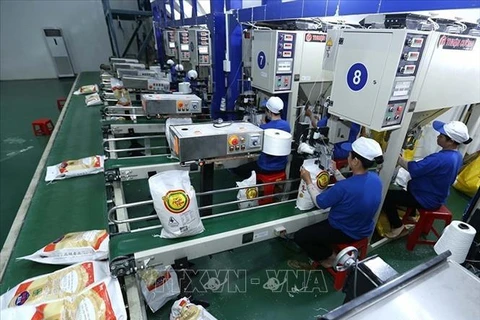
The proposed project would use rice husks as its primary feedstock, with an estimated one million tonnes processed annually using advanced technology developed in Kazakhstan. At present, the top priority is to secure a stable supply of raw materials from rice-producing provinces across the Mekong Delta.
The Department of Customs requested regional customs sub-departments to provide maximum facilitation and ensure same-day customs clearance for exported agricultural, forestry and fishery products, including outside regular working hours.
E5RON92 petrol rose by 635 VND to a maximum of 19,826 VND (0.76 USD) per litre, while E10RON95-III went up 547 VND to 20,550 VND per litre.
The US was Vietnam's second-largest supplier of agricultural products, with export turnover reaching 4.7 billion USD in 2025, a remarkable increase from less than 3.5 billion USD in 2024, Fruitnet said, citing a new report by the US Department of Agriculture (USDA).
Ambassador Pham Viet Hung described Grand Halal Bangkok 2026 as an important opportunity for Vietnamese businesses to connect not only with Thailand's Halal industry but also with Halal food producers worldwide, while learning from experience of Thailand and international partners.
Speakers introduced a range of solutions, including HDPE cages, automated feeding systems, Internet of Things (IoT)-based environmental monitoring, artificial intelligence (AI) applications and integrated multi-trophic aquaculture to improve productivity and sustainability.
According to the National Statistics Office under the Ministry of Finance, GDP expanded by 8.39% in the second quarter, up from 8.14% a year earlier. Growth for the first six months reached 8.18%, exceeding the 7.63% recorded in the same period of 2025. The performance reflected broad-based contributions from both the supply and demand sides of the economy.
Only shipments that fully satisfy the EUDR's data requirements will qualify for export to the EU, and exporters will no longer be able to source products with unclear compliance records for the European market.
The National Statistics Office (NSO) under the Ministry of Finance reported that the manufacturing and processing sector remained the principal driver of economic growth, accounting for 33.07% of the economy's total value-added growth during the first six months of the year.
Addressing a seminar on restructuring capital mobilisation channels hosted by the Finance and Investment newspaper on July 15, Bui Hoang Hai, Vice Chairman of the State Securities Commission of Vietnam (SSC), said the domestic economy continues to face considerable external challenges in 2026, including the effects from the Middle East conflict.
Economists at United Overseas Bank (UOB), a Singapore-based multinational bank, said Vietnam’s gross domestic product (GDP) expanded by 8.39% in the second quarter of 2026, from 7.94% in the first quarter. As a result, economic growth for the first half of the year reached 8.18%, keeping Vietnam at the top among ASEAN economies.
Despite the positive headline figures, analysts caution that actual purchasing power has yet to recover fully.
As one of Vietnam’s key economic growth drivers, the manufacturing and processing industry now faces mounting pressure to move beyond a development model based on inexpensive labour, intensive energy consumption and high emissions.
The State Bank of Vietnam set the daily reference exchange rate at 25,243 VND/USD on July 16, up 10 VND from the previous day.
According to the Department of Taxation, 259 overseas suppliers have registered, declared and paid taxes through the portal. Tax revenue from the group reached 78.1% of the full-year target, surging 119% from a year earlier and making foreign suppliers the fastest-growing source of tax revenue in Vietnam's digital economy.
With 21,351 valid FDI projects worth a combined 146.8 billion USD, Ho Chi Minh City remains Vietnam's leading recipient of foreign investment. The southern largest economic hub recorded nearly 7.5 billion USD in registered FDI in the first half of 2026, fulfilling over 68% of the annual target.
The FTA would widen access to markets with strong demand for premium food products in line with the country’s strategy of shifting exports towards increasing added value.
Rooftop solar power is entering a new phase of development with a more solid foundation. When integrated with energy storage systems and direct power purchase mechanisms, it not only contributes to supplementing distributed energy sources and reducing pressure on the national power system, but also serves as a driving force for green growth, enhances the competitiveness of the economy, and ensures energy security.
Vietnam's competitive advantages are evolving. Rather than relying primarily on low labour costs and tax incentives, the country's future competitiveness will increasingly depend on structural and long-term factors, including transparent institutions, policy predictability and an investment environment capable of supporting long-term strategic investors.
An official expressed confidence that stronger cooperation in cross-border e-commerce will become a new growth channel, contributing to the realisation of the bilateral trade target while supporting the digital economies of both countries.