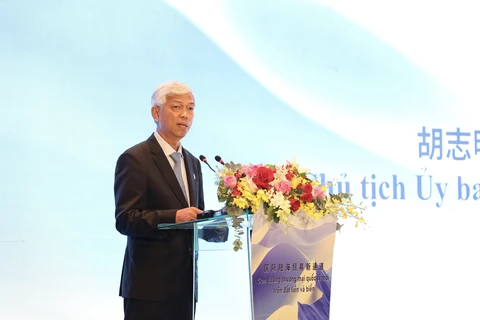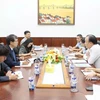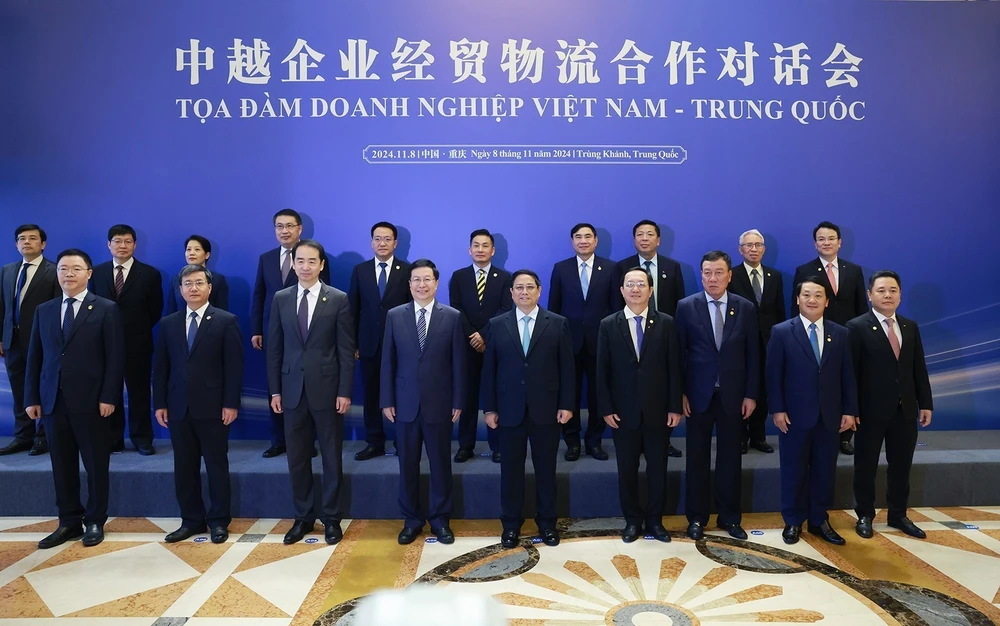
Chongqing (VNA) – Prime Minister Pham Minh Chinh attended a Vietnam - China business seminar in Chongqing city on November 8, saying bilateral cooperation potential remains huge and the two countries’ businesses should enhance partnerships in the spirit of harmonising interests and sharing risks.
The event took place as part of the Vietnamese leader’s trip to attend the 8th Greater Mekong Subregion (GMS) Summit and bilateral activities in China.
Participants in the seminar shared the view that the flourishing Vietnam - China relationship is an extremely important factor creating big opportunities for the two business communities. They also highlighted the crucial role of Vietnamese and Chinese firms in realising the common commitments and perceptions of the countries’ Party and State leaders.
In particular, the top Party and State leaders of the two countries agreed to elevate the comprehensive strategic cooperative partnership and build a Vietnam - China community with a shared future that carries strategic significance.
Notably, they agreed to bolster economic, trade, and investment cooperation so that it becomes a bright spot and an important pillar of bilateral relations.
For the last more than 10 years, bilateral trade has increased over four-fold, turning China into the largest exporter of goods to Vietnam and Vietnam into the top trading partner of China in ASEAN. Meanwhile, China’s investment has risen over seven-fold to rank 6th among 148 countries and territories investing in the Southeast Asian nation. In 2023, it took the lead in terms of the number of new investment projects in Vietnam.
In the sound relationship between the two countries, Chongqing has always been a locality with long-standing friendship and close-knit ties with Vietnam. Chongqing is a place that President Ho Chi Minh spent many years during his revolutionary life. It holds an important and special position as a leading economic, trade, cultural, educational, scientific, technological, and logistics hub in China's western region, a key pillar of the "Great Western Development" strategy and the "Belt and Road Initiative," and the starting point for the new overland and maritime transport corridors, as well as an important centre for the China-Europe Railway Express.
In recent years, friendship exchange and win-win cooperation between Chongqing and Vietnamese localities have been promoted. Trade turnover between the two sides reached 4.2 billion USD in the first nine months of this year. Vietnam has been the largest trade partner of Chongqing among ASEAN member countries for many years. In both 2023 and 2024, Chongqing’s leaders have visited and worked with localities and partners in Vietnam.
Participants held that there is plenty of room for Chongqing and Vietnamese localities to further bolster cooperation. Through PM Chinh’s working trip, together with the official confirmation of the establishment of the Vietnamese Consulate General in Chongqing, exchange and all-round cooperation between Chongqing, its neighbouring localities and Vietnamese localities are expected to reach a new height, becoming deeper, more substantial, and more effective, bringing significant benefits to businesses and people on both sides.
Addressing the event, PM Chinh highlighted the similarities and close bond between Vietnam and China in terms of nature, culture, and history.
The two countries, connected by mountains and rivers, have shared a long-standing history of relations and a friendship of being both "comrades and brothers," he stated.
Thanks to high-level visits by the leaders of the two Parties and countries, the Vietnam-China comprehensive strategic cooperative partnership has developed on a solid political foundation, shared cultural values, favourable legal frameworks, and an open market foundation, he said, adding that the two sides are working to build the Vietnam-China community with a shared future that carries strategic significance.
The Vietnamese Government leader said that with these foundations in place, it is crucial to further promote economic, trade, and investment cooperation in a more dynamic, robust, and effective manner.
As of October, China had nearly 5,000 valid investment projects in Vietnam, with a total registered capital of close to 30 billion USD. In the first nine months of this year, China continued to lead in the number of new investment projects, and ranked second in terms of total registered capital. Bilateral trade reached nearly 172 billion USD last year, and 190.9 billion USD in the January-September period, up 14.5% year-on-year.
However, Chinh noted that these results have yet to reflect the full potential of the strong relationship between the two countries and that there remain vast opportunities and untapped potential for cooperation. He took time to share with the business community Vietnam’s key factors, major directions, and strategies in socio-economic development, foreign policy, integration, national defence and security, cultural development, and social welfare to ensuring that businesses from both countries can feel secure in their cooperation and investment.
Vietnam identifies economic development as its central mission, and aims to build an independent and self-reliant economy while actively and deeply integrating into the international community in a substantive and effective manner, he said, adding that the country always works to ensure national defence and security, follows a defence policy of "four no’s," maintains political stability, and upholds public order and safety to create a secure environment for investors.
In addition, Vietnam is pushing forward three strategic breakthroughs of building a transparent institutional framework, developing strategic infrastructure, and training high-quality human resources; and making efforts to improve the business and investment environment by creating an open, transparent, equal, and healthy business climate, simplifying administrative procedures, reducing logistics costs, input costs, and compliance costs, and enhancing the competitiveness of products.
He highlighted the country's spirit of “harmonising benefits and sharing risks” between the State, businesses and people.
To date, Vietnam has set up diplomatic ties with nearly 200 countries, signed 17 free trade agreement with 65 leading markets in the world. Last year, Vietnam lured nearly 36.6 billion USD in foreign direct investment (FDI), a year-on-year increase of 32.1%. As much as 27.3 billion USD in FDI was funnelled into the nation in January – October this year, rising 2% against the same time in 2023 while 19.6 billion USD in the capital was disbursed, up 8.8% year-on-year, the PM stated.
He called on enterprises of both nations to strengthen investment and business cooperation and promote their bridging role to concretise the agreements reached by leaders of the two Parties and states for prosperity and happiness in each nation.
Regarding the firms’ recommendations, Chinh said the smart customs system has been carried out to simplify customs procedures while competent sides of the two countries have built policies to improve logistics infrastructure, provide financial support, foster technical cooperation, and develop emerging industries such as the digital economy, green economy, circular economy, as well as traceability for products, packaging, and product design.
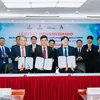
At the event, seven Memoranda of Understanding were signed between Vietnamese and Chinese companies across various domains, including railway, battery storage production, and development of energy supporting industry./.