Foreign-sourced capital to dwindle as from 2018

Total foreign-sourced capital for projects will gradually decline as from 2018, when Vietnam will completely graduate from official development assistance, according to PM Nguyen Xuan Phuc.
Foreign-sourced capital to dwindle as from 2018 ảnh 1A view of the Cat Linh - Ha Dong rail route, which is funded with Chinese capital, in Hanoi (Photo: VNA)

Hanoi (VNA) – Total foreign-sourced capital forprojects will gradually decline as from 2018, when Vietnam will completelygraduate from official development assistance (ODA), leading to more prudentconsideration of projects using less preferential loans, according to PrimeMinister Nguyen Xuan Phuc.

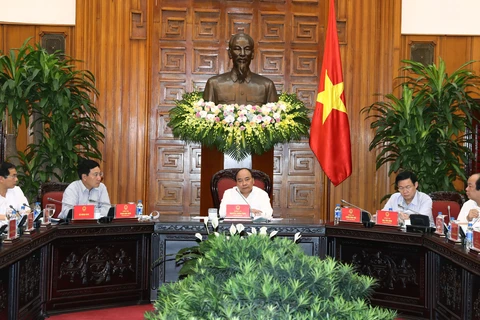
The Government leader made a written answer to aquery of National Assembly deputy Hoang Quang Ham, who is also a member of theNational Assembly’s Committee for Financial and Budgetary Affairs.

PM Phuc noted that under the medium-term publicinvestment plan for 2016-2020, total medium-term investment capital sourcedfrom the State budget is 2,000 trillion VND in maximum. Of the sum, 300trillion VND is foreign capital allocated from the central budget, including abackup worth 30 trillion VND.

The medium-term foreign capital of 270 trillionVND basically meets the actual disbursement demand of the projects listed inthe medium-term plan.

Additionally, to make use of concessional loanssuch as those from the International Development Association (IDA) and theAsian Development Fund (ADF) before Vietnam completely graduates from ODAbecause it already became a middle-income country, the Ministry of Planning andInvestment obtained the PM approval to negotiate and sign some new projectagreements in 2016 and 2017 with an estimated disbursable capital of 29trillion VND, which matches the backup of 30 trillion VND in the medium-term plan.

However, some unexpected problems arose such asadjustment to total investment of some ongoing projects and changes in someprojects’ financial mechanisms.

Therefore, it is necessary to review themedium-term public investment plan for 2016-2020 so as not to affect theprogress and effectiveness of projects and Vietnam’s relations with developmentpartners and sponsors, PM Phuc said.

Regarding the growth slowdown in the firstquarter compared to the fourth quarter of the previous year, the PM said it isa normal phenomenon considering the fact that the long Lunar New Year (Tet) holidayand traditional spring festivals in Q1 impact production and businessactivities. Meanwhile, in Q4, enterprises often augment production and businessactivities to serve soaring Tet demand and meet their annual targets.

The PM pointed out that GDP growth usually gainsspeed in the following quarters, noting that international organisations inVietnam also recognised that this situation reflects the seasonal characteristicof economic growth in a year. Data show that GDP value in Q1 usually accountsfor about 18 percent of the total annual GDP, Q2 24 percent, Q3 26 percent, andQ4 32 percent. -VNA
VNA

See more

Hanoi’s roadmap to implement low-emission zones from July is providing a strong boost to the electric two-wheeler market (Photo: VNA)

Low-emission zone roadmap drives electric two-wheeler boom in Hanoi

From July 1, Hanoi will introduce time-based or area-based restrictions on petrol-powered motorcycles within Ring Road 1, with plans to expand coverage across the entire zone by 2028 and extend to areas within Ring Road 3 by 2030. The policy is expected to reshape travel habits for millions of urban residents.

Delegates at the opening ceremony of the Made in Da Nang Expo 2026 (Photo: VNA)

Nearly 300 firms join Made in Da Nang Expo 2026

Speaking at the opening ceremony, Vice Chairman of the Da Nang People’s Committee Tran Chi Cuong said the exhibition is a large-scale trade promotion event aimed at showcasing products, connecting markets, and helping businesses enhance competitiveness while expanding domestic and export markets.

 Green production, standardised value chains key to fruit, vegetable sector growth

Green production, standardised value chains key to fruit, vegetable sector growth

Facing mounting pressure from increasingly stringent domestic and international standards, Vietnam’s fruit and vegetable sector is accelerating its shift toward green, safe, and sustainable production models. Beyond changing farming practices, localities and businesses are stepping up efforts to standardise value chains and build brands to achieve growth targets for 2026.

Hiep Phuoc Industrial Park in Ho Chi Minh City. (Photo: VNA)

Southern industrial real estate enters strategic growth phase

Key industrial hubs in the south, including Ho Chi Minh City, Dong Nai and Tay Ninh, are transitioning from a period driven largely by supply expansion and rising land prices to a more refined growth model. This new phase is shaped by infrastructure upgrades, supply chain restructuring, product improvement and greater emphasis on operational performance.

The launch of the Vietnam National Brand Week 2026 on April 16 (Photo: VNA)

Vietnam National Brand Week 2026 opens

Running from April 16 to 23 nationwide, the Vietnam National Brand Week 2026 marks the 18th anniversary of Vietnam Brand Day (April 20, 2008 – 2026).

Ca Mau is currently home to more than 5,200 fishing vessels, including nearly 1,900 boats measuring over 15 metres in length, and all have been equipped with vessel monitoring systems. (Illustrative photo: VNA)

Ca Mau drives changes among fishermen to tackle IUU fishing

Ca Mau is stepping up communication campaigns to disseminate legal regulations on IUU fishing, highlight recent enforcement results, and convey recommendations from the European Commission (EC)’s fifth inspection mission to fishing communities and relevant stakeholders.