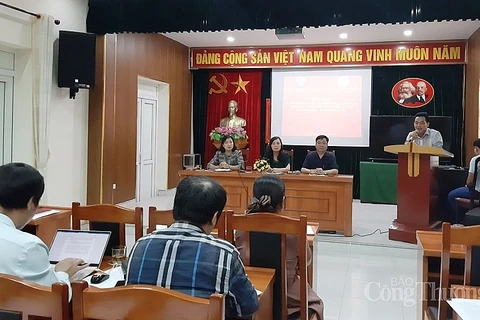
Member of the Politburo and head of the Party Central Committee’s Economic Commission Tran Tuan Anh speaks at the event. (Photo: VietnamPlus)
 Hanoi (VNA) - Experts suggest that it is necessary to develop a free trade zone to fully exploit land value, thereby building a modern centre linking the Red River Delta with routes to the rest of the country in the next 30 years.
Some unfulfilled targets
Members of the Politburo and head of the Party Central Committee’s Economic Commission Tran Tuan Anh said for the implementation of the Resolution of the 13th National Party Congress and others of the Politburo regarding socio-economic development and ensuring national defense and security in economic zones, the Economic Commission has been tasked with leading a project reviewing the implementation of Resolution No.54-NQ/TW and Conclusion No.13-KL/TW of the Politburo.
The steering committee for the implementation of Resolution No.54-NQ/TW together with the Vietnam National University - Hanoi held a workshop on the development of culture, society, science-technology and environmental protection in the delta by 2030, with a vision to 2045 on July 12.
Anh pointed out that after nearly 17 years of implementation of the resolution, there were some unrealised targets as Vietnam’s unique culture has not received due attention and yet to become an inner driving force to guide Vietnam’s sustainable development.
That was the same for science-technology and innovation as there were no breakthroughs to improve productivity. In addition, bottlenecks remain in health care and education and Vietnam is lagging behind compared to developed countries in the region and the world.
Environmental pollution continued to be a major problem to the region in particular and the country at large, Anh stated.
In fact, the modest natural land area in the Red River Delta is a spanner in the work of regional development. The region is the smallest one among six economic zones across Vietnam, covering a total area of 2.12 million ha. It makes up only 6.4 percent of the total area of the country but 23.5 percent of the national population.
At present, the areas of used land amount to 97.3 percent. Average population density was measured at 1,078 persons per sq. km., the highest in the country.
Bui Quang Tuan, General Director of the Vietnam Institute of Economics (VIE) under the Vietnam Academy of Social Sciences, said the regional economy has not formed value chains and linkages between sectors. In particular, the northern major economic zone still lacks partnerships between manufacturers and support industries for industrial activities.
Establishment of free trade zone proposed
At the workshop, representatives from the VIE recommended policies on socio-economic development in the Red River Delta in a sustainable manner by 2030 and with a view to 2045.
They proposed the establishment of a development alliance between localities in the Red River Delta. This would help to gradually shift to innovation from drawing investment in order to create a favourable ecosystem motivating engagement of new and dynamic companies in the field.
The building of an urban area with a Fourth Industrial Revolution (4IR) centre that aims to bolster the region’s growth is also high on the agenda.
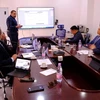
 At the workshop on the development of the Red River Delta by 2030, with a vision to 2045. (Photo: VietnamPlus)
 For his part, Tuan underlined a need to upgrade the manufacturing cluster via the building of a research and development (R&D) park.
He also put forward localities to enhance linkages and cooperation with each other, while asking for permission to pilot a free trade zone which is a kind of special economic zone. Accordingly, the zones are hoped to optimise advantages of urban areas that boast skilled workers and necessary factors for business operation.
Anh took note and spoke highly of essays and discussions between leaders of ministries, sectors and localities in the Red River Delta and experts and scientists.
The official affirmed that the steering committee for Resolution No.54-NQ/TW will select suitable and optimal ideas presented at the workshop to submit to the Politburo and the Secretariat of the Party Central Committee in the coming time./.