Garment, footwear exports aim to reach 80 bln USD by 2025

Vietnam’s textile, garment and footwear sectors aim to achieve a total export value of 77-80 billion USD in 2025 and 106-108 billion USD in 2030, according to the strategy for the development of Vietnam’s textile and footwear industry.
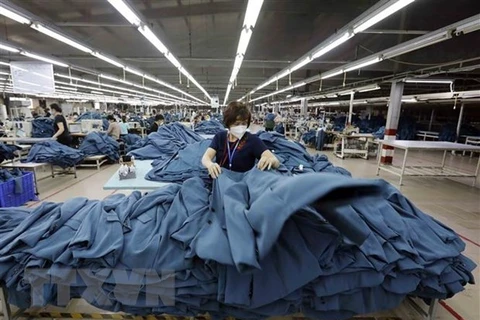
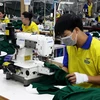
Garment, footwear exports aim to reach 80 bln USD by 2025 ảnh 1Illustrative photo (Source: VNA)
Hanoi (VNS/VNA) – Vietnam’s textile, garment andfootwear sectors aim to achieve a total export value of 77-80 billion USD in2025 and 106-108 billion USD in 2030, according to the strategy for thedevelopment of Vietnam’s textile and footwear industry.

Under the development strategy approved by the Government, for the long term,the garment, textile, leather and footwear sectors are still key exportindustries of the economy.

The sectors will continue to promote investment in the production of materialsand auxiliary materials, as well as supporting industries.

They will encourage the production of fabrics from domestically produced yarnto reduce imports, and form a complete supply and value chain in the region.

For the leather and footwear industry, Nguyen Duc Thuan, Chairman of Lefaso,said domestic enterprises need to actively adapt to the requirements of themarket and brands on sustainable development standards for products. They mustreduce emissions in the production process, and increase the use of solarenergy and highly sustainable products.

Also, according to the strategy, Vietnam’s textile and garment industry expectsexport turnover to reach 50-52 billion USD in 2025 and 68-70 billion USD in2030.

The strategy also states that developing the fashion industry is considered anew direction. Accordingly, this sector will focus on developing designers, andraw material supply, production and distribution systems to form supply chainsand create sustainable foundations for the development of Vietnam’s fashionindustry as well as fashion centres in Hanoi and HCM City.

The strategy encourages enterprises to gradually switch their productionmethods to FOB (free on board) and ODM (original design manufacturer) to addvalue to products, and build a private brand to improve the competitiveness ofthe businesses and products.

Materials are the most difficult factor in the textile and garment industry.Therefore, to promote the development of the textile and garment supportingindustry, the textile and garment industry strives to have a localisation rateat 51-55% in 2021 - 2025 and 56-60% in 2026-2030.

To achieve this goal, it is necessary to attract investment in the developmentof supporting industries and the production of raw materials and accessoriesfor the textile and garment industry based on advantages in the free tradeagreements Vietnam has joined.

The projects to develop the supporting industry and the production of rawmaterials and accessories should be built in regions with a number of textileand garment enterprises to reduce transport charges and production cost andimprove competitiveness.

The strategy also mentions the role of State management agencies in encouragingenterprises to invest in producing fiber, yarn, textile and dyeing withadvanced technology and connections with domestic garment enterprises.

This approved textile and garment development strategy will helpform industrial parks with wastewater treatment areas to attract textile anddyeing projects. Now, the infrastructure for textile, dyeing and fabricproduction is still limited.

Domestic fabric production only reaches 2 billion metres per year, meeting25-30% of the demand of the garment industry. Vietnam’s textile and garmentindustry currently must import 60-70% of the raw materials. Vietnam has joinedmany FTAs, creating conditions for textiles and garments to expand exportmarkets with the tariff gradually reducing to zero.

According to Chairman of the Vietnam Textile and Apparel Association Vu Duc Giang,in the first quarter of 2023, the number of export orders decreased by 25-27%due to the decrease in global purchasing power.

Therefore, businesses can produce lower-value products, and diversify marketsand products to keep production and promote growth.

Chairman of Vinatex Le Tien Truong said that many businesses now only ran 70-80%of production capacity due to a reduction in consumer demand. So, Vinatex isnow focusing on raw material production more than garment production. Thematerials are always the first step in greening, creating a foundation forqualified materials as green requirements of the US and Europe.

Vinatex had organised the production of yarn products from recycled materialsor organic materials. At the same time, the raw material production factorieswere equipped with solar power to meet green energy standards.

According to forecasts,the situation of Vietnam’s textile and garment industry in 2023 would be worsethan in 2022. Therefore, businesses needed to follow the market's developmentsto have flexible solutions to ensure efficiency in production and business, aswell as promote the export of goods, Truong said./.
VNA
See more

At the working session (Photo: VNA)

Can Tho, Guangxi seek collaboration in logistics, supply chains

Chinese investors now back 35 projects in Can Tho with registered capital of nearly 1.2 billion USD. In the first seven months of 2026, Can Tho’s exports to China hit 77.5 million USD, while imports stood at 64.7 million USD. Key exports included rice, seafood, farm produce, processed agricultural products and apparel while main imports comprised agricultural chemicals, veterinary medicines, fertilisers, chemicals, fabrics and other materials and inputs.

Vietnamese Minister of Finance Ngo Van Tuan grants an interview to the Vietnam News Agency (VNA). (Photo: VNA)

Vietnam, Russia move to boost financial cooperation

On bilateral economic, trade and investment ties, Tuan said two-way trade hit 3.24 billion USD in the first seven months of 2026, up 12% from a year earlier. Vietnam’s exports to Russia totaled 1.33 billion USD, while imports amounted to 1.91 billion USD.

Cai Mep - Thi Vai Port complex in Ho Chi Minh City (Photo: VNA)

Ho Chi Minh City seeks to make seaports new growth driver

To maximise its seaport advantages, Ho Chi Minh City is developing smart and green ports while promoting clean energy, lower emissions and sustainable supply chains. It aims to establish an integrated ecosystem linking seaports with industrial parks, logistics centres, free trade zones, multimodal transport networks and an international financial centre.

Farmers visit the off-season durian orchard of Cao Chi Dai in Vinh Hanh commune, An Giang province (Photo: VNA)

Vietnam promotes finance for green agriculture

Over the past five years, Vietnam has developed and gradually implemented a green finance system to support low-emission and environmentally friendly production, including agriculture. Based on the State Bank of Vietnam's Directive No. 03/CT-NHNN dated March 24, 2015, banks including BIDV, VCB, HDBank and Agribank have introduced green credit packages for waste treatment, high-tech agriculture, digital transformation, regional linkages and emission reduction across production chains.

An overview of the meeting between representatives from Polish businesses and the Agency for Domestic Market Surveillance and Development. (Photo: Agency for Domestic Market Surveillance and Development)

Polish businesses seek suppliers, partners in Vietnam

MAJAMI, a confectionery manufacturer and trader under Sweet House, is seeking distributors for Polish confectionery products in the Vietnamese market. Meanwhile, GABONA, a distributor and wholesaler of professional cosmetics, hair care and make-up products and beauty accessories, is looking for Vietnamese manufacturers of vegan and natural cosmetics.

Kendra Rinas, Chief of Mission for IOM Vietnam speaks at the event. (Photo: VNA)

Vietnam advances in building, using migrant labour data system: workshop

Data presented in the report reflects effective migration governance in recent years. The average recruitment cost paid by migrant workers dropped by 23.8%, from 164.9 million VND (6,400 USD) in 2021 to 125.7 million VND in 2025. Conversely, average first-month earnings abroad rose by 25.4%, increasing from 22.4 million VND to 28.1 million VND.

Workers produce leather shoes for export at Lefaso Tra Vinh Investment and Production Joint Stock Company in Tra Cu commune, Vinh Long province. (Photo: VNA)

Vietnamese exporters pivot to ease pressure from US tariffs

Pressure from the new US tariff policy is prompting Vietnamese exporters to reassess their strategies. Rather than pursuing volume-driven growth, many are shifting towards higher-value orders, tighter cost control, greater productivity and a more balanced allocation of markets to reduce reliance on a single destination.

A worker handles and stacks goods. Nearly 138,100 businesses were newly founded from January to August, up 7.7% over the same period last year, while more than 40,800 businesses completed dissolution procedures, a jump of 125.5%. (Photo: VNA)

Firm entry and exits point to continued restructuring pressure

Updates from the National Statistics Office last week showed that nearly 138,100 businesses were newly founded from January to August, up 7.7% over the same period last year, while more than 40,800 businesses completed dissolution procedures, a jump of 125.5%.