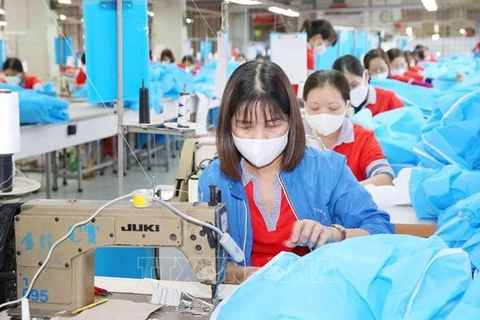
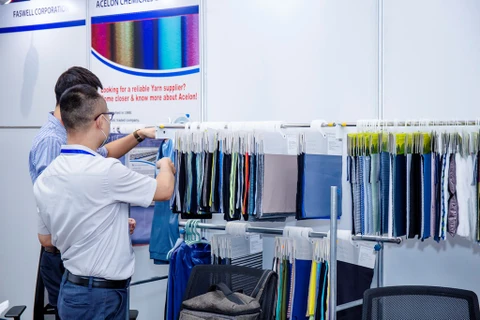
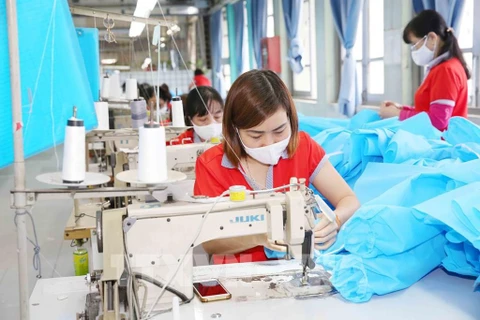
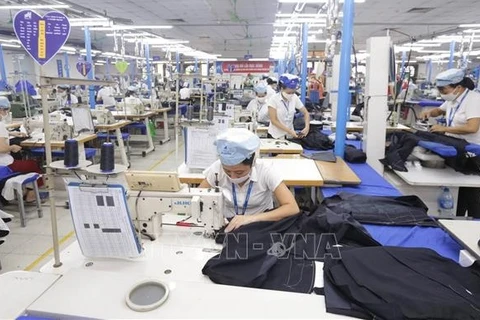
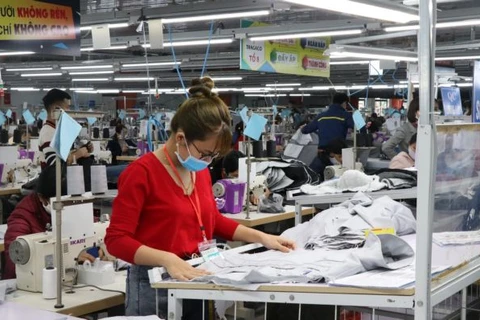
Production line of Jasan Textile and Dyeing Vietnam. Policies are needed to attract investments in dyeing and weaving to increase the supply of materials for the production of garments for export. (Photo: VNA/VNS)
 He added that this is a big improvement as the rate had remained at around 50% for a long time.
Vinatex’s report also revealed that the whole industry's export revenue between January and August was worth 30.2 billion USD, a rise of nearly 20% over the same period last year and the highest growth rate of the past decade. It was estimated that the industry ran a trade surplus of around 17 billion USD in the eight months.
Truong said that among textile and garment exporting countries, Vietnam was the earliest to ease restrictions for normal operation after the COVID-19 pandemic compared to Bangladesh, India and China, which enabled the country to grab the opportunity to promote garment exports.
However, challenges remain for the rest of the year, he said.
He pointed out that other exporting countries are also applying similar policies to promote post-pandemic recovery and resume normal production and business. Meanwhile, global demand is declining on the global economic slowdown and rising inflation.
Vinatex forecast that the average export revenue will decrease to 3.1-3.2 billion USD per month in the four remaining months of this year, compared to the average of 3.8 billion USD per month from January to August.
Truong said that the textile and garment industry hopes to receive the Government’s support in terms of tax and credits.
In the medium and long term, he said that Vinatex will invest in promoting a green and circular economy, adding that the investment will be large, however.
The Vietnam Textile and Apparel Association said that Vietnamese garment and textile enterprises face fierce competition from other major exporters in China, Bangladesh, India and Turkey, in markets with free trade deals, with the rule of origin from yarn and fabric onward being a weakness of Vietnam’s garment industry which has to import 80% of fabrics to produce garments for export.
Statistics showed that, on average, Vietnam spent around 2 billion USD on importing raw materials, mainly from China.
Besides, importing countries are also increasing product criteria. The Vietnam Trade Office in Sweden recently said that the EU and other Nordic countries such as Norway and Iceland are requiring the textile and garment industry to develop more sustainably and circularly.
These countries set stricter requirements for natural and synthetic fibres, which must be organic, recycled or of biological origin. For example, the cotton used in Nordic eco-labelled clothing must not be genetically modified, wholly organic or recycled.
Some Vietnamese firms were investing in research and development of raw materials to reduce the dependence on imported materials, but the supply remained limited.
The association urged the development strategy for the textile and footwear industries to 2030 with a vision to 2035 to be approved early to create conditions for the formation of large industrial parks with the concentrated wastewater treatment system, advanced technologies, and green technologies to attract investment in textile and dyeing.
The association said that this will help tackle the bottlenecks in the fabric supply for garment export and meet origin requirements for tax incentives from free trade agreements.
The Ministry of Industry and Trade said it is important to raise solutions to encourage technology renovation for the weaving and dyeing industry and build a support industry for the garment industry.
The focus should be on attracting investments in treating wastewater and establishing production chains. /.
VNA