Textile - garment exports to grow further this year

Vietnam’s textile - garment industry is set to earn 45 billion USD in exports in 2022, compared to 40.4 billion USD last year, an insider has said.
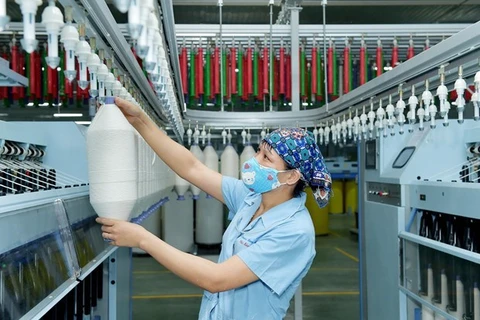
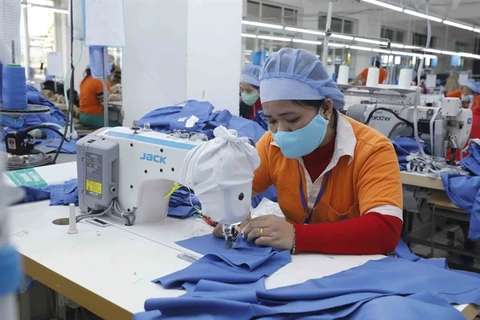
Textile - garment exports to grow further this year ảnh 1A garment factory in Vietnam (Photo: VNA)
Hanoi (VNA) –Vietnam’s textile - garment industry is set to earn 45 billion USD in exports in2022, compared to 40.4 billion USD last year, an insider has said.

Truong Van Cam, Vice Chairmanof the Vietnam Textile and Apparel Association (VITAS), said the industry has been expanding fast over the last five years, at 20 - 26% annually. Vietnam iscurrently the world’s third largest exporter in this regard.

The country’s textile andgarment products are holding a global market share of 5.2%, with the biggestimporters being the US, the Republic of Korea, Japan, and Europe.

Cam held that to sustain thegrowth trend, the State should quickly disburse the financial aid package forenterprises and reform the mindset in attracting investment to textile andgarment material production.

Meanwhile, businesses should adoptgreen manufacturing practices, including reducing and recycling waste, to meetthe growing preference for environmentally friendly products, he added./.
VNA
See more

Production of electronic components at DBG Technology Vietnam Co., Ltd. in Yen Binh Industrial Park, Thai Nguyen province. (Photo: VNA)

Vietnam’s trade surplus with EU expands amid economic headwinds

Trade between Vietnam and the EU maintained momentum during the January–May period, supported by the EU – Vietnam Free Trade Agreement (EVFTA) and sustained demand for key Vietnamese exports, even as the EU grappled with inflationary pressures and sluggish consumer spending.

Containers are unloaded at Nghi Son International Port in Nghi Son ward, Thanh Hoa province. (Photo: VNA)

Vietnam eyes to shape national maritime industrial ecosystem

These advantages provide a strong foundation for the development of the marine economy and logistics services. As a result, the marine economy has been identified as a national strategic priority, with the coordinated development of maritime transport, seaports and shipbuilding serving as a key pillar in shaping a sustainable national maritime industrial ecosystem.

The road to the VSIP Can Tho Industrial Park connecting with National Highway 80 is under construction. (Photo; VNA)

Vietnam draws harder line on FDI quality under new resolution

The Ministry of Finance’s Foreign Investment Agency reported that total registered FDI neared 25 billion USD in the first five months of this year, a jump of almost 35% from a year earlier, with new project registrations driving the bulk of the expansion.

According to Fortune’s latest list, Vinachem ranks 148th among Southeast Asia’s top 500 companies in 2026. (Photo: vinachem.com.vn)

Vinachem makes Fortune Southeast Asia 500 for the first time

According to Fortune’s latest list, Vinachem ranked 148th among Southeast Asia’s top 500 companies in 2026. The ranking is compiled using key financial indicators including revenue, profit and total assets, and covers enterprises from seven regional economies, namely Vietnam, Indonesia, Thailand, Malaysia, Singapore, Philippines and Cambodia.

Lien Khuong International Airport in the central province of Lam Dong (Photo: VNA)

Lien Khuong Airport expected to reopen in August

The project is invested by ACV, with a total investment of over 1 trillion VND (38 million USD), including the repair of the entire runway, taxiways, safety strips, and technical infrastructure and equipment to ensure flight operations.

Representatives of Ho Chi Minh City's tax agency address concerns and clarify tax-related issues raised by the FDI business community. (Photo: VNA)

Ho Chi Minh City moves to ease tax hurdles for FDI firms

The Ho Chi Minh City tax agency said it will maintain regular dialogue with businesses, push ahead with administrative reform and digital transformation, and identify implementation bottlenecks to recommend policy adjustments, facilitating investment and business activities for FDI enterprises.

A workshop on the Halal market is held in Ho Chi Minh City on June 16, 2026. (Photo: VNA)

Growing Halal market offers opportunities for Vietnamese businesses

The Halal market is becoming a promising avenue for businesses in Ho Chi Minh City. With its well-developed manufacturing, trade and service ecosystem and dynamic business community, the city is well positioned to strengthen its role in regional and global Halal supply chains.

Wistron Infocomm Vietnam Co., Ltd, an FDI enterprise, has invested in Dong Van III Industrial Park of Ninh Binh province since 2021, creating jobs for more than 12,800 workers. (Photo: VNA)

Vietnam seeks to position itself as leading destination for foreign investment

A significant shift in the recently issued Resolution 10 is the move from a strategy of attracting “more capital” towards attracting “higher-quality FDI”. The objective is no longer limited to investment volume but extends to absorbing advanced technologies, increasing domestic value creation, strengthening innovation capacity and accelerating modernisation in the economy.

Enterprises must disclose to investors the issuance plan, legal and investment risks and the rights and obligations of issuers and bondholders. (Photo: VNA)

Vietnam tightens rules on corporate bond issuance

Under Decree No 200/2026/ND-CP, enterprises issuing bonds will continue to operate under the principle of self-borrowing, self-repayment and self-responsibility, meaning issuers are fully accountable for the efficiency of capital use, debt repayment capacity and any disputes arising from bond issuance, use of funds, and payment of principal and interest.

A performance on The Huc bridge of the temple as part of a nighttime tourism programme to discover the Ngoc Son temple on Hoan Kiem Lake, downtown Hanoi. (Photo: VNA)

Hanoi adopts framework to boost night-time economy development

The resolution encourages a wide range of cultural, artistic and tourism activities, including performances, exhibitions, film screenings, presentations of traditional and intangible cultural heritage, and other programmes held in public spaces, pedestrian streets, heritage sites, theatres, cinemas and cultural venues.