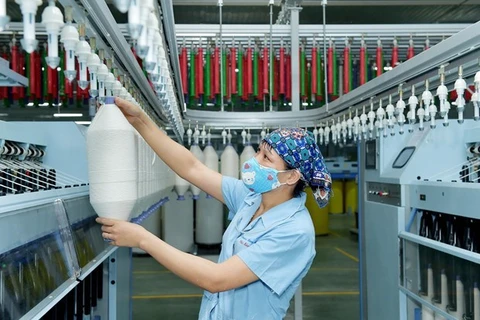
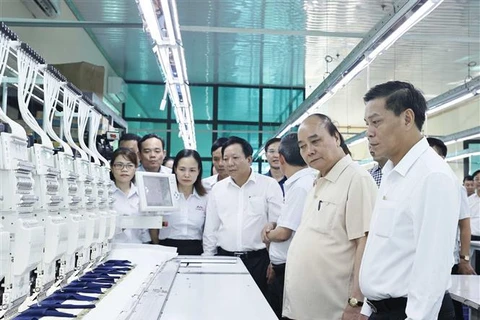
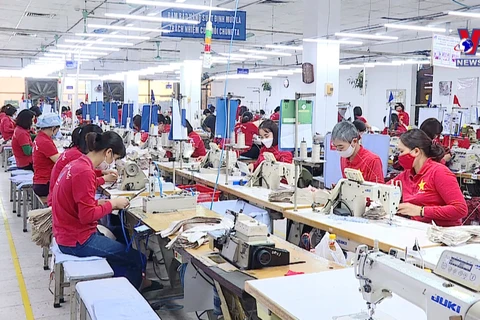
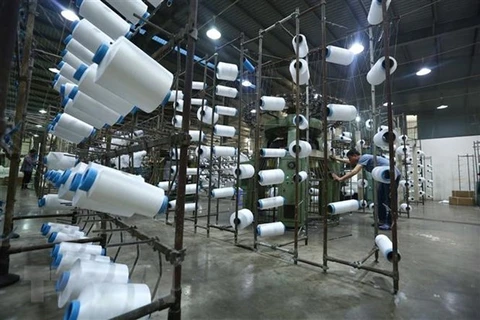
Exports of textile and garments totaled some 22.3 billion USD from January-June (Photo: VNA)
 Hanoi (VNA) – Vietnam’s high-quality garment and textile sector should focus on improving its position in the supply chain and expanding scale, Chairman of the Vietnam National Garment and Textile Group (Vinatex) Le Tien Truong has said.
Vietnam's textile-garment producers have targeted earnings of up to 21 billion USD from exports in the second half of 2022, raising the total of the year to around 42 – 43 billion USD.
The industry has seen a gradual recovery this year after being adversely impacted by the COVID-19 pandemic for the past two years. It enjoyed a trade surplus of 8.86 billion USD in the first half of the year.
Exports of textile and garments totaled some 22.3 billion USD from January-June, a 17.7% increase from the same period last year.
Garment exports alone rose by 19.5% year-on-year to 16.94 billion USD, and that of fabrics reached 1.4 billion USD, up 20.8% year-on-year.
Vietnam imported 13.4 billion USD worth of trims and accessories in H1, up 9.8% year-on-year.
Truong told the press that the target of 42-43 billion USD, or even 44 billion USD, is feasible, but it is crucial to keep a close watch on the situation, given uncertain forecast for the market in the second half.
Vinatex will adopt all necessary measures to maintain jobs, orders and customers to avoid losses, and thus maintaining the sector’s performance in the first six months, he continued.
Vietnamese garments and textiles have been shipped to the US, Europe, Japan and many other countries, the Chairman said, noting that the Vietnamese products rank second in terms of market share in the US, Japan and the Republic of Korea (RoK).
With its widespread presence in major markets, Vietnam now needs to integrate more intensively in the global supply chain, Truong stressed.
As Vietnam loses its price advantage, he suggested the industry pay more attention to the supply of complete packages, covering the production of yarns and fabric, and garments.
At the same time, it needs to adopt a pioneering role in creating green and recycled products, towards circular items, Truong said, citing Vietnam’s commitments of reducing at least 30% of the methane emissions by 2030 and net zero emissions by 2050.
He said Vinatex businesses have installed solar power facilities, which can supply up to 20% of the total electricity needed for yarn production, and 35% of the electricity used by the garment sector.
Vinatex has also optimised clean materials and worked to ensure occupational safety and hygiene, meeting requirements of international buyers, the Chairman said.
Chairman of the Vietnam Textile & Apparel Association (VITAS) Vu Duc Giang also anticipated the industry is facing a bumpy road ahead with various obstacles in the remaining months of 2022. The immense risk of COVID-19 resurgence caused by new variants is still present, he said, adding that strict virus control measures that disrupt the input supply chain and sales remain in place with large trade partners like China, Japan and Taiwan (China).
There are also other threats, including record-high inflation at major importers, including the US and Europe, and the Russia-Ukraine tension triggering a steep rise in prices of inputs, he added.
Prices of cotton, crude oil and petrol soared 19.1%, 40% and 67%, respectively, compared to those at the beginning of this year while transportation cost tripled the average rate of the last five years, driving total expenditures of Vietnamese exporters up as much as 20 – 25%, the official explained.
He further noted that compared to their rivals, Vietnamese exporters are confronting disadvantages in currency exchange rates. They have also been dealing with post-pandemic labour shortage and struggling to fulfil FTA commitments on rule of origin and environment protection, Giang said.
To keep production going and sustainably develop the industry, producers must innovate technologies, promote green transformation, and pay greater attention to training designers, according to Giang.
VITAS has been working to connect domestic and foreign firms. The hope is that it will build supply chains, expand markets, and enhance international cooperation in implementing projects in renewable energy, efficient water use, designing, branding and labour management, he said./.