Genome of rare Linhzhi mushroom conserved

The genome of rare Linhzhi mushrooms has been successfully conserved by scientists of the Phuoc Binh National Park in south central province of Ninh Thuan, opening opportunities for the production of the mushroom.
Genome of rare Linhzhi mushroom conserved ảnh 1Experts from the Phuoc Binh national park checking the mushrooms planted under the forest canopy. (Photo: VNA)

Hanoi (VNA) -
The genome of rare Linhzhi mushrooms has beensuccessfully conserved by scientists of the Phuoc Binh National Park in southcentral province of Ninh Thuan, opening opportunities for the production of themushroom.

The research was part of a project titled ‘Conservation of Linh Chi geneticsources originating from the Phuoc Binh National Park’.

The three-year project was carried out by the Phuoc Binh National ParkManagement Board in cooperation with the Ninh Thuận Science and TechnologyDepartment, the Ho Chi Minh City Institute of Biotechnology and Food, and theInstitute of Food Supplements.

The project was estimated to cost 2 billion VND (86,700 USD).

According to Luu Van Luong, an expert from the park, the research groupconducted several surveys to collect all kind of Linhzhi mushrooms in thenational park as well as test their DNA to name 8 species and add them to listof fauna and flora.

Based on the results, the national park successfully classified and conservedtwo kinds of mushrooms, namely the Ganoderma Lucidu (red Linhzhi) and Humphreyaendertii (black Linhzhi), said Luong.

The genetic preservation was implemented under the off-site or ex situconservation method in laboratories.

A model of conserving and producing the red and black Linhzhi in mushroomhouses and in semi-natural conditions under the forest canopy was carried outby the park.

The model was evaluated by the researchers before being transferred to localfarmers for production, said Luong.

The researchindicators showed that it took 68 days from seeding to harvest for the redmushroom and 88 days for the black ones.

The interval between harvests was 10 or 12 days. The mushroom would bring 3crops if they had good care.

On an area of 30sq.m, the yield of red Linhzhi was nearly 24kg of dry mushroomper 1,000 embryos while black Linhzhi’s yield was 12kg.

Nguyen Tuan Anh, vice head of the park’s international cooperation section,said the Linhzhi gene conservation project had an important meaning in geneticresource preservation to the rare Linhzhi mushrooms of Ninh Thuan province.

The national park has cooperated with scientific agencies to conduct researchto analyse and publish medicinal active ingredients of the Linhzhi originatingfrom the park, Anh said.

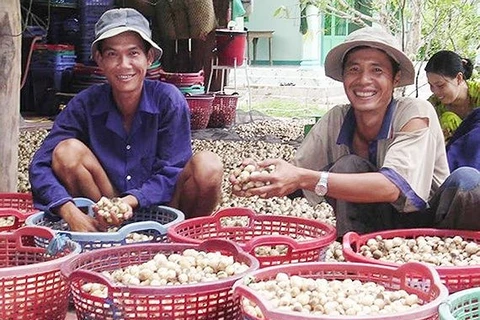
At present, the park had taken 5 households to grow the mushroom as a trial,while offering financial assistance for setting up gardens and providingmushroom embryos.

According to the park’s experts, growing the mushrooms was simple and cheap soit was suitable for poor households./.
VNA
See more

Prof. Dr. Tran Hong Thai, President of the Vietnam Academy of Science and Technology (VAST), has a working session with leaders of Russia’s State Atomic Energy Corporation Rosatom. (Photo: VNA)

Vietnam, Russia develop quantum technology cooperation roadmap

Quantum technology is an emerging field undergoing rapid breakthroughs and requiring enormous investment resources. Learning from the experience of pioneering countries such as Russia will enable Vietnam to significantly shorten the time needed to build its workforce and develop endogenous capabilities.

Senior Vice-President of Latin America and Asia at Thales Group Guy Bonassi (L) at a meeting with Vietnamese Ambassador to France Trinh Duc Hai (Photo published by VNA)

Vietnam, France should expand cooperation in strategic fields: business leader

General Secretary of the Communist Party of Vietnam Central Committee and President To Lam’s visit to France, Guy Bonassi, Senior Vice-President of Latin America and Asia at Thales Group, said the upgrade of bilateral ties to a Comprehensive Strategic Partnership reflects their shared desire to deepen and broaden cooperation, with technological autonomy, resilience and human resources development assuming increasingly important roles.

The Vietnamese delegation led by Deputy Prime Minister Ho Quoc Dung visits the Korea Institute of Science and Technology (KIST). (Photo: VNA)

Vietnam, RoK promote strategic technological cooperation

Deputy Prime Minister Ho Quoc Dung proposed expanding joint research programmes, particularly in strategic areas where Vietnam has development needs, and KIST has strengths, including semiconductor integrated circuits, AI, batteries and energy storage, and biotechnology.

Digital transformation brings economic benefits closer to businesses

Digital transformation brings economic benefits closer to businesses

In addition to streamlining processes and reducing the time required to complete administrative procedures, digital models are creating more opportunities for businesses, household enterprises and small traders to access information, adopt new payment methods, connect with partners and expand their markets.

Images are collected and processed at a satellite image receiving station. (Photo: VNA)

Vietnam, France explore new space technology cooperation opportunities

Building on the effectiveness of VNREDSat-1, Vietnam and France are continuing to promote cooperation in the next phase, including a proposal for VNREDSat-2. The two sides have discussed technological options, resources and an implementation roadmap, with a view not only to developing a new-generation satellite but also to increasing Vietnam’s level of participation and technological capabilities.

Using AI to search and process legal information (Photo: VNA)

Legal profession reshaped in age of artificial intelligence

In Ho Chi Minh City, digital transformation in the legal profession is not simply about introducing more technology into professional practice. It must also create ways of working that ensure technology serves people, while lawyers retain control and responsibility for the quality of legal services. This is particularly important in a metropolis with a large-scale economy and diverse legal needs.

Vietnamese youths learn about AI application scenarios at the China-ASEAN AI Application Cooperation Centre in Guangxi. (Photo: VNA)

China’s Guangxi fosters AI cooperation with Vietnamese localities

During his visit to China and Guangxi in April, General Secretary of the Communist Party of Vietnam (CPV) Central Committee and President To Lam expressed a desire to further expand cooperation between Vietnam, particularly border localities, and Guangxi in areas including AI.

Hanoi Market Surveillance officers inspect products showing signs of violations of regulations on product labelling, advertising and intellectual property. (Photo published by VNA)

Positive progress recorded in tackling intellectual property rights infringements

To raise public and business awareness while improving the effectiveness of preventing and dealing with infringements, the Ministry of Science and Technology will continue working with other ministries, sectors and localities to strengthen intellectual property protection and enforcement on a regular, continuous and sustained basis, with no prohibited areas or exceptions.

Delegates visit exhibition stands at the 2026 national quality and productivity forum in Ho Chi Minh City. (Photo: VNA)

Enabling institutions needed for science-technology to generate new productivity

The Government should shift from providing funding to creating enabling conditions by developing infrastructure, platforms, standards and markets, while coordinating the innovation ecosystem. Innovation and technology diffusion should also go hand in hand, particularly by bringing AI, digital and green technologies to small- and medium-sized enterprises as well as traditional sectors.