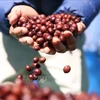
A farmer in Hung Yen province picks longan which were cultivated in accordance with VietGAP standards.
(Source: VNA)
Hanoi (VNS/VNA) - Although Vietnam has many products with geographical indication (GI) certification, the country has failed to exploit the benefits, according to experts. Hung Yen longan is one example.
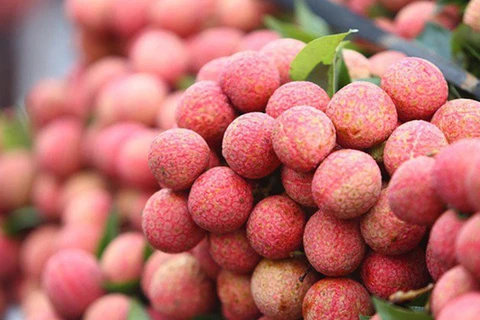
There are many varieties of longan nationwide, but Hung Yen’s ‘long’ longan, known as the fruit for kings, is famous for its thick pulp and sweet taste.
Hung Yen’s long (cage) longan was ranked 13th in the top 50 famous fruits of Vietnam and was registered with a national trademark and geographical indication.
However, many consumers still find it difficult to distinguish between Hung Yen longan and longan from other localities.
Bui Xuan Tam, Director of Ne Chau Longan Cooperative in Hung Yen city’s Hong Nam commune, said longans from other provinces often imitate Hung Yen longan.
“When thinking about Hung Yen, consumers immediately think of long longan, but in fact, there are nearly a dozen varieties of longan in the province,” he said, adding that the province has created a development strategy for Hung Yen longan.
In the future, Hung Yen would recommend growers of delicious longan varieties, which were favoured by consumers, and expand the farming in accordance with VietGAP (Vietnamese Good Agricultural Practices) standards.
Nguyen Van Quan, head of office of Hung Yen province’s Department of Agriculture and Rural Development, said longan without certificates were cheaper than those cultivated by renowned producers.
“It was a challenge to manage the sale of longan as they were sold by street vendors,” he said.
A survey conducted by the Ministry of Industry and Trade (MoIT) showed that only 9.5 percent of enterprises and organisations regularly use GI.
Leaders of the MoIT said enterprises got support in terms of capital during the development of GI but after that they didn’t know how to take the next step.
Another reason was that GI was not granted to the right subject, they said.
GI violations were still taking place in many localities with specialties like Luc Ngan lychee, Ngoc Linh ginseng or Phu Quoc fish sauce.
Recently, intellectual property development has been a concern and invested by localities. The number of products protected by GI has risen to 73 – mainly agricultural products such as fruits and seafood.
The GI has affected the perception of businesses and people about the product’s reputation and value. Therefore, the value and price of the product went up substantially.
Nguyen Xuan Ha from Hoa Binh province’s Cao Phong Orange JSC, said after obtaining GI, the price of orange doubled compared with before.
The economic value of orange cultivation was raised from 250 million VND to 700 million VND (10,800 - 30,000 USD) per one hectare.
In the past, traders used to bring oranges from other localities to Cao Phong District and sold them under this brand. However, Ha said, since the Cao Phong Orange Association was established, the issue has been solved because it was producers who best knew how to identify counterfeit products and who brought the products to the localities.
Cha muc Ha Long (Ha Long grilled squid pie) had a similar experience.
After building a brand, the price of the product increased by 13-17 percent, while consumption rose by 33-35 percent, creating more jobs for local residents.
The current trend of the market requires products of clear origin and trademarks protected by authorities. Therefore, the registration of GI for products is very important in order to improve their value and competitiveness.
With the registration of GI, Vietnamese products are protected in the domestic market as well as have the opportunity to increase export output, particularly to demanding markets like the European Union or Japan.
Effective exploitation of GI
The GI registration is the first step in establishing ownership and legal factors related to local specialties.
In order to develop sustainably, it is necessary to have close coordination between ministries, including the Ministry of Science and Technology, the Ministry of Agriculture and Rural Development, and the Ministry of Industry and Trade in building and managing geographical indications, according to Do Thang Hai, deputy minister of industry and trade.
Localities, enterprises and trade associations also play an important role, he said.
Dao The Anh, Deputy Director of Field Crops Research Institute, said experience from some countries showed that small businesses and enterprises didn’t have enough financial capacity. Thus, the Government will support the use of GI through dissemination on these products’ information to consumers.
Currently, this support is feasible because the country has the "One Product One Commune" Programme (OCOP). The OCOP programme, which aims at promoting local products, would facilitate the exploitation and use of GI.
Once a product obtains GI registration, it should be quickly included in the OCOP Programme to get support in terms of marketing capacity and production as well as improve its quality, he said./.
VNA