Global experts gather in Quang Binh for magnetic materials symposium

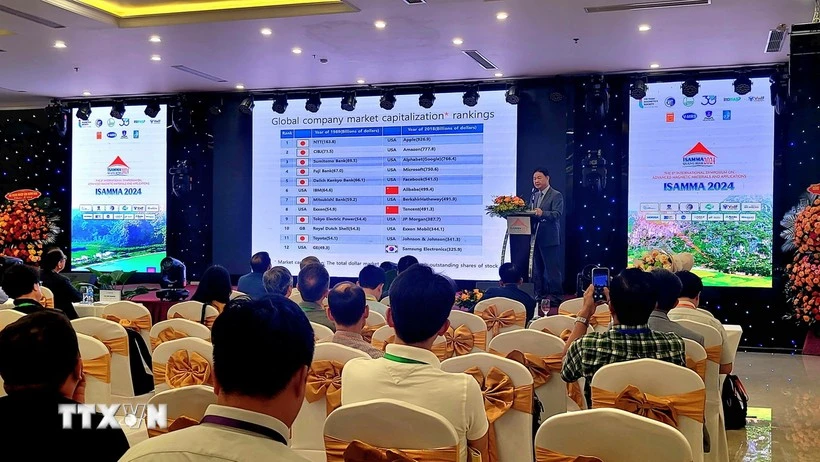
Over 300 leading scientists and industry experts from 20 countries and territories gathered in the central province of Quang Binh on August 5 for the fifth International Symposium on Advanced Magnetic Materials and Applications (ISAMMA 2024).

At the event (Photo: VNA)

Quang Binh (VNA) – Over 300 leading scientists and industry experts from 20 countries and territories gathered in the central province of Quang Binh on August 5 for the fifth International Symposium on Advanced Magnetic Materials and Applications (ISAMMA 2024).

The event brought together the brightest minds in the field, hailing from scientific powerhouses such as Japan, the Republic of Korea (RoK), Russia, China, the US, India, Singapore, Thailand, Spain, Sweden, the Philippines, Slovakia, Italy, France, the UK, and Germany.

In his opening remarks, President of the Vietnam Magnetics Society Prof. Nguyen Huu Duc stressed that ISAMMA 2024 not only represents high scientific value but also fosters the spirit of integration and fair cooperation between Vietnamese science and the global scientific community. It provides an opportunity to advance and accelerate research and application of magnetic materials for Vietnamese industry, he added.

Participants focused their discussions on new studies on advanced and emerging magnetic materials, spin electronics, semiconductor technology, artificial intelligence for energy regeneration, and application of nanomagnetic materials in healthcare.

In a historic first for an international conference on magnetics, two special lectures were presented. Prof. Liesl Folks, Vice President for Semiconductor Strategy at the University of Arizona, delivered a lecture titled "Strategies for Developing the Semiconductor Industry” while Prof. Kyung-Ho Shin, Vice President of the Rok’s Daegu Gyeongbuk Institute of Science and Technology, presented "Creating social value based on sci-tech innovation".

ISAMMA was initiated by Prof. Minoru Takahashi of Tohoku University of Japan in 1987. Magnetics and magnetic materials have seen significant development since the last century, with vast applications spanning daily life and technology, including in electrical and electronic devices, information and communication technology, health care, industry, aerospace, and national defence.

Vietnam has joined activities of the Executive Committee of the Asian Union of Magnetics Societies since 2012 as an observer, became an alternate member in 2017, and achieved full membership in 2018.

The Magnetics Sub-Association, under the Vietnam Physical Society (VPS), was established in 1986, with Prof. Vu Dinh Cu as the head. After a period of inactivity, the VPS decided to revive the magnetics society under the Vietnam Materials Research Society on June 27, 2017./.
VNA

See more

Illustrative photo: AFP

AI Law takes effect, anchors national governance framework

Taken together, the new AI Law and its implementation roadmap not only complete Vietnam’s legal architecture for AI, but also lay a structured foundation for risk management, innovation and ecosystem development, aiming to ensure coherent and effective enforcement in the years ahead.

Viettel Networks and Ericsson sign their cooperation agreement on the sidelines of the Mobile World Congress 2026. (MWC 2026)

Viettel Networks, Ericsson partner to advance autonomous telecom networks

Under a newly signed cooperation agreement, Ericsson will provide network automation platforms and artificial intelligence (AI) technologies while working with Viettel to conduct real-world trials. The collaboration marks a new step forward, combining Viettel’s large-scale network operation expertise with Ericsson’s strengths in automation solutions and advanced technologies.

Prime Minister Pham Minh Chinh speaks with students at Hanoi University of Science and Technology (Photo: VNA)

Resolution 57: Developing high-quality sci-tech human resources key to master strategic technologies

After one year of implementing Resolution No. 57-NQ/TW of the Politburo, alongside notable achievements, the Central Steering Committee for science and technology development, innovation, and digital transformation has identified persistent shortcomings and bottlenecks requiring urgent attention - most notably a shortage of high-quality human resources in strategic technology fields.

The Saigon Hi-Tech Park (Photo: VNA)

Vietnam advances toward mastering UAV technology

Products are already making their way into the US market, but this is not merely a story of applying new technology in practice, but a gradual process of mastering core details and affirming international capabilities in the UAV industry, one of Vietnam’s strategic high-tech sectors.

Tran Quang Hung, Chairman of the Board of Directors of HIC, presents the company’s operating model at the launch event. (Photo: hanoimoi.vn)

Hanoi’s innovation centre to drive digital transformation, creative industries

HIC is envisioned as a central “brain” connecting data, resources, policies, technology and culture to address urban development challenges, operate the national innovation ecosystem, promote a sustainable digital economy and digital society, improve the quality of life for local residents, and foster creative industries, particularly cultural industries linked to Hanoi’s identity.

Participants pose for a group photo at the International Conference on Advanced Microscopy for Life Sciences and Materials held in Gia Lai on February 25. (Photo: ICISE)

International conference spotlights advanced microscopy in life sciences, materials

The microscopy user community in Vietnam remains fragmented, lacking a common platform for sharing technical expertise, research experience and collaboration opportunities. This limited connectivity has, to some extent, curtailed the full potential of microscopy technologies in advancing scientific progress and industrial applications at home and abroad.

With just a smartphone, travellers can search for and book a variety of travel services for their journey. (Photo: VNA)

Digital transformation – a lever for building a smart tourism ecosystem

In recent years, digital transformation has become a common feature in socio-economic development strategies. For tourism – a multi-sector, experience-driven industry closely tied to information – digitalisation is no longer a trend but an inevitable requirement to enhance competitiveness and ensure sustainable development.