Hanoi (VNA) – Eyeing great opportunities to make full use of artificial intelligence (AI) for promoting economic growth and deal with social issues, Vietnam is striving to develop and apply AI in a responsible manner.
With the goal of turning AI into an important technology field in Vietnam, in January 2021, the Prime Minister issued the National Strategy on Research, Development and Application of AI until 2030, with an aim of making Vietnam a centre for innovation and the development of AI solutions and applications in the ASEAN region by 2030.
After three years of implementing the strategy, Vietnam has achieved initial results, rising to the 59th position out of 193 countries, and the 5th position out of the 10 ASEAN countries in the Government AI Readiness Index from Oxford Insights in 2023.
However, the rapid AI growth has also posed many challenges in management, especially those related to cybersecurity, the protection of personal information, intellectual property protection, and the determination of legal responsibilities of stakeholders related to AI.
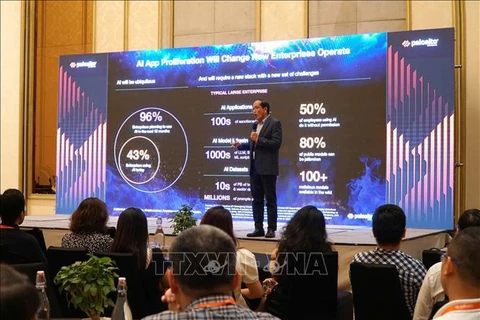
At the Vietnam Artificial Intelligence Day 2024 (AI4VN 2024), head of the Party Central Committee’s Economic Commission Tran Luu Quang affirmed that Vietnam always takes the interest of the nation, society and people as the centre of AI development and application. Vietnam will absolutely not abuse technology to infringe upon these legitimate rights and interests, he stressed.
Currently, many organisations and countries around the world have made efforts to develop a legal and ethical framework to manage, control and promote responsible AI. It can be said that the world is relatively unified on the basic principles of responsible AI, which affirm that AI must be for humans, not harmful to humans; AI must ensure that it performs as intended; it must be safe and secure, fair and equitable, and transparent and explainable, and protect personal data and copyrights.
Over the years, the Ministry of Science and Technology (MoST) as well as relevant ministries and sectors have worked hard to perfect the legal corridor and implement practical mechanisms and policies to facilitate the development of AI in Vietnam and develop AI responsibly.
MoST Deputy Minister Bui The Duy said that ethics and responsibility in AI lie at all stages, from algorithm development, data collection, to training tools and applications. Therefore, this issue must be taken into account right from the system development stage, involving many ministries and sectors. In addition, ensuring personal data security, respecting copyright, intellectual property rights, improving labour productivity while protecting the environment and social security are also considered important matters.
In June, 2024, the MoST issued Decision No. 1290/QD-BKHCN on a number of principles on research and development of responsible AI systems towards a human-cantered society where everyone enjoys the benefits of AI systems, ensuring a reasonable balance between the benefits and risks of the systems.
Accordingly, the nine principles for research and development of responsible AI systems and guidelines for implementation are spirit of cooperation, promoting innovation; transparency; controllability; safety; security; privacy; respect for human rights and dignity; user support; and accountability.
The decision is the first document in Vietnam that sets out general principles in the research and development of responsible AI systems.
Duy said that these principles and guidelines will continue to be researched and updated to suit practical situations./.
See more
Vietnam pushes stronger basic research to drive innovation, self-reliance
Prof. Dr. Nguyen Van Minh, former rector of the Hanoi National University of Education, said basic research not only generates new knowledge but also fosters innovation and improves the quality of economic growth. Vietnam's growing research capacity has enhanced its regional and international standing while contributing to sustainable development, strategic autonomy, national defence and governance.
Global technology firms partner with Da Nang to develop AI infrastructure
Da Nang is committed to supporting businesses, particularly small- and medium-sized enterprises (SMEs), in digital transformation, AI adoption, and workforce development, with the goal of becoming a hub for innovation and AI development in central Vietnam, said a local official.
Deputy PM outlines five strategic pillars for AI development
Deputy PM Ho Quoc Dung said the current priority is to change the mindset. AI should not be developed in isolation by individual agencies or organisations but through an interconnected ecosystem linking the State, universities and research institutes, and businesses.
Innovation challenge seeks AI-native solutions to real-world problems
Following a rigorous five-week intensive bootcamp led by experts from Google Research, Stanford, and NVIDIA, the teams entered a grueling 48-hour AI hackathon to develop AI-native applications.
Vietnam, IAEA expand cooperation in peaceful nuclear applications
Vietnam is implementing 19 cooperation projects with the IAEA in different areas, including agriculture, healthcare, nuclear safety and security, and physical and chemical sciences. The initiatives demonstrate how nuclear technologies can contribute to socio-economic development.
Vietnam, RoK deepen startup ecosystem connectivity
Both sides agreed that Vietnam-RoK startup cooperation must pivot from fact-finding tours, trade shows and short-term networking towards a hard-nosed partnership model that delivers concrete market access, business partner matchmaking, product validation, technology piloting and investor connectivity.
VinFuture's global science network delivers lasting value for Vietnam
Via conferences, expert dialogues, networking and inspirational talks, VinFuture has brought many of the world's leading scientists to Vietnam not just to share knowledge, but to co-design research, advise on talent pipelines, and build practical solutions for the country’s most urgent problems.
PM orders faster implementation of science, technology, digital transformation agenda
Under Directive No. 29/CT-TTg, the Prime Minister instructed ministers, heads of ministerial-level agencies and provincial and municipal leaders to treat science, technology, innovation and digital transformation as a top political priority, stressing that faster disbursement must go hand in hand with efficiency, transparency and the prevention of waste and corruption.
Science – technology, innovation central to Vietnam’s development strategy
End-to-end electronic processing rates have climbed to 91.7% for outgoing documents and 93.8% for incoming ones, the highest nationwide. The rate of administrative procedures handled entirely online has surged to roughly 97–99% at present from 89.65% as of July 1, 2025
Robot- and AI-driven advances in stroke care introduced at Can Tho conference
Experts are introducing six-dimensional (6D) cerebral vascular imaging for treatment planning, AI-assisted stroke imaging, and robotic intervention and rehabilitation. They are also presenting next-generation neurointerventional devices and personalised treatment strategies to shorten treatment times, improve survival rates, and reduce long-term disability.
Vietnam strengthens position in Asia’s AI trade landscape
HSBC (Hongkong and Shanghai Banking Corporation Limited) identifies Vietnam as the economy that has recorded the fastest improvement in its position within the AI supply chain. The country’s share of global trade in AI-related equipment surged from 1.2% in 2015 to 12.4% in 2025, the strongest increase worldwide during the period.
Japan-based semiconductor expert sees broad cooperation opportunities with Vietnam
Japan is aware that no country can single-handedly manage the entire semiconductor supply chain, so cooperation with partners like the US, Europe, and Asian countries including Vietnam forms a crucial part of Japan's strategy, said Assoc. Prof. Dr Le Duc Anh of the University of Tokyo.
Expert proposes 3 strategies for Vietnam to develop strategic technology products
Dr Ta Anh Phuong, CEO of Seinetime, a French technology start-up specialising in data personalisation and artificial intelligence (AI) solutions, said Vietnam's strategic technology goods should pass a global relevance test and strive to achieve strategic indispensability, making them products that international corporations actively seek to incorporate into their operations.
ICISE urged to strengthen role in advancing Vietnam's science
Deputy Prime Minister Ho Quoc Dung expressed his hope that Professor Tran Thanh Van, the Rencontres du Vietnam Association and ICISE would continue serving as bridges between Vietnam and the international scientific community, attracting leading researchers and making practical contributions to the country's scientific and technological progress.
Gia Lai province hosts 10th Vietnam School on Neutrinos
During the event, participants receive both fundamental and advanced training in particle physics and neutrino science through lectures covering neutrino physics, the Standard Model, particle and radiation detectors, reactor neutrino experiments, high-energy neutrino astronomy, supernova neutrinos, and major international projects such as Super-Kamiokande, T2K and Hyper-Kamiokande.
Data resources key to transforming Vietnam’s growth model
Experts said an efficient data market will ensure that data flows to sectors where it generates the greatest economic value, thereby improving the economy's overall efficiency.
Vietnam should prioritise semiconductor manufacturing and packaging: Japanese expert
As Vietnam implements the Politburo's Resolution No. 57-NQ/TW on breakthroughs in science, technology, innovation and national digital transformation, the development of a domestic semiconductor industry has become an important strategic priority.
Vietnam tops Southeast Asia in AI learning on Gemini: Google
Academic queries account for 17% of all prompts submitted by Vietnamese users, well above the regional average of 11%, cementing Vietnam’s position as the region’s top adopter of AI for education.
Vietnam designates October 15 as National Digital Citizen Day
Under the newly issued resolution, citizens have the right to control the use of their personal data, access digital services and receive legal protection in the digital environment.
Top leader unveils people-centred vision for new development model
Vietnam's growth model, long fueled by low-cost labour, resource extraction, contract manufacturing, expanded investment, and capital accumulation, has run out of road. The country now needs a sweeping reform agenda to shift from extensive growth to a model driven by productivity, knowledge, science and technology, innovation, and digital transformation.