Gov’t studies making use of idle dollars, gold

How to mobilise idle foreign currency and gold from locals to invest in business and production has become a hot issue recently, with the Government once again asking the central bank to consider proposals.
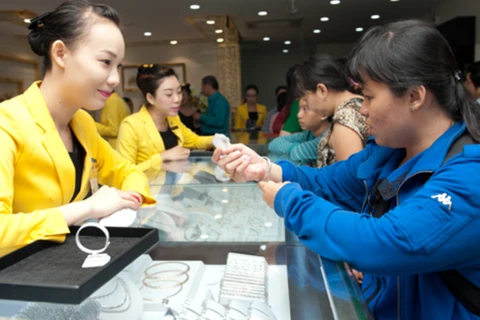
Gov’t studies making use of idle dollars, gold ảnh 1Customers buy gold at a B​ao T​in- M​inh Ch​au Jewellery Company shop in Tr​an Nh​an T​ong Street, H​anoi​ (Photo: VNA)
Hanoi (VNS/VNA) - How to mobiliseidle foreign currency and gold from locals to invest in business and productionhas become a hot issue recently, with the Government last week once againasking the State Bank of Vietnam (SBV) to consider proposals.

At a working session with SBV last week,Government Office chairman Mai Tien Dung said the Prime Minister has asked SBVto study a more appropriate interest rate policy to encourage local US dollarholders to deposit the currency in banks, as the current interest rate of zero percentdiscourages them to put money in credit institutions. At present, Vietnam stillhas to borrow dollars from international markets at 4 percent interest, so thereshould be suitable policies to tap dollars at home, he noted.

It is the third time the Prime Minister hasmentioned the issue.

Vietnam stopped the mobilisation of gold in2011, and a similar move was applied for the dollar in 2015 when the zero percentinterest rate for dollar deposits came into effect. The policies havecontributed to restricting dollarisation and goldenisation in the economy andavoiding chaos in the market, with locals not using the dollar and gold asmeans of payment.

However, with the application of thepolicies, for gold alone, it is estimated that there are currently some 500tonnes held by the people, which would be very useful if converted into the dongto invest in the economy.

A similar trend was also seen for the idle dollarsource. SBV applied the zero percent dollar deposit policy in December 2015,which has contributed to curbing dollarisation in the economy, controllinginflation and stabilising the macro economy. However, it has also preventeddollar holders from depositing the greenback in banks.

As a result, some experts felt it is timeto get rid of the policy while the dollar/dong exchange rate was relativelystable and inflation was low.

Tien Phong Bank director Nguyen Hung saidit would be difficult to continue with the policy, especially with the USFederal Reserve increasing the interest rate. As the economy’s resources reachtheir limit, the benefits of adjusting interest rates higher to mobilisedollars to create new stimulus and generate a large source of capital for thebanking system should be calculated, he added.

Echoing Hung, banking and finance expert CanVan Luc also proposed to adjust the interest rate upwards, since according tohis analysis, that local demand for dollar loans was very large.

According to Luc, in the first half of 2017alone, demand for foreign currency loans increased by some 5 percent against1.5-2 percent in the same period of 2016. Commercial banks were borrowingdollars from abroad at an interest rate of 2.5 percent per year. Mobilisationfrom the local people would be cheaper and not subject to several restrictions.This move would contribute to lowering both input and output interest rateswhile still avoiding a dollarisation situation, he said.

If the interest rate was maintained at zeropercent, keeping dollars at home or depositing them in banks was the same, butif the three-month term had low deposit rates, such as 0.25 percent, thenpeople would consider depositing dollars in banks. This would generate arelatively stable capital source for banks. If the term was more than one year,the medium and long term mobilisation structure of the banking system would beraised, the expert analysed.

Besides using banks as an indirect channelto mobilise dollars, Nguyen Van Thuan from HCM City Finance and MarketingUniversity also proposed to use the stock market as a direct channel to attractthe source.

However, he said, the Government shouldtake more measures to make the stock market more transparent, with listed firmspaying due heed to sustainable growth, to attract dollar and gold holders.

To mobilise gold, Luc proposed to issuegold free interest rate deposit certificates, which the holders could mortgageat banks for loans.

According to Luc, the measure was moreflexible and would not increase goldenisation in the economy. He said othercountries such as India had been successful in applying this measure; however,he noted that the application must be scrutinised and if it adopted, a suitabletime must be chosen.

Tien Phong Bank’s Hung also affirmed thatsuccessful gold mobilisation to reinvest in business and production would bebeneficial, but it should have an appropriate policy as gold is quite differentfrom money.

Gold mobilisation is complicated and riskyas its price depends on the global and domestic market, he said, adding carefulscrutiny is required to make the mobilisation effective.

Experts also agreed that the most importantthing was to keep the macro economy stable and create a favourable businessenvironment, explaining that gold and dollar holders would automaticallyconvert it into dong when they found profitable opportunities in a stable macroeconomy.-VNA
VNA

See more

Delegates share information during the livestream programme. (Photo: VNA)

Bac Ninh promotes agricultural products through livestream

More than 300 products from Bac Ninh, Hanoi, Hung Yen, Son La, Thai Nguyen and Phu Tho were showcased during a livestream session held by the Bac Ninh Farmers' Union, ranging from traditional foods, agricultural products and medicinal herbs to natural products, OCOP goods, handicrafts and craft village products.

An automobile assembly line of THACO Truong Hai Group. (Photo: VNA)

Flexible fiscal policy helps drive economic growth

According to the Ministry of Finance, State budget revenue in the first eight months of 2026 was estimated at 2.02 quadrillion VND (77.7 billion USD), equivalent to 80% of the annual estimate and up 16% year-on-year. Domestic revenue reached 1.75 quadrillion VND, accounting for 86.6% of total revenue and rising 16.6%.

Visitors explore Vietnamese products at WorldFood Moscow 2026. (Photo: VNA)

Vietnamese goods step up market expansion in Russia

The Vietnamese participants are showcasing a wide range of products, including beverages, fresh and dried fruit, processed foods, instant foods and dipping sauces, while seeking distribution partners, expanding their market presence and increasing brand recognition in the country.

A Vietnamese manufacturer showcases a modern production line at VietnamPrintPack 2026. (Photo: VNA)

VietnamPrintPack 2026 kicks off in Ho Chi Minh City

VietnamPrintPack 2026 serves as a hub connecting the supply chain, showcasing breakthrough solutions in automation, digital printing, radio-frequency identification (RFID)-integrated smart packaging, and eco-friendly materials across Vietnam's industrial landscape.

Gemalink International Port in Ho Chi Minh City is one of the strategic seaports for industry, trade and global integration. (Photo: VNA)

Vietnam deepens global supply-chain integration

Deputy Minister of Industry and Trade Phan Thi Thang said Vietnam remains a top priority for international corporations and buyers seeking new sources of supply, thanks to its 17 FTAs, stable investment environment, improving production capacity and strategic location in Southeast Asia.

Illustrative image (Photo: VNA)

Vietravel Airlines resumes Hanoi – Da Lat route

Resuming the route is part of the carrier's year-end operating plan. It's a concrete step toward optimising the airline's domestic network, and a sign of its commitment to helping Lam Dong province revitalise tourism following the airport upgrades, its representative said.

Prof. Tan Jian Ping, Director of the Centre of Excellence for Sustainable Technologies for Agricultural Advancement and a Zero-Waste Economy (STARGAZE) at Xiamen University Malaysia (Photo published by VNA)

Vietnam, Malaysia see potential for smart agriculture cooperation

Prof. Tan Jian Ping, Director of the Centre of Excellence for Sustainable Technologies for Agricultural Advancement and a Zero-Waste Economy (STARGAZE) at Xiamen University Malaysia (XMUM), said NAP 2.0 focuses on applying Industry 4.0 technologies, including the Internet of Things (IoT), unmanned aerial vehicles, artificial intelligence (AI), automation and biotechnology.

The 30th Export Day draws representatives from various organisations and businesses in Argentina. (Photo: VNA)

Vietnam, Argentina eye broader Mercosur access amid free trade push

During the 30th Export Day, organised on September 15 in Buenos Aires by the Chamber of Exporters of the Argentine Republic (CERA) under the theme "New Export Frontier: The Transformation Underway," Vietnamese Ambassador to Argentina Ngo Minh Nguyet highlighted that Vietnam considers Argentina and Mercosur important partners in South America and sees broad potential to deepen trade and investment ties.

Drone is used in seeding, fertilising and pesticide spraying (Photo: VNA)

Greening agriculture through low-emission crop production

The scheme to sustainably develop 1 million ha of high-quality, low-emission rice in the Mekong Delta by 2030 is advancing, said Nguyen Quoc Manh, Deputy Director of the Department of Plant Production and Protection at the Ministry of Agriculture and Environment.

DACE launches organic spice processing, preservation and export plant in Cao Bang (Photo: VNA)

Cao Bang develops organic farming zones linked to European markets

Around 2,353ha of farmland in the province meets organic standards, including more than 2,332ha of spice-growing areas cultivating cinnamon, star anise and ginger that have obtained internationally recognised certifications such as USDA (US), EU and JAS (Japan).

Electronic components are produced at a factory in Hanoi. (Photo: VNA)

Hanoi's imports surge 41% in first eight months of 2026

Hanoi aims to achieve average annual export growth of at least 12% during 2026-30, with the city seeking to diversify export markets, boost high-tech and value-added products and reduce reliance on traditional markets.