Govt' to consider zero-interest loans for all airlines

The Government Office has instructed the Ministry of Planning and Investment, the Ministry of Finance, the Ministry of Transport and the State Bank of Vietnam to study a proposal by the Vietnam Aviation Business Association (VABA), in which the airline industry is to gain access to 25 trillion VND (over 1.1 billion USD) of zero-interest loans.
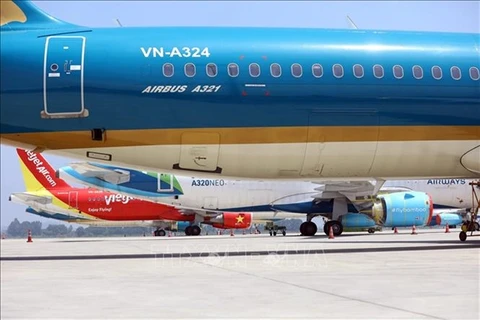
Govt' to consider zero-interest loans for all airlines ảnh 1The Government is considering a 25 trillion VND zero-interest loan package for all Vietnamese airlines in a bid to support the industry during the pandemic. (Photo: VNA)
Hanoi (VNA) - The Government Office has instructed the Ministry of Planning andInvestment, the Ministry of Finance, the Ministry of Transport and theState Bank of Vietnam to study a proposal by the Vietnam Aviation BusinessAssociation (VABA), in which the airline industry is to gain access to 25trillion VND (over 1.1 billion USD) of zero-interest loans.

The loans,according to VABA, are intended to help the airlines to cover recurringexpenses, acquire supply and new machinery and to perform maintenance dutiesduring the pandemic. The loan amount will be subject to the size of eachairline, its share of the market and the amount it contributed to the Statebudget.

Theassociation cited a 4 trillion VND, zero-interest, 3-year-term loan granted toVietnam Airlines as a basis for their proposal, saying the Government mustensure a level playing field. In addition, it has also demanded a 70 percentcut in environmental tax for all the airlines.

VABA's ChairmanPham Viet Dung said the tax was no longer applicable as almost allinternational and domestic flights have been shuttered. VABA, therefore, askedthe Government to reduce the tax from 3,000 VND, or 0.13 USD, to 1,000 VND fromnow until June 6, 2022.

In addition,VABA asked the Government to consider a proposal to slash 30 percent off theairlines' income tax for 2020 and the first half of 2021, 50 percent off VATtax, industry workers' income tax and 50 percent off taxable amount on spareparts for aeroplanes.

Theassociation said the third and fourth outbreak of the novel coronavirus in Vietnam resulted in a 90 percent drop in revenue for the airlines, compared to thepre-pandemic level.

A VABA reportsaid almost all international and domestic flights have been stopped since May.Revenue dropped by 60 percent compared to the previous period as airlinesreported a combined loss of 16 trillion VND in 2020.

The airlineshave had to pay more than 100 billion VND (4.4 million USD) every day while80-90 percent of their fleets were grounded, according to Bui Doan Ne, Vice Presidentof the Vietnam Aviation Business Association (VABA).

Short-termdebts due for payment among the three largest airlines have reached a total of 36trillion VND, with VNA alone accounting for 20 trillion VND. VABA has askedbanks for loans worth 30 trillion VND, of which 10-12 trillion VND allocated toVNA, 10 trillion VND to Vietjet, 5 trillion VND to Bamboo Airways, 5.7 trillionVND to Pacific Airlines and 1 trillion VND to Vietravel Airlines.

In a recentdevelopment, VABA has sent a number of proposals on how to support the airlineindustry's recovery. The proposals include faster vaccination of thepopulation, a standardised COVID-19 testing protocol, internationallyrecognised vaccine passports and the establishment of safe travel corridors forinternational visitors./.
VNA

See more

A refilling station of Petrolimex (Photo: VNA)

Import tariffs on certain fuel products reduced to 0%

Rising tensions in the Middle East, particularly the conflict involving the US, Israel and Iran, have significantly affected the global energy market, especially shipping activity through the Strait of Hormuz – a strategic route for transporting crude oil from the region.

Fishermen raise the national flag before heading out to the sea to affirm Vietnam’s sovereignty over its seas and islands. (Photo: VNA)

Dong Thap promotes IUU awareness from start of fishing season

Gia Thuan commune, located in the eastern part of the province, is a key fishing locality with 563 fishing vessels, including 423 offshore boats and 140 nearshore vessels, producing an average annual catch of over 42,970 tonnes of seafood.

Industrial production surges in the first two months of 2026. (Photo: VNA)

Industrial production posts strong growth in first two months

According to the National Statistics Office (NSO) under the Ministry of Finance, the index of industrial production (IIP) in February was estimated to decrease 18.4% from the previous month but increase 1% year on year. Overall, in the January–February period, the IIP rose 10.4% compared with the same period last year.

A delegation from the Nghe An provincial People’s Committee inspects production and business activities at the VSIP Nghe An Industrial, Urban and Service Park. (Photo:nhandan.vn)

Nghe An steps up reforms to attract FDI

In 2025, the provincial People’s Committee licensed 25 new FDI projects and approved capital adjustments for 20 others, bringing the total newly registered and additional investment to more than 1 billion USD. Many large-scale projects in the Southeast Nghe An Economic Zone have already become operational, contributing to export growth, state budget revenues and job creation.

Nearly 35,500 enterprises are newly registered nationwide, with total registered capital reaching nearly 313.7 trillion VND and more than 167,500 registered workers. (Photo: VNA)

Nearly 35,500 new businesses set up in first two months

The enterprises registered combined capital of about 313.7 trillion VND and more than 167,500 employees. Compared with the same period last year, the number of new businesses surged by 70.7%, while registered capital rose by 36.1% and registered labour increased by 19.1%.

The yarn factory of Unitex Textile and Dyeing Company Limited applies new technology to optimise operations using an automated model. (Photo: VNA)

Resolution 68: International lessons for private sector development

A common feature in many successful economies is a fundamental shift in the perception of private enterprises. In countries such as Singapore, Germany, Republic of Korea (RoK) and China, private firms are viewed not mainly as entities requiring strict control but as development partners and key forces generating growth, jobs and innovation.