Green transition an urgent need for sustainable export to EU: confab

To secure sustainable export to the EU, Vietnamese enterprises must adopt green production and apply high technology to meet the EU’s strict technical and environmental standards, heard a seminar held in Hanoi on September 19.
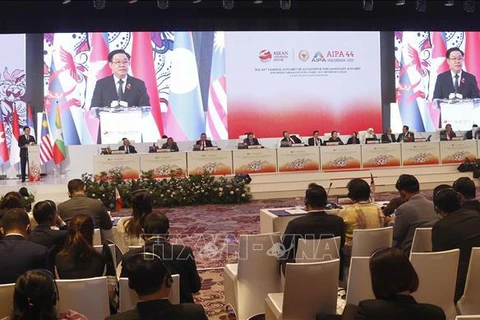
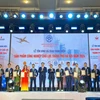
Green transition an urgent need for sustainable export to EU: confab ảnh 1Some speakers at the seminar held in Hanoi on September 19 (Photo: VNA)
Hanoi (VNA) – To securesustainable export to the EU, Vietnamese enterprises must adopt greenproduction and apply high technology to meet the EU’s strict technical andenvironmental standards, heard a seminar held in Hanoi on September 19.

Participants in the event, organisedby the Cong Thuong (Industry & Trade) magazine, pointed out that in thethird year of implementing the EU - Vietnam Free Trade Agreement (EVFTA), thecountry’s export advantages and results have been partly affected by the EU’s furtherapplication of high standards and increase of special requirements related toenvironment and sustainability for imports.

Ngo Chung Khanh, Deputy Director ofthe Multilateral Trade Policy Department at the Ministry of Industry and Trade,said sustainable development is a chapter of the EVFTA, and it coversenvironmental and labour aspects.

Unlikenormal free trade agreements, sustainability forms a very important part of theEVFTA, so businesses exporting goods to the EU need to pay more attention tothe issues mentioned in this deal, he went on.

NguyenHong Loan, an expert of the technical assistance project on impact assessmentof the EU’s Carbon Border Adjustment Mechanism (CBAM), said the EU has long hadvery high environmental standards. These regulations have been tightened recently,starting with the approval of the European Green Deal that targets slashing thegreenhouse gas emissions by 55% by 2030 compared to 1990 and achieving net zeroemissions by 2050.

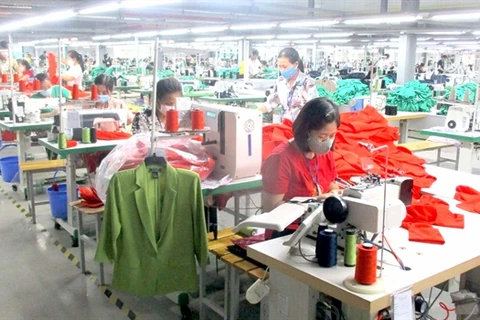
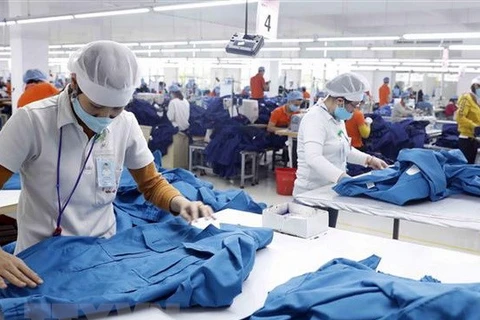
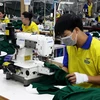
Green transition an urgent need for sustainable export to EU: confab ảnh 2A garment factory in Vietnam. Garment is among the country's main exports to the EU. (Photo: VNA)
NguyenThi Thu Trang, Director of the Centre for WTO and International Trade under theVietnam Chamber of Commerce and Industry (VCCI), noted that the EU’s green orsustainability standards cover all the products considered strengths ofVietnam, including agricultural and fishery products, wood items, textile -garment, and leather - footwear. Therefore, the number and scope of affected Vietnamesebusinesses and exports are considerable.

Thisis also a challenge to domestic firms since those standards require gradual changestowards sustainability, which means businesses have to keep frequent monitoringto ensure their adherence. Besides, the compliance with these standards alsoneeds better awareness, greater efforts, and bigger expenses from businesses,especially small- and medium-sized ones, she added.

VuongDuc Anh, Chief of the Office of the Board of Directors at the Vietnam NationalTextile and Garment Group (Vinatex), said that to Vinatex, sustainabledevelopment is a long-term strategy that could not be carried out overnight orimmediately. Therefore, the group will have to closely follow requirements ofmarkets.

Vinatex is working to ready strategicmanpower for sustainable development by improving their awareness and equippingthem with necessary knowledge. In particular, the pilot manufacturing of sustainableproducts will be costly but also necessary since sustainable development isdefinitely a target in its medium- and long-term strategies, Anh added./.
VNA
See more

Workers process tra (pangasius) for export (Photo: VNA)

Vietnam–Singapore trade continues to thrive

For the year as a whole, Vietnam retained its position as Singapore’s 10th largest trading partner. Bilateral trade reached a record high of nearly 40 billion SGD, up 26.2% from the previous peak of 31.67 billion SGD recorded in 2024.

Eric Van Vaerenbergh, an energy expert and lecturer at the Brussels Engineering School (ECAM) (Photo: VNA)

Belgian expert optimistic about Vietnam’s economic outlook

Vietnam should move from a growth model based mainly on expanding capital and labour to one driven by productivity improvements. He said that this requires enhancing the quality of the workforce, particularly engineers, technicians, and managers in industrial sectors.

Workers at the VSIP Hai Phong industrial and urban complex, which specialises in producing electronic components for office equipment. (Photo: VNA)

Roadmap aims to improve business climate and boost competitiveness

By the end of 2026, Vietnam aims to rank among the world’s top 50 performers in the United Nations Sustainable Development Goals, advance at least three places in the International Property Rights Index, and climb at least one position in the Global Innovation Index.

Vietnam is strengthening its position in the technology value chain, becoming a major manufacturing hub for complete consumer electronics products. (Photo: VNA)

ESG standards offer opportunities to reposition Vietnam’s electronics firms

The 2025-2027 period will be a critical turning point, as exporters to the European market will be required to strictly comply with ESG standards, including net-zero emissions roadmaps, labour standards, corporate governance and transparency requirements. As a key export sector, the electronics industry is being directly and strongly affected by this shift.

A production line for camera modules and electronic components at the factory of MCNEX VINA Co. Ltd, a Republic of Korean-invested company in Phuc Son Industrial Park, Ninh Binh province. (Photo: VNA)

Science, technology, innovation as engines of economic growth

To ensure that science and technology truly act as a powerful growth engine, experts emphasised the need for the Government to put in place supportive mechanisms and policies that encourage enterprises to invest in research and development, while strengthening cooperation among the State, research institutions and the business sector.

The headquarters of the Ministry of Industry and Trade in Hanoi (Photo: VNA)

PM updates lead roles to drive UKVFTA forward

The Ministry of Industry and Trade (MoIT) is named the lead agency, with overall responsibility for the agreement’s general goals and definitions, trade remedies, non-tariff barriers to trade and investment in renewable energy, competition policies, State-owned enterprises, enterprises with special or exclusive rights and those with designated monopolies, as well as institutional, general and final terms.

Vietravel Airlines is taking measures to enhance service quality and optimise operations amid high travel demand during Tet. (Photo: VNA)

Vietravel Airlines to add new route serving Lunar New Year travel peak

During the peak period of the Lunar New Year (Tet) festival in 2026, Vietravel Airlines plans to operate six – eight flights daily on the Ho Chi Minh City – Hanoi route, three flights daily on the Ho Chi Minh City – Da Nang and Ho Chi Minh City – Vinh routes; and two flights daily on the Ho Chi Minh City – Quy Nhon route.

The completion of Can Tho - Ca Mau expressway has helped shorten travel time from Can Tho to Ca Mau to just one hour and a half (Photo: VNA)

Can Tho–Ca Mau expressway fully opens from January 19

The new section, together with the Can Tho–Hau Giang segment that has been operating smoothly since late December last year, has completed the entire 110.85-km route. With total investment exceeding 27.52 trillion VND (1.04 billion USD), the four-lane expressway is built to modern standards and serves as a key transport artery linking major economic and political centres, industrial zones and seaports in the southwestern region.