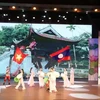
Cheo performance on stage (Photo: VNA)
 Hanoi (VNA) – Hanoi is among localities with the richest cultural heritage in Vietnam, with 1,793 intangible cultural heritage items, including three UNESCO-recognised Intangible Cultural Heritages of Humanity, one on UNESCO list of Intangible Cultural Heritage in need of Urgent Safeguarding and one World Documentary Heritage.
As many of the heritages are facing the threat of falling into oblivion, the capital city is busy with activities to protect them.
Within the framework of a project on inventory and protection of intangible cultural heritages during 2015-2016, the municipal Department of Culture and Sports assisted in the popularisation of “Trong quan” folk song in Hat Mon commune, Phuc Tho district; Khanh Ha commune, Thuong Tin district; and Phuc Tien commune, Phu Xuyen district.
Since 2017, the department has also helped organise training courses on folk performance arts in the community such as puppetry, ca tru and cheo singing, gong dances, and others.
Head of the department’s heritage management office Pham Thi Lan Anh said the city has implemented a project on education of intangible cultural heritages to Hanoi’s school students, with the involvement of the municipal People’s Committee Office, the Department of Cultural Heritage, the Vietnam Museum of Ethnology and the municipal Department of Education and Training.
The project has succeeded in integrating four intangible cultural heritages into physics and chemicals subjects for eighth and ninth graders, which are revolving lantern, water puppetry, custom of chewing betel nuts and Bat Trang ceramics.
Hanoi also took the lead nationwide in conducting a general survey of its intangible cultural heritages, thereby determining which type should be given priority in conservation. As a result, local awareness of protecting and upholding their value has improved considerably.
At present, the city is building a plan to preserve and uphold the value of intangible cultural heritages for the 2021-2025 period, thus laying a foundation to conserve the heritages and pass them down to later generations./.