Phu Quoc fish sauce making becomes national intangible cultural heritage

The Ministry of Culture, Sports and Tourism recognised the making of fish sauce on Phu Quoc island city in the Mekong Delta province of Kien Giang as a national intangible cultural heritage in late May, creating a driving force for local residents to maintain and uphold the essence of the traditional craft.
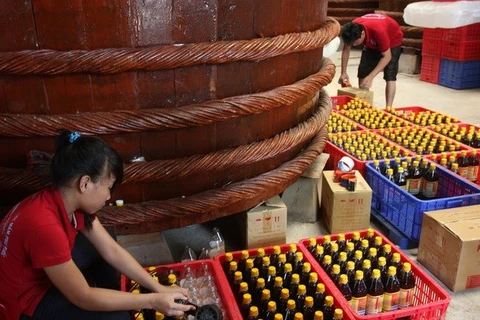
Phu Quoc fish sauce making becomes national intangible cultural heritage ảnh 1Phu Quoc fish sauce uses anchovy with high protein level as a key ingredient (Photo: VNA)

Hanoi (VNA) - The Ministry of Culture, Sports and Tourism recognised the making of fish sauce on Phu Quoc island city in the Mekong Delta province of Kien Giang as a national intangible cultural heritage in late May, creating a driving force for local residents to maintain and uphold the essence of the traditional craft.

Chairwoman of the Phu Quoc Fish Sauce Association Ho Kim Lien said Phu Quoc’s waters are home to a variety of seaweed and plankton that are major feed sources for anchovies - a key ingredient in its fish sauce.

The craft has existed in Phu Quoc for over 200 years ago. Local residents catch fresh anchovies and salt them before fermenting them in giant wooden barrels.

Fermenting them in wooden barrels is a feature of the traditional craft. The older the barrel is, the more durable it becomes and the better the quality of the fish sauce is.

The barrel has a wide mouth and is made from 55 planks of equal size: 2.2 metres long, 20cm wide, and 6cm thick. The diameter of the barrel mouth is about 3.2 metres and that of the bottom is some 2.6 metres. It is also strapped with green rattan.

Lien said the fish sauce is produced based on traditional methods, with the recipe being three parts anchovy and one salt, and the fermentation period lasts from 10 to 15 months. From the first to final layers, the fish sauce is divided into different types based on their protein levels. The final product has an amber colour and a slight aroma.

With support from the French Embassy in Hanoi in 1998, the Ministry of Fisheries along with Kien Giang province prepared an application for geographical indication. On June 1, 2001, Phu Quoc fish sauce was the first product in Vietnam to secure such status.

In July 2013, the EU granted the “Phu Quoc” origin certificate to the Vietnamese fish sauce.

A month later, the Ministry of Industry and Trade handed over the certificate to representatives of the Phu Quoc island district People’s Committee and the Phu Quoc Fish Sauce Association and it has now become an attractive local tourism product.

Phu Quoc city is now home to around 100 fish sauce makers, mostly in Duong Dong and An Thoi wards. Between now and 2025, it will strive to produce 12 million litres of fish sauce each year on average.

According to Lien, a major difficulty for the industry is that some consumers cannot identify genuine Phu Quoc traditional fish sauce, leading to unstable prices. There is currently no planning for a Phu Quoc fish sauce craft village, so it has not yet become a tourist destination.

The Phu Quoc Fish Sauce Association, founded in October 2000 and with 53 members, will pay attention to developing fish sauce quality to continue promoting its trademark, she said.

The craft is also expected to seek UNESCO world intangible cultural heritage status, contributing to improving its brand value and promoting the image of Phu Quoc island city./.

VNA

See more

A performance staged at the closing ceremony of the Hanoi International Martial Arts Festival 2026 on August 9. (Photo: VNA)

Hanoi Martial Arts Festival 2026 closes, spreading Thang Long spirit

Held under the theme “Thang Long Spirit – Quintessence of Vietnamese Martial Arts,” the festival took place at the Thang Long Imperial Citadel from August 7-9. It was part of Hanoi's efforts to implement Politburo Resolution No. 80-NQ/TW on the development of Vietnamese culture.

The poster of "Glorious Ashes" movie.

Vietnamese cinema returns to Berlin summer film programme

The screening attracted considerable interest from film enthusiasts and the Vietnamese community in the German capital. It marked the fourth time Vietnamese films have been featured in the programme, following "The House of No Man" by Tran Thanh, "Glorious Ashes" by Bui Thac Chuyen, and "My Best Friend's Wedding" by Nguyen Quang Dung and Diep The Vinh in previous years.

Xuan Son comes on in the second half and contributes to Vietnam’s second goal, with his shot forcing a Cambodian defender into an own goal to put Vietnam 2-1 ahead (Photo: VNA)

Vietnam's 22-match unbeaten run draws praise from RoK media

Under the tournament format, the semifinals and final will be played over two legs. Vietnam will travel to Malaysia for the first leg on August 16 before hosting the second leg on August 19. Should Vietnam overcome Malaysia, they will meet the winner of the other semifinal between Thailand and Singapore in the final.

A performance at the Vietnam–Korea Festival 2026 in Da Nang city (Photo: VNA)

Vietnam–Korea Festival 2026 kicks off in Da Nang

Now in its fifth edition, the festival has cemented its place as Da Nang’s signature annual diplomatic event, spotlighting the distinct cultures of both nations, fostering friendship and driving cooperation with Korean localities and partners.

A performance at the opening ceremony of the 2026 Hanoi International Martial Arts Festival on August 7 (Photo: VNA)

Hanoi opens international martial arts festival

The event attracts about 2,000 martial artists of 66 delegations, including seven international delegations from six countries, namely Indonesia, Russia, France, Germany, Switzerland and Morocco.

The statue of Vietnam's King Ly Thai To ( (974 - 1028) in Bonghwa county (Photo: VNA)

RoK to develop K-Vietnam Valley project linked to Ly Dynasty heritage

With the designation in place, Bonghwa will carry out eight specialised projects worth a combined 347.6 billion KRW (245.1 million USD) from 2026 to 2030 – among them the K-Vietnam Valley itself, tourism development around Changpyeong Reservoir, rental smart farms, and a Baekdudaegan healing ‘pet village.’

The organising committee presents awards to outstanding martial artists at the festival. (Photo: VNA)

9th Int’l Festival of Vietnamese Traditional Martial Arts wraps up

The ninth International Festival of Vietnamese Traditional Martial Arts has fostered the martial spirit, strengthened national pride, promoted cultural exchanges and reinforced the aspiration to bring Vietnamese traditional martial arts to a wider international audience.

An appetising bowl of My Quang features a rich combination of ingredients. (Photo: VNA)

Da Nang to host festival honouring Quang Nam-style noodle soup

My Quang is not only a signature dish of the Quang region but also reflects the history, culture and daily life of communities in central Vietnam. With its diverse ingredients, preparation methods and distinctive flavours, the noodle soup has become one of Vietnam's best-known culinary specialities, helping strengthen Da Nang's position on the culinary tourism map.