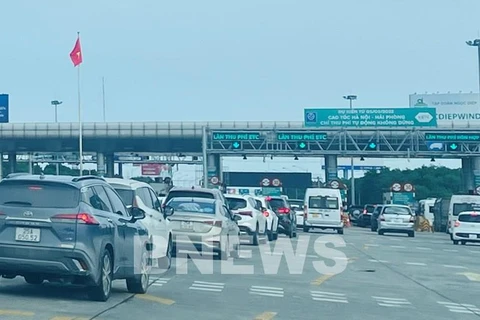
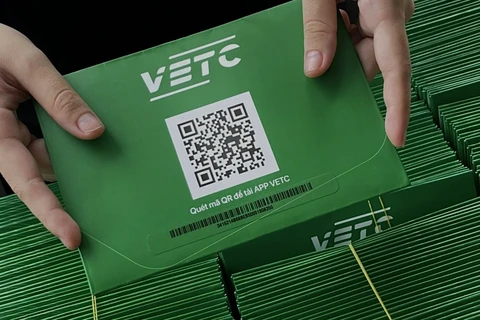
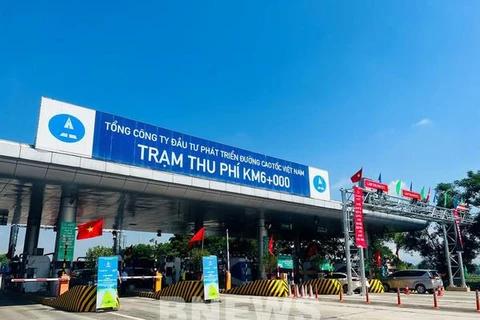
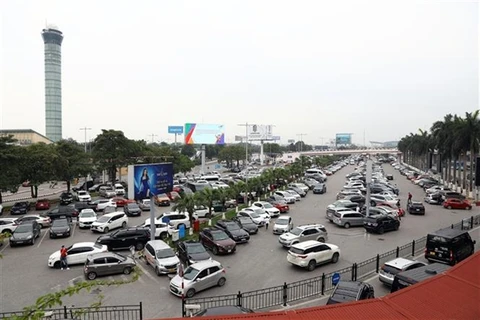
Illustrative image (Photo: VNA)
 The plan was revealed at the project “Collecting toll for cars entering Hanoi’s inner areas to reduce traffic congestion and pollution”, which recently has been supplemented by the Hanoi University of Transport and reported to the municipal Transport Department.
A representative of the project’s consulting group told Tien Phong (Vanguard) online newspaper that currently, Hanoi has many more routes connecting to the inner areas than it did two years ago.
Therefore, the number of toll stations also needs to increase, he said.
Under the project, by 2025, the areas determined to set up the toll stations are within the Ring Road No 3.
All cars moving from outside the Ring Road 3 into the city’s inner areas have to pay tolls.
Some vehicles will be exempted from paying the tolls, including priority vehicles, police cars, military vehicles, ambulances, fire trucks; official vehicles; and buses.
The group of vehicles eligible for fee reduction includes cars of public utility companies; vehicles engaged in passenger transport; vehicles transporting goods; cars less than nine seats of households living in toll-collection areas, and cars belonging to offices located within toll-collection areas.
The tolls are determined at 50,000-100,000 VND (2-4 USD) per vehicle. The time to collect the tolls is between 5am and 9pm.
The total investment for the establishment of a toll station system is estimated at 2.6 trillion VND (106 million USD).
The project will apply non-stop toll collection technology. This form of toll collection is a combination of Radio Frequency Identification (RFID) and Automatic Number Plate Recognition (ANPR) through an automatic surveillance camera system to detect non-paying vehicles, serve toll collection and handle non-payment of tolls.
The project’s consulting group said when applying to collect the tolls, it is expected to reduce 20% of traffic flow going into the inner areas, thereby reducing traffic congestion.
The consulting group said that if collecting a toll of 50,000 VND (2 USD) per car, costs of investment, management and operation will be covered.
With a fee of 100,000 VND (4 USD) per a car, there will be an annual budget revenue of about 300 billion VND (12.2 million USD) per year.
Data from the transport department shows that Hanoi currently has around 6.4 million vehicles, 5.6 million of which are motorbikes. There are around 600,000 cars, plus another two million other vehicles, from outside the capital.
Chairman of the Vietnam Transport Association (VATA) Nguyen Van Quyen said that collecting tolls to reduce traffic congestion is a must.
However, it is not simple to deploy the project. Public transport is required to meet the travelling demand of the people, he said.
For example, the metro and bus systems in the city must meet 50-60% of people's travel demand to encourage them to switch from private cars to public vehicles.
But the current capacity of public transport in Hanoi now fails to do that, he said.
Khuong Kim Tao, former deputy chief of the National Committee for Traffic Safety’s Office said it is a right policy, but it must be calculated and the difficulties that may occur when implementing the project must be thoroughly acknowledged.
“First of all, we should have a pilot survey and then have an assessment before expanding,” he said.
For example, the city now has two roads of Le Van Luong and Nguyen Trai, which are heavily congested each day. It should pilot collecting fees at these two roads and then evaluate the effectiveness before applying the project.
When public transportation is not convenient, people will still have to use private cars, he said.
But not everyone is willing or able to pay tolls. At that time, people will avoid traveling on big roads with toll stations, they will travel on small roads, increasing traffic congestion on them, he added.
People will have a tendency to buy houses or apartments inside the Ring Road No 3 to avoid having to pay regular and long-term tolls, he added.
And with more people living inside the Ring Road No 3, traffic congestion in the city’s inner areas will increase.
Phan Le Binh, a traffic expert told Tuoi tre (Youth) online newspaper that currently, most of cars in Vietnam have been equipped with automatic toll payment tags (e-tag), making them eligible to use the electronic toll collection (ETC) system.
So, if the project is implemented, it should be integrated into the ETC card, he said, adding that using another card will be inconvenient and cause more troubles for people and businesses./.