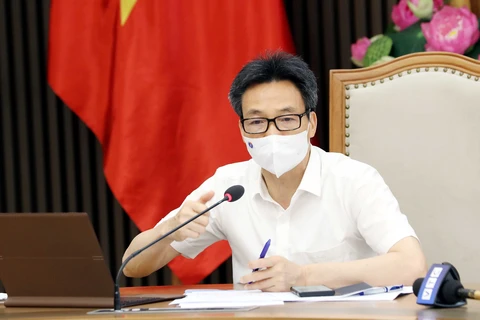
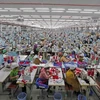
Hanoi authorities have exerted best efforts to help enterprises in COVID-19-free zones, or ‘green zones’, maintain operations (Illustrative photo: VNA)
 Hanoi (VNA) – Hanoi authorities have exerted the best efforts to help enterprises in COVID-19-free zones, or ‘green zones’, maintain operations.
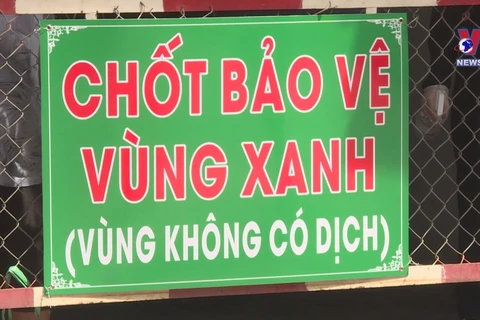
The capital city has named three zones in accordance with COVID-19 situations as well as its geographical, residential and production traits.
Efforts are being made to firmly maintain ‘green zones’ and gradually turn ‘red zones’ into ‘orange’ and then ‘yellow’ zones and return to the ‘safe’ status.
Nguyen Van Thuoc, director of a textile accessories firm with 140 workers at the Thach That-Quoc Oai industrial park, said that the company has received approval to have 70 percent of its workforce returned to work.
To date, over 90 percent of employees has received COVID-19 jabs, he added.
Head of another textile company in Son Tay township on the outskirts of Hanoi said that since late August, local authorities have allowed 500 workers to return to work.
The firm devised plan to have half of its total workers, or 1,000, to be at work, which has been submitted to the Son Tay steering board for COVID-19 prevention and control for consideration.
Many localities in Hanoi have strived to create favourable conditions for firms to maintain operations while complying with COVID-19 prevention and control measures even before they are classified as the ‘green zones’.
Hoai Duc district are home to 3,575 firms and production facilities, including 313 firms at 10 industrial clusters, with a total 7,288 workers.
Vice Chairman of the People’s Committee of the district Nguyen Trung Thuan said that during social distancing, firms at the industrial cluster wishing to maintain operation need to build plans for the 'three on the spot' and 'one route, two destinations' models and submit them to the People’s Committee for approval.
Some 825 businesses in the district received permission to resume production in August and September.
Similarly, Quoc Oai district is determined to protect its ‘green-zone’ status and promptly designs production plans in tandem with COVID-19 prevention and control efforts.
It is home to the Thach That-Quoc Oai industrial parks and the two clusters of Ngoc Liep and Yen Son, with 92 firms in total. The district has allowed 58 firms with 1,320 workers to resume operation.
Hanoi has so far had more than 600 ‘green-zones’ for businesses, which receive approval from local authorities. The firms are sparing no efforts to realise the twin targets of curbing the spread of COVID-19 and maintaining operation.
The municipal People’s Committee has permitted 19 district-level localities to resume certain services starting 12:00 noon on September 16, given the progress in the COVID-19 fight.
The Hanoi Department of Health said there are 19 district-level localities free of community infection cases between 6am on September 6, when the capital started applying Directive No. 20/CT-UBND of the municipal People’s Committee, and 6pm on September 15.
These localities are allowed to reopen some business and service establishments, starting 12:00 noon on September 16, including book and stationery stores; vehicle, electronics, refrigeration, and household appliance repair services; and takeaway food and drink services.
These establishments must be closed before 9pm every day.
The Hanoi administration requested the establishments to operate under local authorities’ monitoring and examination and carry out all regulated anti-pandemic measures, including ordering their staff to make health declaration and comply with the 5K principle, asking customers to scan QR codes, frequently disinfecting their establishments, and minimising direct contact.
The municipal Health Department also told the district-level People’s Committees to align anti-COVID-19 measures with the situation in their localities.
It noted that Hanoi has basically put the outbreak under control as the number of community infections has declined over the last three weeks. It has basically completed mass testing citywide and administered the first shot of COVID-19 vaccine to almost all people in the targeted group.
The hashtag ‘green zone’, or ‘safe zone’, has increased in popularity over recent days and reflects the determination of many localities to control the ongoing fourth wave of COVID-19 around Vietnam. Setting up more such “green zones” to fight the pandemic is an effective measure to prevent the virus from spreading./.